[STUDY GUIDE] • HIGH-YIELD PRACTICE & REVIEW EDITION
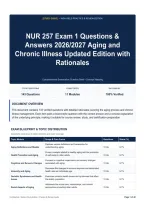
NUR 257 Exam 1 Questions &
Answers 2026/2027 Aging and
Chronic Illness Updated Edition with
Rationales
Comprehensive Examination Question Bank • Concept Mapping
TOTAL QUESTIONS EXAM TOPICS RATIONALES
143 Questions 11 Modules 100% Verified
DOCUMENT OVERVIEW
This document contains 143 verified questions with detailed rationales covering the aging process and chronic
illness management. Each item pairs a board-style question with the correct answer and a concise explanation
of the underlying principle, making it suitable for course review, study, and certification preparation.
EXAM BLUEPRINT & TOPIC DISTRIBUTION
Systematic breakdown of subject domains and exam coverage.
Topic Module Scope & Core Focus Questions Share (%)
Explores various definitions and frameworks for
Aging Definitions and Models understanding aging. 13 Qs 9.1%
Covers concepts related to healthy aging and the promotion
Health Promotion and Aging of well-being in older adults. 13 Qs 9.1%
Focuses on cognitive impairments and sensory changes
Cognitive and Sensory Changes associated with aging. 13 Qs 9.1%
Discusses the changes in immune response and associated
Immunity and Aging health risks as individuals age. 13 Qs 9.1%
Geriatric Syndromes and Health Examines common health issues and syndromes that affect
Issues the elderly population. 13 Qs 9.1%
Addresses the social roles, relationships, and cultural
Social Aspects of Aging perspectives impacting older adults. 13 Qs 9.1%
Confidential • Student Study Edition • Practice & Review Guide Page 1 of 40
,STUDENT STUDY & MASTERY EDITION PRACTICE & REVIEW GUIDE
Mental Health and Emotional Focuses on emotional responses, grief, and mental health
Well-Being challenges faced by older adults. 13 Qs 9.1%
Covers the understanding and management of chronic
Chronic Illness Management illnesses in older adults. 13 Qs 9.1%
Discusses healthcare legislation and policies affecting older
Healthcare Access and Policy adults. 13 Qs 9.1%
Explores issues related to elder mistreatment and the types of
Elder Abuse and Mistreatment abuse faced by older adults. 13 Qs 9.1%
Communication and Support in Examines effective communication strategies and support
Care mechanisms for older adults. 13 Qs 9.1%
Total Exam Coverage 11 Integrated Topic Modules 143 Qs 100.0%
Confidential • Student Study Edition • Practice & Review Guide Page 2 of 40
,STUDENT STUDY & MASTERY EDITION PRACTICE & REVIEW GUIDE
TOPIC 1: AGING DEFINITIONS AND MODELS
13 Questions • 9.1% of Exam • Explores various definitions and frameworks for understanding aging.
QUESTION 1
Functional Aging
Answer: Aging defined by physical abilities and performance.
Rationale: Functional aging focuses on how an individual's physical capabilities and performance decline, distinguishing it
from chronological or biological aging. This concept emphasizes the observable and measurable aspects of the aging
process related to daily functioning.
QUESTION 2
Social Aging
Answer: Aging based on role changes in society.
Rationale: Social aging describes the process of individuals adapting to changing societal roles and expectations
throughout their lifespan, such as becoming a parent or retiring. This concept emphasizes the dynamic interplay between
personal development and the social structures within which aging occurs.
QUESTION 3
Chronological Aging
Answer: Aging measured by the passage of time.
Rationale: Chronological aging directly refers to the number of years a person has lived, making it a measure solely based
on the passage of time. This contrasts with biological aging, which reflects physiological changes and functional decline
over time.
QUESTION 4
Centenarians
Answer: Individuals aged 100 to 109 years.
Rationale: A centenarian is defined as a person who has reached the age of 100 years and continues to live into their 100s.
This age bracket specifically encompasses individuals from 100 up to, but not including, 110 years old.
Confidential • Student Study Edition • Practice & Review Guide Page 3 of 40
, STUDENT STUDY & MASTERY EDITION PRACTICE & REVIEW GUIDE
QUESTION 5
Healthy Aging
Answer: Focus on functional ability, not just disease absence.
Rationale: Healthy aging emphasizes maintaining independence and quality of life through maximizing an individual's
capabilities, rather than solely defining health by the lack of diagnosed pathology. The key concept tested is the shift from a
biomedical model to a biopsychosocial approach in defining positive aging.
QUESTION 6
Geriatric Syndromes
Answer: Common health issues in older adults, like falls.
Rationale: Geriatric syndromes are multifactorial health conditions common in older adults, characterized by a constellation
of symptoms rather than a single disease, such as falls, delirium, and urinary
incontinence. These syndromes reflect the cumulative impact of age-related changes and chronic conditions, leading to
functional decline and increased morbidity.
QUESTION 7
Shifting Perspectives Model
Answer: Focuses on emotional and social aspects of chronic illness.
Rationale: The Shifting Perspectives Model posits that individuals with chronic illness navigate a continuous process of
adapting their self-perception, emphasizing the lived experience and the dynamic interplay between personal and social
realities. This framework highlights how patients reconstruct their understanding of self and illness over time, integrating
emotional and social dimensions.
QUESTION 8
Nail Changes
Answer: Thickening nails increase risk of fungal infections.
Rationale: Thickened nails impede adequate hygiene and ventilation, creating a moist environment conducive to fungal
proliferation and subsequent infection. This principle highlights the relationship between structural nail changes and
susceptibility to dermatophyte invasion.
Confidential • Student Study Edition • Practice & Review Guide Page 4 of 40
NUR 257 Exam 1 Questions &
Answers 2026/2027 Aging and
Chronic Illness Updated Edition with
Rationales
Comprehensive Examination Question Bank • Concept Mapping
TOTAL QUESTIONS EXAM TOPICS RATIONALES
143 Questions 11 Modules 100% Verified
DOCUMENT OVERVIEW
This document contains 143 verified questions with detailed rationales covering the aging process and chronic
illness management. Each item pairs a board-style question with the correct answer and a concise explanation
of the underlying principle, making it suitable for course review, study, and certification preparation.
EXAM BLUEPRINT & TOPIC DISTRIBUTION
Systematic breakdown of subject domains and exam coverage.
Topic Module Scope & Core Focus Questions Share (%)
Explores various definitions and frameworks for
Aging Definitions and Models understanding aging. 13 Qs 9.1%
Covers concepts related to healthy aging and the promotion
Health Promotion and Aging of well-being in older adults. 13 Qs 9.1%
Focuses on cognitive impairments and sensory changes
Cognitive and Sensory Changes associated with aging. 13 Qs 9.1%
Discusses the changes in immune response and associated
Immunity and Aging health risks as individuals age. 13 Qs 9.1%
Geriatric Syndromes and Health Examines common health issues and syndromes that affect
Issues the elderly population. 13 Qs 9.1%
Addresses the social roles, relationships, and cultural
Social Aspects of Aging perspectives impacting older adults. 13 Qs 9.1%
Confidential • Student Study Edition • Practice & Review Guide Page 1 of 40
,STUDENT STUDY & MASTERY EDITION PRACTICE & REVIEW GUIDE
Mental Health and Emotional Focuses on emotional responses, grief, and mental health
Well-Being challenges faced by older adults. 13 Qs 9.1%
Covers the understanding and management of chronic
Chronic Illness Management illnesses in older adults. 13 Qs 9.1%
Discusses healthcare legislation and policies affecting older
Healthcare Access and Policy adults. 13 Qs 9.1%
Explores issues related to elder mistreatment and the types of
Elder Abuse and Mistreatment abuse faced by older adults. 13 Qs 9.1%
Communication and Support in Examines effective communication strategies and support
Care mechanisms for older adults. 13 Qs 9.1%
Total Exam Coverage 11 Integrated Topic Modules 143 Qs 100.0%
Confidential • Student Study Edition • Practice & Review Guide Page 2 of 40
,STUDENT STUDY & MASTERY EDITION PRACTICE & REVIEW GUIDE
TOPIC 1: AGING DEFINITIONS AND MODELS
13 Questions • 9.1% of Exam • Explores various definitions and frameworks for understanding aging.
QUESTION 1
Functional Aging
Answer: Aging defined by physical abilities and performance.
Rationale: Functional aging focuses on how an individual's physical capabilities and performance decline, distinguishing it
from chronological or biological aging. This concept emphasizes the observable and measurable aspects of the aging
process related to daily functioning.
QUESTION 2
Social Aging
Answer: Aging based on role changes in society.
Rationale: Social aging describes the process of individuals adapting to changing societal roles and expectations
throughout their lifespan, such as becoming a parent or retiring. This concept emphasizes the dynamic interplay between
personal development and the social structures within which aging occurs.
QUESTION 3
Chronological Aging
Answer: Aging measured by the passage of time.
Rationale: Chronological aging directly refers to the number of years a person has lived, making it a measure solely based
on the passage of time. This contrasts with biological aging, which reflects physiological changes and functional decline
over time.
QUESTION 4
Centenarians
Answer: Individuals aged 100 to 109 years.
Rationale: A centenarian is defined as a person who has reached the age of 100 years and continues to live into their 100s.
This age bracket specifically encompasses individuals from 100 up to, but not including, 110 years old.
Confidential • Student Study Edition • Practice & Review Guide Page 3 of 40
, STUDENT STUDY & MASTERY EDITION PRACTICE & REVIEW GUIDE
QUESTION 5
Healthy Aging
Answer: Focus on functional ability, not just disease absence.
Rationale: Healthy aging emphasizes maintaining independence and quality of life through maximizing an individual's
capabilities, rather than solely defining health by the lack of diagnosed pathology. The key concept tested is the shift from a
biomedical model to a biopsychosocial approach in defining positive aging.
QUESTION 6
Geriatric Syndromes
Answer: Common health issues in older adults, like falls.
Rationale: Geriatric syndromes are multifactorial health conditions common in older adults, characterized by a constellation
of symptoms rather than a single disease, such as falls, delirium, and urinary
incontinence. These syndromes reflect the cumulative impact of age-related changes and chronic conditions, leading to
functional decline and increased morbidity.
QUESTION 7
Shifting Perspectives Model
Answer: Focuses on emotional and social aspects of chronic illness.
Rationale: The Shifting Perspectives Model posits that individuals with chronic illness navigate a continuous process of
adapting their self-perception, emphasizing the lived experience and the dynamic interplay between personal and social
realities. This framework highlights how patients reconstruct their understanding of self and illness over time, integrating
emotional and social dimensions.
QUESTION 8
Nail Changes
Answer: Thickening nails increase risk of fungal infections.
Rationale: Thickened nails impede adequate hygiene and ventilation, creating a moist environment conducive to fungal
proliferation and subsequent infection. This principle highlights the relationship between structural nail changes and
susceptibility to dermatophyte invasion.
Confidential • Student Study Edition • Practice & Review Guide Page 4 of 40