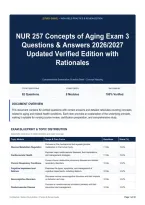
[STUDY GUIDE] • HIGH-YIELD PRACTICE & REVIEW EDITION
NUR 257 Concepts of Aging Exam 3
Questions & Answers 2026/2027
Updated Verified Edition with
Rationales
Comprehensive Examination Question Bank • Concept Mapping
TOTAL QUESTIONS EXAM TOPICS RATIONALES
82 Questions 8 Modules 100% Verified
DOCUMENT OVERVIEW
This document contains 82 verified questions with correct answers and detailed rationales covering concepts
related to aging and related health conditions. Each item provides an explanation of the underlying principle,
making it suitable for nursing course review, certification preparation, and comprehensive study.
EXAM BLUEPRINT & TOPIC DISTRIBUTION
Systematic breakdown of subject domains and exam coverage.
Topic Module Scope & Core Focus Questions Share (%)
Focuses on the mechanisms that regulate glucose
Glucose Metabolism Regulation metabolism in the human body. 11 Qs 13.4%
Explores major cardiovascular diseases, their implications,
Cardiovascular Health and management strategies. 11 Qs 13.4%
Covers chronic obstructive pulmonary diseases and related
Chronic Respiratory Conditions respiratory disorders. 10 Qs 12.2%
Cognitive Impairment and Examines the types, symptoms, and management of
Delirium cognitive impairments, including delirium. 10 Qs 12.2%
Discusses various neurocognitive disorders and their impacts
Neurocognitive Disorders on behavior and care. 10 Qs 12.2%
Focuses on cerebrovascular accidents (strokes) and their
Cerebrovascular Disease prevention and management. 10 Qs 12.2%
Confidential • Student Study Edition • Practice & Review Guide Page 1 of 32
,STUDENT STUDY & MASTERY EDITION PRACTICE & REVIEW GUIDE
Analyzes the different types of strokes and their specific
Stroke Types and Effects neurological effects. 10 Qs 12.2%
Explores Parkinson's disease characteristics, symptoms, and
Parkinson Disease Management care strategies. 10 Qs 12.2%
Total Exam Coverage 8 Integrated Topic Modules 82 Qs 100.0%
Confidential • Student Study Edition • Practice & Review Guide Page 2 of 32
,STUDENT STUDY & MASTERY EDITION PRACTICE & REVIEW GUIDE
TOPIC 1: GLUCOSE METABOLISM REGULATION
11 Questions • 13.4% of Exam • Focuses on the mechanisms that regulate glucose metabolism in the human body.
QUESTION 1
Four key considerations to the regulation of glucose metabolism:
Answer: Hormonal regulation, neural regulation, exercise, and stress.
Rationale: Glucose metabolism is primarily controlled by the interplay of hormonal signals like insulin and glucagon, neural
input, and physiological states such as exercise and stress, which dynamically adjust substrate availability and utilization.
This multifaceted regulation ensures adequate energy supply to tissues while maintaining glycemic homeostasis.
QUESTION 2
Glucose is produced from
Answer: Endogenous glycogen stored in the muscles and liver.
Rationale: Glucose is primarily synthesized endogenously through glycogenolysis, the breakdown of stored glycogen in the
liver and muscles, to maintain blood glucose homeostasis. This process is critical for providing fuel to cells, particularly
during fasting periods.
QUESTION 3
Glycogenolysis is
Answer: The process by which glycogen is broken down into glucose to be used by the body to maintain
blood glucose levels.
Rationale: Glycogenolysis catabolizes stored glycogen into glucose-6-phosphate, which can then be dephosphorylated to
free glucose for release into the bloodstream, thereby regulating glycemia.
This process is critical for maintaining energy homeostasis, particularly during fasting states.
Confidential • Student Study Edition • Practice & Review Guide Page 3 of 32
, STUDENT STUDY & MASTERY EDITION PRACTICE & REVIEW GUIDE
QUESTION 4
Adults at least age 40 should be screened how often for hypertension?
Answer: Yearly.
Rationale: Regular blood pressure screening is recommended annually for adults aged 40 and older to detect and manage
hypertension early, a key modifiable risk factor for cardiovascular disease. This aligns with guidelines emphasizing
consistent monitoring for this demographic due to increased prevalence and risk.
QUESTION 5
Management OF HYPERTENTION (8)
Answer: •Take medication as prescribed
•Monitor BP regularly
•Stop smoking
•Reduce alcohol intake
•Dietary changes: Low sodium, low fat & cholesterol, read labels to find sodium, fat, cholesterol, sugar and
calories
•Reduce weight, if overweight or obese
•Increase exercise, 3-4 times per week
•Manage stress: exercise (walking, bicycling, swimming), meditation, yoga.
Rationale: Effective hypertension management requires a multi-faceted approach combining pharmacotherapy and lifestyle
modifications. Adherence to prescribed medications, regular blood pressure monitoring, and significant changes in diet,
exercise, weight, substance use, and stress reduction are all critical components for achieving and maintaining
normotension.
QUESTION 6
Signs of potential exacerbation of illness in an older adult with coronary heart disease?
(10)
Answer: Lightheadedness or dizziness disturbances in gait and balance loss of appetite or unexplained
weight loss inability to concentrate. changes in personality or mood changes in grooming mood unusual
patterns in voiding vague discomfort or frequent doubts of anxiety excessive fatigue, vague pain withdraw
from usual pleasures.
Rationale: These symptoms reflect decreased cerebral perfusion and cardiac output, leading to cognitive and functional
impairments, as well as non-specific signs of physiological distress common in older adults with compromised
cardiovascular function. The key underlying concept is the multifaceted impact of reduced cardiac efficiency on systemic
and neurological function in the elderly.
Confidential • Student Study Edition • Practice & Review Guide Page 4 of 32
NUR 257 Concepts of Aging Exam 3
Questions & Answers 2026/2027
Updated Verified Edition with
Rationales
Comprehensive Examination Question Bank • Concept Mapping
TOTAL QUESTIONS EXAM TOPICS RATIONALES
82 Questions 8 Modules 100% Verified
DOCUMENT OVERVIEW
This document contains 82 verified questions with correct answers and detailed rationales covering concepts
related to aging and related health conditions. Each item provides an explanation of the underlying principle,
making it suitable for nursing course review, certification preparation, and comprehensive study.
EXAM BLUEPRINT & TOPIC DISTRIBUTION
Systematic breakdown of subject domains and exam coverage.
Topic Module Scope & Core Focus Questions Share (%)
Focuses on the mechanisms that regulate glucose
Glucose Metabolism Regulation metabolism in the human body. 11 Qs 13.4%
Explores major cardiovascular diseases, their implications,
Cardiovascular Health and management strategies. 11 Qs 13.4%
Covers chronic obstructive pulmonary diseases and related
Chronic Respiratory Conditions respiratory disorders. 10 Qs 12.2%
Cognitive Impairment and Examines the types, symptoms, and management of
Delirium cognitive impairments, including delirium. 10 Qs 12.2%
Discusses various neurocognitive disorders and their impacts
Neurocognitive Disorders on behavior and care. 10 Qs 12.2%
Focuses on cerebrovascular accidents (strokes) and their
Cerebrovascular Disease prevention and management. 10 Qs 12.2%
Confidential • Student Study Edition • Practice & Review Guide Page 1 of 32
,STUDENT STUDY & MASTERY EDITION PRACTICE & REVIEW GUIDE
Analyzes the different types of strokes and their specific
Stroke Types and Effects neurological effects. 10 Qs 12.2%
Explores Parkinson's disease characteristics, symptoms, and
Parkinson Disease Management care strategies. 10 Qs 12.2%
Total Exam Coverage 8 Integrated Topic Modules 82 Qs 100.0%
Confidential • Student Study Edition • Practice & Review Guide Page 2 of 32
,STUDENT STUDY & MASTERY EDITION PRACTICE & REVIEW GUIDE
TOPIC 1: GLUCOSE METABOLISM REGULATION
11 Questions • 13.4% of Exam • Focuses on the mechanisms that regulate glucose metabolism in the human body.
QUESTION 1
Four key considerations to the regulation of glucose metabolism:
Answer: Hormonal regulation, neural regulation, exercise, and stress.
Rationale: Glucose metabolism is primarily controlled by the interplay of hormonal signals like insulin and glucagon, neural
input, and physiological states such as exercise and stress, which dynamically adjust substrate availability and utilization.
This multifaceted regulation ensures adequate energy supply to tissues while maintaining glycemic homeostasis.
QUESTION 2
Glucose is produced from
Answer: Endogenous glycogen stored in the muscles and liver.
Rationale: Glucose is primarily synthesized endogenously through glycogenolysis, the breakdown of stored glycogen in the
liver and muscles, to maintain blood glucose homeostasis. This process is critical for providing fuel to cells, particularly
during fasting periods.
QUESTION 3
Glycogenolysis is
Answer: The process by which glycogen is broken down into glucose to be used by the body to maintain
blood glucose levels.
Rationale: Glycogenolysis catabolizes stored glycogen into glucose-6-phosphate, which can then be dephosphorylated to
free glucose for release into the bloodstream, thereby regulating glycemia.
This process is critical for maintaining energy homeostasis, particularly during fasting states.
Confidential • Student Study Edition • Practice & Review Guide Page 3 of 32
, STUDENT STUDY & MASTERY EDITION PRACTICE & REVIEW GUIDE
QUESTION 4
Adults at least age 40 should be screened how often for hypertension?
Answer: Yearly.
Rationale: Regular blood pressure screening is recommended annually for adults aged 40 and older to detect and manage
hypertension early, a key modifiable risk factor for cardiovascular disease. This aligns with guidelines emphasizing
consistent monitoring for this demographic due to increased prevalence and risk.
QUESTION 5
Management OF HYPERTENTION (8)
Answer: •Take medication as prescribed
•Monitor BP regularly
•Stop smoking
•Reduce alcohol intake
•Dietary changes: Low sodium, low fat & cholesterol, read labels to find sodium, fat, cholesterol, sugar and
calories
•Reduce weight, if overweight or obese
•Increase exercise, 3-4 times per week
•Manage stress: exercise (walking, bicycling, swimming), meditation, yoga.
Rationale: Effective hypertension management requires a multi-faceted approach combining pharmacotherapy and lifestyle
modifications. Adherence to prescribed medications, regular blood pressure monitoring, and significant changes in diet,
exercise, weight, substance use, and stress reduction are all critical components for achieving and maintaining
normotension.
QUESTION 6
Signs of potential exacerbation of illness in an older adult with coronary heart disease?
(10)
Answer: Lightheadedness or dizziness disturbances in gait and balance loss of appetite or unexplained
weight loss inability to concentrate. changes in personality or mood changes in grooming mood unusual
patterns in voiding vague discomfort or frequent doubts of anxiety excessive fatigue, vague pain withdraw
from usual pleasures.
Rationale: These symptoms reflect decreased cerebral perfusion and cardiac output, leading to cognitive and functional
impairments, as well as non-specific signs of physiological distress common in older adults with compromised
cardiovascular function. The key underlying concept is the multifaceted impact of reduced cardiac efficiency on systemic
and neurological function in the elderly.
Confidential • Student Study Edition • Practice & Review Guide Page 4 of 32