Pharmacology Exam 2 Frequently Tested Actual Questions and
Answers
Question 1.
MS (multiple sclerosis)
Correct Answer: -presence of focal demyelinated plaques within the CNS,
accompanied by variable degrees of inflammation and gliosis, with partial
preservation of axons -inflammatory immune-mediated disorder -activated T
cells cross BBB and attack myelin -exposed axons become damaged or
destroyed -unilateral optic neuritis, transverse myelitis, cerebellar ataxia,
brainstem strokes
Question 2.
CIS (clinically isolated syndrome)
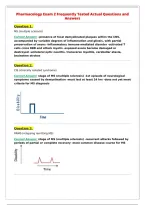
Correct Answer: stage of MS (multiple sclerosis) -1st episode of neurological
symptoms caused by demyelination -must last at least 24 hrs -does not yet meet
criteria for MS diagnosis
Question 3.
RRMS (relapsing remitting MS)
Correct Answer: stage of MS (multiple sclerosis) -recurrent attacks followed by
periods of partial or complete recovery -most common disease course for MS
,Question 4.
SPMS (secondary progressive MS)
Correct Answer: stage of MS (multiple sclerosis) -initial relapsing-remitting
pattern followed by gradual worsening consisting of gradual accumulation of
permanent neuro deficits despite tx -no longer signs of remission
Question 5.
PPMS (primary progressive MS)
Correct Answer: stage of MS (multiple sclerosis) -gradual functional decline from
the start of the illness without relapses -disability accumulates slowly over
years -chronic progressive disease
Question 6.
alemtuzumab
Correct Answer: MS drug -RRMS, SPMS MOA:
-binds to CD52, non-modulating antigen on B and T cell lymphocyte surfaces
Question 7.
alemtuzumab
Correct Answer: MS drug -RRMS, SPMS BW:
-immune thrombocytopenia -anti-glomerular basement membrane disease
-infusion reactions -malignancy-thyroid, melanoma, lymphoproliferative
disorders -stroke -only available through REMS ADE:
-immune glomerulonephritis -lymphocytopenia -skin rash
,Question 8.
natalizumab
Correct Answer: MS drug -CIS, RRMS, SPMS MOA:
-prevents WBC adhesion by binding to the alpha-4 subunit integrins
Question 9.
natalizumab
Correct Answer: MS drug -CIS, RRMS, SPMS BW:
-PML (progressive multifocal leukoencephalopathy) -test for anti-JCV antibodies
at baseline and every 6 mos -use <2 years ADE:
-increased hepatic function tests
Question 10.
ocrelizumab
Correct Answer: MS drug -CIS, *PPMS*, RRMS, SPMS MOA:
-binds to CD20 on B cells CI:
-active HBV infection
Question 11.
ublituximab
Correct Answer: MS drug -CIS, RRMS, SPMS MOA:
-binds to CD20 on pre and mature B cells CI:
-active HBV infection
Question 12.
ofatumumab, rituximab
Correct Answer: MS drug (2) -CIS, RRMS, SPMS MOA:
-binds to CD20 on B cells CI:
-active HBV infection
Question 13.
interferon B
Correct Answer: MS drug -CIS, RRMS, SPMS MOA:
-modulates immune responsiveness -increases integrity of BBB ADE:
-drug induced lupus -flu-like symptoms -effect may be limited by use of
neutralizing Abs
, Question 14.
glatiramer acetate
Correct Answer: MS drug -CIS, RRMS, SPMS MOA:
-binds to MHC molecules and consequent competition with various myelin Ags
for their presentation to T cells -inducer of specific helper T cell suppressors
BW:
-anaphylaxis risk -injection site necrosis -SC daily dosing
Question 15.
mitoxantrone
Correct Answer: MS drug -RRMS, SPMS MOA:
-intercalates into DNA resulting in cross-links and strand breaks -binds to
nucleic acids and inhibits DNA/RNA synthesis BW:
-A LOT (bone marrow suppression, cardiotoxicity, etc) -do not prescribe unless
the benefits outweigh the risks
Question 16.
S1PR modulators (sphingosine-1 phosphate receptor modulators)
Correct Answer: MS drug -CIS, RRMS, active SPMS -end in -mod MOA:
-sphingosine analogue that modulates the S1PR -sequesters T cells in lymph
nodes
Question 17.
S1PR modulators (sphingosine-1 phosphate receptor modulators)
Correct Answer: MS drug -CIS, RRMS, active SPMS -end in -mod CI:
-cardiac issues -myocardial infarction, stroke, TIA -sick sinus syndrome -avoid in
pregnancy
Question 18.
teriflunomide
Correct Answer: MS drug -CIS, RRMS, SPMS MOA:
-inhibits pyrimidine biosynthesis -reduce the number of activated lymphocytes
in the CNS BW:
-hepatotoxicity -embryofetal toxicity -avoid in pregnancy
Answers
Question 1.
MS (multiple sclerosis)
Correct Answer: -presence of focal demyelinated plaques within the CNS,
accompanied by variable degrees of inflammation and gliosis, with partial
preservation of axons -inflammatory immune-mediated disorder -activated T
cells cross BBB and attack myelin -exposed axons become damaged or
destroyed -unilateral optic neuritis, transverse myelitis, cerebellar ataxia,
brainstem strokes
Question 2.
CIS (clinically isolated syndrome)
Correct Answer: stage of MS (multiple sclerosis) -1st episode of neurological
symptoms caused by demyelination -must last at least 24 hrs -does not yet meet
criteria for MS diagnosis
Question 3.
RRMS (relapsing remitting MS)
Correct Answer: stage of MS (multiple sclerosis) -recurrent attacks followed by
periods of partial or complete recovery -most common disease course for MS
,Question 4.
SPMS (secondary progressive MS)
Correct Answer: stage of MS (multiple sclerosis) -initial relapsing-remitting
pattern followed by gradual worsening consisting of gradual accumulation of
permanent neuro deficits despite tx -no longer signs of remission
Question 5.
PPMS (primary progressive MS)
Correct Answer: stage of MS (multiple sclerosis) -gradual functional decline from
the start of the illness without relapses -disability accumulates slowly over
years -chronic progressive disease
Question 6.
alemtuzumab
Correct Answer: MS drug -RRMS, SPMS MOA:
-binds to CD52, non-modulating antigen on B and T cell lymphocyte surfaces
Question 7.
alemtuzumab
Correct Answer: MS drug -RRMS, SPMS BW:
-immune thrombocytopenia -anti-glomerular basement membrane disease
-infusion reactions -malignancy-thyroid, melanoma, lymphoproliferative
disorders -stroke -only available through REMS ADE:
-immune glomerulonephritis -lymphocytopenia -skin rash
,Question 8.
natalizumab
Correct Answer: MS drug -CIS, RRMS, SPMS MOA:
-prevents WBC adhesion by binding to the alpha-4 subunit integrins
Question 9.
natalizumab
Correct Answer: MS drug -CIS, RRMS, SPMS BW:
-PML (progressive multifocal leukoencephalopathy) -test for anti-JCV antibodies
at baseline and every 6 mos -use <2 years ADE:
-increased hepatic function tests
Question 10.
ocrelizumab
Correct Answer: MS drug -CIS, *PPMS*, RRMS, SPMS MOA:
-binds to CD20 on B cells CI:
-active HBV infection
Question 11.
ublituximab
Correct Answer: MS drug -CIS, RRMS, SPMS MOA:
-binds to CD20 on pre and mature B cells CI:
-active HBV infection
Question 12.
ofatumumab, rituximab
Correct Answer: MS drug (2) -CIS, RRMS, SPMS MOA:
-binds to CD20 on B cells CI:
-active HBV infection
Question 13.
interferon B
Correct Answer: MS drug -CIS, RRMS, SPMS MOA:
-modulates immune responsiveness -increases integrity of BBB ADE:
-drug induced lupus -flu-like symptoms -effect may be limited by use of
neutralizing Abs
, Question 14.
glatiramer acetate
Correct Answer: MS drug -CIS, RRMS, SPMS MOA:
-binds to MHC molecules and consequent competition with various myelin Ags
for their presentation to T cells -inducer of specific helper T cell suppressors
BW:
-anaphylaxis risk -injection site necrosis -SC daily dosing
Question 15.
mitoxantrone
Correct Answer: MS drug -RRMS, SPMS MOA:
-intercalates into DNA resulting in cross-links and strand breaks -binds to
nucleic acids and inhibits DNA/RNA synthesis BW:
-A LOT (bone marrow suppression, cardiotoxicity, etc) -do not prescribe unless
the benefits outweigh the risks
Question 16.
S1PR modulators (sphingosine-1 phosphate receptor modulators)
Correct Answer: MS drug -CIS, RRMS, active SPMS -end in -mod MOA:
-sphingosine analogue that modulates the S1PR -sequesters T cells in lymph
nodes
Question 17.
S1PR modulators (sphingosine-1 phosphate receptor modulators)
Correct Answer: MS drug -CIS, RRMS, active SPMS -end in -mod CI:
-cardiac issues -myocardial infarction, stroke, TIA -sick sinus syndrome -avoid in
pregnancy
Question 18.
teriflunomide
Correct Answer: MS drug -CIS, RRMS, SPMS MOA:
-inhibits pyrimidine biosynthesis -reduce the number of activated lymphocytes
in the CNS BW:
-hepatotoxicity -embryofetal toxicity -avoid in pregnancy