Peds Final Exam Actual Questions with Detailed Answers
Question 1.
Diarrhea in young children
Correct Answer: A SYMPTOM Defined as sudden increase in frequency and
change in consistency of stools May be associated with Upper Respiratory or
urinary tract infections, antibiotics, or laxative use Usually self limited and
subsides without specific treatment
Question 2.
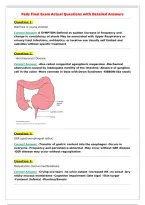
· Hirschsprung's Disease
Correct Answer: -Also called congenital aganglionic megacolon -Mechanical
obstruction caused by inadequate motility of the intestine -Absence of ganglion
cell in the colon -More common in boys with Down Syndrome -RIBBON-like stools
Question 3.
GER (gastroesophageal reflux)
Correct Answer: -Transfer of gastric content into the esophagus -Occurs in
everyone -Frequency and persistence abnormal -May occur without GER disease
-GER disease may occur without regurgitation
Question 4.
Dehydration clinical manifestations
Correct Answer: -Crying w/o tears -no urine output -increased HR -no sweat -Dry
sticky mucous membranes -Cognitive impairment (late sign) -Skin turgor
-Fontanel (Infants) -Diarrhea/Emesis
,Question 5.
Meckel Diverticulum (remnant of fetal omphalomesenteric duct)
Correct Answer: Ulceration, bleeding, intestinal obstruction (2-4% of population)
Treatment: surgical removal of diverticulum "Currant Jelly Stools"
Question 6.
Pyloric stenosis
Correct Answer: Constriction of the pyloric sphincter with obstruction of gastric
outlet Very Painful
Question 7.
intussusception
Correct Answer: -Telescoping of the intestines or invagination of one portion of
the intestines into another. -MOST COMMON CAUSE OF INTESTINAL
OBSTRUCTION IN CHILDREN 3 MONTHS TO 3 YEARS -Occasionally due to the
intestinal lesion (10%) -Spontaneously resolves (10%)
Question 8.
Crohn's disease
Correct Answer: -inflammatory bowel disease -Chronic inflammatory process
involving ANY part of the GI tract -Try to isolate cause and reduce flare ups
Question 9.
When caring for a child with probable appendicitis, the nurse should be alert to recognize
which sign or symptom as a manifestation of perforation?
Correct Answer: Sudden relief from pain
, Question 10.
An infant with short bowel syndrome is receiving total parenteral nutrition (TPN). The
practitioner has added continuous enteral feedings through a gastrostomy tube. The nurse
recognizes this as important for which reason?
Correct Answer: Stimulate adaptation of the small intestine
Question 11.
The nurse is caring for a neonate with a suspected tracheoesophageal fistula. What should
nursing care include?
Correct Answer: Elevating the head but giving nothing by mouth.
Question 12.
A 6-month-old infant with Hirschsprung dis- ease is scheduled for a temporary colostomy.
What should postoperative teaching to the parents include?
Correct Answer: Assessing bowel function
Question 13.
An infant had a gastrostomy tube placed for feedings after a Nissen fundoplication and
bolus feedings are initiated. Between feedings while the tube is clamped, the infant
becomes irritable, and there is evidence of cramping. What action should the nurse
implement?
Correct Answer: Vent the tube
Question 14.
post op cleft lip/palate
Question 15.
Consent
Question 16.
Contact isolation
Question 1.
Diarrhea in young children
Correct Answer: A SYMPTOM Defined as sudden increase in frequency and
change in consistency of stools May be associated with Upper Respiratory or
urinary tract infections, antibiotics, or laxative use Usually self limited and
subsides without specific treatment
Question 2.
· Hirschsprung's Disease
Correct Answer: -Also called congenital aganglionic megacolon -Mechanical
obstruction caused by inadequate motility of the intestine -Absence of ganglion
cell in the colon -More common in boys with Down Syndrome -RIBBON-like stools
Question 3.
GER (gastroesophageal reflux)
Correct Answer: -Transfer of gastric content into the esophagus -Occurs in
everyone -Frequency and persistence abnormal -May occur without GER disease
-GER disease may occur without regurgitation
Question 4.
Dehydration clinical manifestations
Correct Answer: -Crying w/o tears -no urine output -increased HR -no sweat -Dry
sticky mucous membranes -Cognitive impairment (late sign) -Skin turgor
-Fontanel (Infants) -Diarrhea/Emesis
,Question 5.
Meckel Diverticulum (remnant of fetal omphalomesenteric duct)
Correct Answer: Ulceration, bleeding, intestinal obstruction (2-4% of population)
Treatment: surgical removal of diverticulum "Currant Jelly Stools"
Question 6.
Pyloric stenosis
Correct Answer: Constriction of the pyloric sphincter with obstruction of gastric
outlet Very Painful
Question 7.
intussusception
Correct Answer: -Telescoping of the intestines or invagination of one portion of
the intestines into another. -MOST COMMON CAUSE OF INTESTINAL
OBSTRUCTION IN CHILDREN 3 MONTHS TO 3 YEARS -Occasionally due to the
intestinal lesion (10%) -Spontaneously resolves (10%)
Question 8.
Crohn's disease
Correct Answer: -inflammatory bowel disease -Chronic inflammatory process
involving ANY part of the GI tract -Try to isolate cause and reduce flare ups
Question 9.
When caring for a child with probable appendicitis, the nurse should be alert to recognize
which sign or symptom as a manifestation of perforation?
Correct Answer: Sudden relief from pain
, Question 10.
An infant with short bowel syndrome is receiving total parenteral nutrition (TPN). The
practitioner has added continuous enteral feedings through a gastrostomy tube. The nurse
recognizes this as important for which reason?
Correct Answer: Stimulate adaptation of the small intestine
Question 11.
The nurse is caring for a neonate with a suspected tracheoesophageal fistula. What should
nursing care include?
Correct Answer: Elevating the head but giving nothing by mouth.
Question 12.
A 6-month-old infant with Hirschsprung dis- ease is scheduled for a temporary colostomy.
What should postoperative teaching to the parents include?
Correct Answer: Assessing bowel function
Question 13.
An infant had a gastrostomy tube placed for feedings after a Nissen fundoplication and
bolus feedings are initiated. Between feedings while the tube is clamped, the infant
becomes irritable, and there is evidence of cramping. What action should the nurse
implement?
Correct Answer: Vent the tube
Question 14.
post op cleft lip/palate
Question 15.
Consent
Question 16.
Contact isolation