
Pediatric Exam 3 Expected Questions and Verified Answers
(2026-2027)
Question 1.
Cardiac Diseases: Congenital Heart Disease
Correct Answer: structure defects present at birth. If not corrected- at risk for
pulmonary HTN tetrology of Fallor, Syndrome, Atrial Septal Defect, Ventricular
Septal Defect, & Patent Ductus Arteriosus
Question 2.
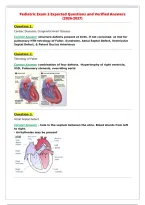
Tetralogy of Fallot
Correct Answer: combination of four defects. -Hypertrophy of right ventricle,
VSD, Pulmonary stenosis, overriding aorta
Question 3.
Atrial Septal Defect
Correct Answer: - hole in the septum between the atria. Blood shunts from left
to right.
- Arrhythmias may be present
, Question 4.
Ventricular Septal Defect
Correct Answer: hole in the septum between the ventricles. Blood shunts from
left to right. -Arrhythmias, HF, pulmonary HTN
Question 5.
Patent Ductus Arteriosus (PDA)
Correct Answer: open lumen in the ductus arteriosus between the aorta and
pulmonary artery = more blood going to the lungs = increase in respiratory
problems.
(2026-2027)
Question 1.
Cardiac Diseases: Congenital Heart Disease
Correct Answer: structure defects present at birth. If not corrected- at risk for
pulmonary HTN tetrology of Fallor, Syndrome, Atrial Septal Defect, Ventricular
Septal Defect, & Patent Ductus Arteriosus
Question 2.
Tetralogy of Fallot
Correct Answer: combination of four defects. -Hypertrophy of right ventricle,
VSD, Pulmonary stenosis, overriding aorta
Question 3.
Atrial Septal Defect
Correct Answer: - hole in the septum between the atria. Blood shunts from left
to right.
- Arrhythmias may be present
, Question 4.
Ventricular Septal Defect
Correct Answer: hole in the septum between the ventricles. Blood shunts from
left to right. -Arrhythmias, HF, pulmonary HTN
Question 5.
Patent Ductus Arteriosus (PDA)
Correct Answer: open lumen in the ductus arteriosus between the aorta and
pulmonary artery = more blood going to the lungs = increase in respiratory
problems.


