
Page |1
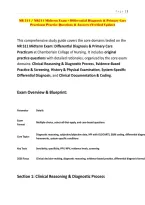
NR 511 / NR511 Midterm Exam – Differential Diagnosis & Primary Care
Practicum Practice Questions & Answers (Verified Update)
This comprehensive study guide covers the core domains tested on the
NR 511 Midterm Exam: Differential Diagnosis & Primary Care
Practicum at Chamberlain College of Nursing. It includes original
practice questions with detailed rationales, organized by the core exam
domains: Clinical Reasoning & Diagnostic Process, Evidence-Based
Practice & Screening, History & Physical Examination, System-Specific
Differential Diagnosis, and Clinical Documentation & Coding.
Exam Overview & Blueprint:
Parameter Details
Exam
Multiple-choice, select-all-that-apply, and case-based questions
Format
Diagnostic reasoning, subjective/objective data, HPI with OLDCARTS, E&M coding, differential diagno
Core Topics
frameworks, system-specific conditions
Key Tests Sensitivity, specificity, PPV, NPV, evidence levels, screening
2026 Focus Clinical decision-making, diagnostic reasoning, evidence-based practice, differential diagnosis formula
Section 1: Clinical Reasoning & Diagnostic Process
, Page |2
Q1. What is needed to make a sound clinical decision?
A) Provider experience only
B) Patient preference only
C) Evidence-based research, clinical practice guidelines, and
published evidence-based algorithms
D) Institutional protocols only
Answer: C
Rationale: Sound clinical decisions require integration of
evidence-based research, clinical practice guidelines, and
published evidence-based algorithms. These resources provide
the foundation for high-quality, patient-centered care.
Q2. Define diagnostic reasoning.
A) Memorizing common disease presentations
B) Following a fixed algorithm for every patient
C) Reflective thinking that questions one's thinking to
determine if all possible avenues have been explored and if
conclusions are based on evidence
D) Documenting patient symptoms in chronological order
Answer: C
Rationale: Diagnostic reasoning is a form of critical thinking that
involves continuously questioning your own thought process to
, Page |3
ensure all possibilities have been considered and that
conclusions are supported by evidence, not assumptions.
Q3. Which of the following represents subjective data?
A) Blood pressure reading of 130/85 mmHg
B) Patient's complaint of "sharp chest pain that started 2 hours
ago"
C) Laboratory result showing elevated white blood cell count
D) Tenderness noted on palpation of the abdomen
Answer: B
Rationale: Subjective data is anything the patient tells you or
complains of, including the chief complaint, history of present
illness (HPI), and review of systems (ROS). Objective data is
what you can see, touch, hear, or smell during your exam.
Q4. Which of the following represents objective data?
A) "I have had a fever for three days"
B) "The pain is a 7 out of 10"
C) Temperature of 101.2°F and erythema noted on examination
D) "My mother had diabetes"
Answer: C
Rationale: Objective data is measurable, observable, and
verifiable information that you gather through physical
examination, vital signs measurement, and diagnostic testing.
Anything the patient reports is subjective.
, Page |4
Q5. Identify the components of the HPI (History of Present
Illness).
A) Family history, social history, past medical history
B) Detailed breakdown of the chief complaint using OLDCARTS
C) Review of systems and physical exam findings
D) Lab results and diagnostic imaging
Answer: B
Rationale: The HPI is specifically related to the chief complaint
only and provides a detailed breakdown using the mnemonic
OLDCARTS (Onset, Location, Duration, Character, Aggravating
factors, Relieving factors, Timing, Severity).
Q6. The mnemonic "OLDCARTS" is used to assess which of the
following?
A) Past medical history
B) Family history
C) History of present illness (HPI)
D) Review of systems
Answer: C
Rationale: OLDCARTS is a systematic approach to gathering
detailed information about the patient's chief complaint and is
a core component of the HPI.
Q7. What does the "C" stand for in the OLDCARTS mnemonic?
NR 511 / NR511 Midterm Exam – Differential Diagnosis & Primary Care
Practicum Practice Questions & Answers (Verified Update)
This comprehensive study guide covers the core domains tested on the
NR 511 Midterm Exam: Differential Diagnosis & Primary Care
Practicum at Chamberlain College of Nursing. It includes original
practice questions with detailed rationales, organized by the core exam
domains: Clinical Reasoning & Diagnostic Process, Evidence-Based
Practice & Screening, History & Physical Examination, System-Specific
Differential Diagnosis, and Clinical Documentation & Coding.
Exam Overview & Blueprint:
Parameter Details
Exam
Multiple-choice, select-all-that-apply, and case-based questions
Format
Diagnostic reasoning, subjective/objective data, HPI with OLDCARTS, E&M coding, differential diagno
Core Topics
frameworks, system-specific conditions
Key Tests Sensitivity, specificity, PPV, NPV, evidence levels, screening
2026 Focus Clinical decision-making, diagnostic reasoning, evidence-based practice, differential diagnosis formula
Section 1: Clinical Reasoning & Diagnostic Process
, Page |2
Q1. What is needed to make a sound clinical decision?
A) Provider experience only
B) Patient preference only
C) Evidence-based research, clinical practice guidelines, and
published evidence-based algorithms
D) Institutional protocols only
Answer: C
Rationale: Sound clinical decisions require integration of
evidence-based research, clinical practice guidelines, and
published evidence-based algorithms. These resources provide
the foundation for high-quality, patient-centered care.
Q2. Define diagnostic reasoning.
A) Memorizing common disease presentations
B) Following a fixed algorithm for every patient
C) Reflective thinking that questions one's thinking to
determine if all possible avenues have been explored and if
conclusions are based on evidence
D) Documenting patient symptoms in chronological order
Answer: C
Rationale: Diagnostic reasoning is a form of critical thinking that
involves continuously questioning your own thought process to
, Page |3
ensure all possibilities have been considered and that
conclusions are supported by evidence, not assumptions.
Q3. Which of the following represents subjective data?
A) Blood pressure reading of 130/85 mmHg
B) Patient's complaint of "sharp chest pain that started 2 hours
ago"
C) Laboratory result showing elevated white blood cell count
D) Tenderness noted on palpation of the abdomen
Answer: B
Rationale: Subjective data is anything the patient tells you or
complains of, including the chief complaint, history of present
illness (HPI), and review of systems (ROS). Objective data is
what you can see, touch, hear, or smell during your exam.
Q4. Which of the following represents objective data?
A) "I have had a fever for three days"
B) "The pain is a 7 out of 10"
C) Temperature of 101.2°F and erythema noted on examination
D) "My mother had diabetes"
Answer: C
Rationale: Objective data is measurable, observable, and
verifiable information that you gather through physical
examination, vital signs measurement, and diagnostic testing.
Anything the patient reports is subjective.
, Page |4
Q5. Identify the components of the HPI (History of Present
Illness).
A) Family history, social history, past medical history
B) Detailed breakdown of the chief complaint using OLDCARTS
C) Review of systems and physical exam findings
D) Lab results and diagnostic imaging
Answer: B
Rationale: The HPI is specifically related to the chief complaint
only and provides a detailed breakdown using the mnemonic
OLDCARTS (Onset, Location, Duration, Character, Aggravating
factors, Relieving factors, Timing, Severity).
Q6. The mnemonic "OLDCARTS" is used to assess which of the
following?
A) Past medical history
B) Family history
C) History of present illness (HPI)
D) Review of systems
Answer: C
Rationale: OLDCARTS is a systematic approach to gathering
detailed information about the patient's chief complaint and is
a core component of the HPI.
Q7. What does the "C" stand for in the OLDCARTS mnemonic?


