
A-LEVEL MATHEMATICS / DIFFERENTIATION / INDEPENDENT SUPPLEMENT
METHOD SUMMARY + ORIGINAL PRACTICE
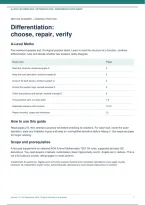
Differentiation:
choose, repair, verify
A-Level Maths
Five worked examples and 18 original practice tasks. Learn to read the structure of a function, combine
differentiation rules and decide whether two answers really disagree.
Study route Pages
Read the structure; worked example A 2
Keep the inner derivative; worked example B 3
Account for both factors; worked example C 4
Control the quotient sign; worked example D 5
Check equivalence and domain; worked example E 6
Three practice sets, six tasks each 7-9
Separated solutions with reasons 10-12
Repair checklist, scope and references 13
How to use this guide
Read pages 2-6, then attempt a practice set before checking its solutions. For each task, name the outer
operation, state any forbidden inputs and keep an unsimplified derivative before tidying it. Use separate paper
for longer working.
Scope and prerequisites
A focused supplement for selected AQA A-level Mathematics 7357 G4 rules, supported by basic G2
derivatives. You need powers, brackets, factorisation, basic trigonometry and ln. Angles are in radians. This is
not a full calculus course, official paper or mark scheme.
Created with AI assistance. Algebra and numerical answers checked with executable calculations; every page visually
reviewed. No independent expert review, achieved grade, attendance or exam-board endorsement is claimed.
Version 1.0 | 26 September 2026 | Original methods and practice 1
, A-LEVEL MATHEMATICS / DIFFERENTIATION / INDEPENDENT SUPPLEMENT
01 / STRUCTURE BEFORE SYMBOLS
Read the final operation
Ask how the expression is assembled. A sum can be differentiated term by term; a product needs both
changing factors; a quotient needs an ordered subtraction; a nested function needs the inner rate. More than
one rule can be needed in the same expression.
Structure First move
u + v or u - v Differentiate the terms separately.
A constant times u Keep the constant and differentiate u.
u multiplied by v Use u'v + uv', unless expansion is simpler.
u divided by v Use (u'v - uv')/v2, where v is not zero.
F(u(x)) Use F'(u(x)) multiplied by u'(x).
Worked example A: two routes, one result
Differentiate y = x2(3x + 4). The final operation is multiplication. With u = x2 and v = 3x + 4, u' = 2x and v' = 3.
Product rule gives y' = 2x(3x + 4) + 3x2 = 9x2 + 8x.
Alternatively, expand the original function: y = 3x3 + 4x2. Differentiating each term gives 9x2 + 8x again. At x =
2 both routes give 52. All real inputs are allowed.
Choose a clear route, not a fashionable rule
A fraction does not always require quotient rule: x4/x = x3 for x not equal to 0. Differentiate the simpler form
but retain the excluded input. A rule choice is useful when it makes the algebra easier to audit.
Checkpoint habit
Before calculating, write a short sentence such as "product outside; chain inside the second factor". This
records your plan and makes a missing contribution easier to locate.
Version 1.0 | 26 September 2026 | Original methods and practice 2
METHOD SUMMARY + ORIGINAL PRACTICE
Differentiation:
choose, repair, verify
A-Level Maths
Five worked examples and 18 original practice tasks. Learn to read the structure of a function, combine
differentiation rules and decide whether two answers really disagree.
Study route Pages
Read the structure; worked example A 2
Keep the inner derivative; worked example B 3
Account for both factors; worked example C 4
Control the quotient sign; worked example D 5
Check equivalence and domain; worked example E 6
Three practice sets, six tasks each 7-9
Separated solutions with reasons 10-12
Repair checklist, scope and references 13
How to use this guide
Read pages 2-6, then attempt a practice set before checking its solutions. For each task, name the outer
operation, state any forbidden inputs and keep an unsimplified derivative before tidying it. Use separate paper
for longer working.
Scope and prerequisites
A focused supplement for selected AQA A-level Mathematics 7357 G4 rules, supported by basic G2
derivatives. You need powers, brackets, factorisation, basic trigonometry and ln. Angles are in radians. This is
not a full calculus course, official paper or mark scheme.
Created with AI assistance. Algebra and numerical answers checked with executable calculations; every page visually
reviewed. No independent expert review, achieved grade, attendance or exam-board endorsement is claimed.
Version 1.0 | 26 September 2026 | Original methods and practice 1
, A-LEVEL MATHEMATICS / DIFFERENTIATION / INDEPENDENT SUPPLEMENT
01 / STRUCTURE BEFORE SYMBOLS
Read the final operation
Ask how the expression is assembled. A sum can be differentiated term by term; a product needs both
changing factors; a quotient needs an ordered subtraction; a nested function needs the inner rate. More than
one rule can be needed in the same expression.
Structure First move
u + v or u - v Differentiate the terms separately.
A constant times u Keep the constant and differentiate u.
u multiplied by v Use u'v + uv', unless expansion is simpler.
u divided by v Use (u'v - uv')/v2, where v is not zero.
F(u(x)) Use F'(u(x)) multiplied by u'(x).
Worked example A: two routes, one result
Differentiate y = x2(3x + 4). The final operation is multiplication. With u = x2 and v = 3x + 4, u' = 2x and v' = 3.
Product rule gives y' = 2x(3x + 4) + 3x2 = 9x2 + 8x.
Alternatively, expand the original function: y = 3x3 + 4x2. Differentiating each term gives 9x2 + 8x again. At x =
2 both routes give 52. All real inputs are allowed.
Choose a clear route, not a fashionable rule
A fraction does not always require quotient rule: x4/x = x3 for x not equal to 0. Differentiate the simpler form
but retain the excluded input. A rule choice is useful when it makes the algebra easier to audit.
Checkpoint habit
Before calculating, write a short sentence such as "product outside; chain inside the second factor". This
records your plan and makes a missing contribution easier to locate.
Version 1.0 | 26 September 2026 | Original methods and practice 2


