
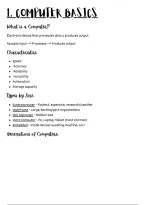
1. COMPUTER BASICS
What is a Computer?
Electronic device that processes data & produces output
Accepts input → Processes → Produces output
Characteristics:
Speed
Accuracy
Reliability
Versatility
Automation
Storage capacity
Types by Size:
Supercomputer - Fastest, expensive, research/weather
Mainframe - Large, banking/govt organizations
Mini Computer - Medium size
Micro Computer - PC, Laptop, Tablet (most common)
Embedded - Inside devices (washing machine, car)
Generations of Computers:
, Generat Years Technology Speed Example
ion
1st 1940-56 Vacuum Tube Slow ENIAC
2nd 1956-63 Transistors Faster IBM 1620
3rd 1963-71 Integrated Circuit Much IBM 360
(IC) faster
4th 1971- Microprocessor Very fast Intel i7 , Ryzen
Present
5th Future AI , Quantum Fastest In development
2. HARDWARE (Physical
Components)
Central Processing Unit (CPU)
Brain of computer - executes all instructions
Has: Control Unit (CU) + Arithmetic Logic Unit (ALU)
Speed measured in: GHz (Gigahertz)
Example: Intel Core i5, AMD Ryzen 7
Memory
Primary Memory (RAM):
Volatile (data lost when power off)
Fast access, temporary storage
Measured in: GB
What is a Computer?
Electronic device that processes data & produces output
Accepts input → Processes → Produces output
Characteristics:
Speed
Accuracy
Reliability
Versatility
Automation
Storage capacity
Types by Size:
Supercomputer - Fastest, expensive, research/weather
Mainframe - Large, banking/govt organizations
Mini Computer - Medium size
Micro Computer - PC, Laptop, Tablet (most common)
Embedded - Inside devices (washing machine, car)
Generations of Computers:
, Generat Years Technology Speed Example
ion
1st 1940-56 Vacuum Tube Slow ENIAC
2nd 1956-63 Transistors Faster IBM 1620
3rd 1963-71 Integrated Circuit Much IBM 360
(IC) faster
4th 1971- Microprocessor Very fast Intel i7 , Ryzen
Present
5th Future AI , Quantum Fastest In development
2. HARDWARE (Physical
Components)
Central Processing Unit (CPU)
Brain of computer - executes all instructions
Has: Control Unit (CU) + Arithmetic Logic Unit (ALU)
Speed measured in: GHz (Gigahertz)
Example: Intel Core i5, AMD Ryzen 7
Memory
Primary Memory (RAM):
Volatile (data lost when power off)
Fast access, temporary storage
Measured in: GB


