
NR 546 Advanced Pharmacology - Final Examination 2026/2027 Chamberlain University
NR 546 ADVANCED PHARMACOLOGY
FINAL EXAMINATION
VERSION 1 AND VERSION 2
NEWEST 2026/2027 ACTUAL EXAM
COMPLETE QUESTIONS AND CORRECT DETAILED ANSWERS
(VERIFIED ANSWERS)
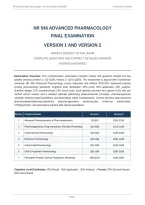
Examination Overview: This comprehensive examination contains exactly 200 questions divided into two
parallel versions (Version 1: Q1-Q100; Version 2: Q101-Q200). The assessment is aligned with Chamberlain
University NR 546 Advanced Pharmacology course objectives and reflects 2026-2027 advanced practice
nursing pharmacology standards. Cognitive level distribution: 25% recall, 55% application, 20% analysis.
Question design: 75% scenario-based, 25% direct recall. Each question provides four options (A-D) with one
verified correct answer and a detailed rationale addressing pharmacokinetic principles, pharmacodynamic
rationale, evidence-based guidelines, and prescriptive safety considerations. Content domains span advanced
pharmacokinetics/pharmacodynamics, pharmacogenomics, cardiovascular, endocrine, antimicrobial,
CNS/psychiatric, and prescriptive practice with special populations.
Section Content Domain Version 1 Version 2
1 Advanced Pharmacokinetics & Pharmacodynamics Q1-Q15 Q101-Q115
2 Pharmacogenomics, Drug Interactions, Precision Prescribing Q16-Q28 Q116-Q128
3 Cardiovascular Pharmacology Q29-Q50 Q129-Q150
4 Endocrine Pharmacology Q51-Q66 Q151-Q166
5 Antimicrobial Pharmacology Q67-Q80 Q167-Q180
6 CNS & Psychiatric Pharmacology Q81-Q94 Q181-Q194
7 Prescriptive Practice, Special Populations, Monitoring Q95-Q100 Q195-Q200
Cognitive Level Distribution: 25% Recall · 55% Application · 20% Analysis | Format: 75% Scenario-Based ·
25% Direct Recall
Page 1
,NR 546 Advanced Pharmacology - Final Examination 2026/2027 Chamberlain University
VERSION 1
100 Questions (Q1 through Q100) | Chamberlain University NR 546 Advanced Pharmacology
SECTION 1: Advanced Pharmacokinetics and Pharmacodynamics
Absorption, Distribution, Metabolism, Excretion, Receptors, & Dose-Response
Q1: A 68-year-old female with new-onset atrial fibrillation is started on oral verapamil 120 mg every
12 hours. The prescriber knows the oral bioavailability of verapamil is approximately 20%
compared with intravenous dosing. Which pharmacokinetic property best explains this low
bioavailability?
A. Renal tubular secretion competes with reabsorption, limiting active drug reaching plasma.
B. Extensive first-pass metabolism by hepatic CYP3A4 and intestinal CYP3A5 reduces systemic
exposure. [CORRECT]
C. High plasma protein binding (>95%) prevents free drug from distributing to the myocardium.
D. P-glycoprotein efflux at the renal proximal tubule accelerates elimination before distribution.
Correct Answer: B. Extensive first-pass metabolism by hepatic CYP3A4 and intestinal CYP3A5
reduces systemic exposure.
Rationale: Verapamil exhibits low oral bioavailability (~20%) primarily due to extensive first-pass metabolism by both
hepatic CYP3A4 and intestinal CYP3A5/3A4 isoenzymes. A significant fraction of the dose is metabolized before
reaching systemic circulation. Choice A is incorrect because renal mechanisms do not reduce pre-systemic
bioavailability. Choice C confuses protein binding (a distribution property) with bioavailability (an absorption/first-pass
property). Choice D misattributes the effect to P-glycoprotein at the kidney, whereas intestinal P-gp efflux contributes
modestly but the dominant mechanism is CYP3A-mediated first-pass metabolism.
Q2: A patient receiving IV phenytoin for status epilepticus is transitioned to oral phenytoin. To
achieve equivalent serum concentrations, the oral dose must be substantially higher than the IV
dose. Which property accounts for this dosing discrepancy?
A. High lipid solubility causing rapid redistribution into adipose tissue
B. Saturable first-pass metabolism and nonlinear (Michaelis-Menten) kinetics [CORRECT]
C. Low oral bioavailability of approximately 50% due to poor gastrointestinal absorption
D. Rapid renal clearance of unchanged drug following oral absorption
Correct Answer: B. Saturable first-pass metabolism and nonlinear (Michaelis-Menten) kinetics
Rationale: Phenytoin exhibits saturable (Michaelis-Menten) kinetics; hepatic metabolism approaches saturation even
at therapeutic concentrations, and oral absorption is near complete (~90%). Small dose increments can produce
disproportionate serum concentration increases. Choice A describes benzodiazepine redistribution, not phenytoin.
Choice C is incorrect because oral phenytoin bioavailability is high (~90%) and the issue is metabolic saturation.
Choice D is wrong because phenytoin is metabolized primarily hepatically, with minimal renal elimination of
unchanged drug.
Page 2
,NR 546 Advanced Pharmacology - Final Examination 2026/2027 Chamberlain University
Q3: A drug has a volume of distribution (Vd) of 3.5 L/kg in a 70 kg adult. Which interpretation is
most accurate?
A. The drug is confined primarily to plasma and extracellular fluid.
B. The drug distributes extensively into total body water but not into tissues.
C. The drug distributes widely into tissues, likely binding intracellular components or fat.
[CORRECT]
D. The Vd alone predicts the dosing interval required for therapeutic effect.
Correct Answer: C. The drug distributes widely into tissues, likely binding intracellular
components or fat.
Rationale: A Vd of 3.5 L/kg far exceeds total body water (~0.6 L/kg), indicating extensive tissue distribution and likely
intracellular binding or lipid partitioning. Choice A would be supported by Vd of ~0.1-0.3 L/kg. Choice B describes a
Vd near 0.6 L/kg. Choice D is incorrect because Vd informs loading dose and elimination half-life (with clearance), but
does not by itself determine dosing interval. Drugs such as amiodarone, digoxin, and tricyclic antidepressants exhibit
similarly large Vd values due to tissue sequestration.
Q4: A patient with severe hypoalbuminemia (albumin 1.8 g/dL) is receiving warfarin 5 mg daily with
an INR of 1.4 (subtherapeutic). Which pharmacokinetic principle explains the apparent resistance
and guides safe adjustment?
A. Decreased plasma protein binding increases free warfarin, so the dose should not be increased despite
low INR.
B. Increased free warfarin is rapidly metabolized, requiring upward titration to maintain therapeutic
INR. [CORRECT]
C. Hypoalbuminemia reduces hepatic CYP2C9 activity, prolonging half-life and mandating dose reduction.
D. Warfarin distributes to adipose tissue in hypoalbuminemia, requiring loading dose administration.
Correct Answer: B. Increased free warfarin is rapidly metabolized, requiring upward titration to
maintain therapeutic INR.
Rationale: Warfarin is highly protein-bound (~99%) to albumin. In hypoalbuminemia, free fraction rises, but the
unbound drug is also more available for hepatic CYP2C9 metabolism and clearance increases, so total plasma
concentration (and INR) may appear low despite normal or high free drug. Increasing the dose carefully while
monitoring INR is appropriate. Choice A is partially true but ignores the compensatory increase in clearance. Choice
C incorrectly links albumin status to CYP2C9 enzyme activity. Choice D misapplies distribution concepts. The clinical
take-home is that INR remains the actionable monitoring parameter rather than albumin-corrected dose calculations.
Q5: A drug follows first-order elimination kinetics. Which statement is correct?
A. A constant amount of drug is eliminated per unit time regardless of plasma concentration.
B. A constant fraction of drug is eliminated per unit time, producing an exponential decline.
[CORRECT]
C. Doubling the dose doubles the half-life and triples the steady-state concentration.
D. Steady state is achieved after one half-life following initiation of therapy.
Correct Answer: B. A constant fraction of drug is eliminated per unit time, producing an
exponential decline.
Rationale: In first-order kinetics, elimination rate is proportional to plasma concentration, so a constant fraction (e.g.,
50%) is eliminated per half-life, producing an exponential concentration decline. Choice A describes zero-order
(saturation) kinetics seen with ethanol, phenytoin, and high-dose aspirin. Choice C is incorrect because half-life is
dose-independent in first-order kinetics, and steady-state concentration increases proportionally with dose. Choice D
is wrong because achieving steady state requires approximately 4-5 half-lives.
Page 3
, NR 546 Advanced Pharmacology - Final Examination 2026/2027 Chamberlain University
Q6: A patient with chronic pain is switched from full agonist morphine to a partial agonist
buprenorphine. Which pharmacodynamic property best explains the precipitation of acute
withdrawal if the transition occurs too soon?
A. Buprenorphine has higher intrinsic activity at the mu receptor, displacing morphine.
B. Buprenorphine has lower intrinsic activity but high receptor affinity, displacing morphine and
producing less effect. [CORRECT]
C. Buprenorphine antagonizes kappa receptors, increasing spinal pain transmission.
D. Buprenorphine undergoes rapid CYP3A4 metabolism, lowering plasma morphine concentrations.
Correct Answer: B. Buprenorphine has lower intrinsic activity but high receptor affinity, displacing
morphine and producing less effect.
Rationale: Buprenorphine is a high-affinity partial mu agonist. When given to a patient physically dependent on a full
agonist, it displaces the full agonist from the mu receptor but produces less effect (lower intrinsic activity),
precipitating withdrawal. Choice A is wrong because buprenorphine has lower, not higher, intrinsic activity. Choice C
is incorrect; buprenorphine is a kappa antagonist but that does not precipitate withdrawal. Choice D is incorrect
because the mechanism is receptor-level pharmacodynamic, not metabolic. Clinical practice requires waiting until
moderate withdrawal is present (Clinical Opiate Withdrawal Score >= 8-10) before initiating buprenorphine.
Q7: A drug has a narrow therapeutic index (TI). Which monitoring strategy is most appropriate for
safe prescribing?
A. Symptom-based dose titration without laboratory monitoring is adequate.
B. Therapeutic drug monitoring with target serum concentrations is required to balance efficacy
and toxicity. [CORRECT]
C. Doubling the dose whenever symptoms persist ensures therapeutic efficacy.
D. Liver function tests alone are sufficient for monitoring narrow-TI drugs.
Correct Answer: B. Therapeutic drug monitoring with target serum concentrations is required to
balance efficacy and toxicity.
Rationale: Narrow therapeutic index drugs (e.g., digoxin, warfarin, lithium, phenytoin, vancomycin, aminoglycosides)
require therapeutic drug monitoring because the ratio of toxic dose to therapeutic dose is small. Choice A ignores the
risk of toxicity. Choice C is dangerous and likely to cause toxicity. Choice D is incorrect because LFTs do not reflect
drug-specific exposure. TDM allows individualization of dosing based on measured serum concentrations combined
with clinical assessment.
Q8: A drug exhibits a quantal dose-response curve with ED50 of 50 mg and LD50 of 500 mg.
Calculate the therapeutic index and interpret its clinical significance.
A. TI = 10; the drug has a wide safety margin and is suitable for outpatient self-administration.
[CORRECT]
B. TI = 0.1; the drug is unsafe and contraindicated for clinical use.
C. TI = 10; the drug has a narrow margin and requires careful monitoring.
D. TI = 500; the drug is virtually nontoxic at any dose.
Correct Answer: A. TI = 10; the drug has a wide safety margin and is suitable for outpatient
self-administration.
Rationale: Therapeutic Index (TI) = LD50/ED50 = 500/50 = 10. A TI of 10 indicates a relatively wide safety margin for
a clinical drug. Choice B miscalculates the ratio. Choice C misinterprets the value; TI of 10 is generally considered
moderate-to-wide. Choice D is mathematically incorrect. Note: TI is based on animal data and provides only an
estimate; clinical safety also depends on interpatient variability, so even drugs with favorable TI require appropriate
monitoring.
Page 4
NR 546 ADVANCED PHARMACOLOGY
FINAL EXAMINATION
VERSION 1 AND VERSION 2
NEWEST 2026/2027 ACTUAL EXAM
COMPLETE QUESTIONS AND CORRECT DETAILED ANSWERS
(VERIFIED ANSWERS)
Examination Overview: This comprehensive examination contains exactly 200 questions divided into two
parallel versions (Version 1: Q1-Q100; Version 2: Q101-Q200). The assessment is aligned with Chamberlain
University NR 546 Advanced Pharmacology course objectives and reflects 2026-2027 advanced practice
nursing pharmacology standards. Cognitive level distribution: 25% recall, 55% application, 20% analysis.
Question design: 75% scenario-based, 25% direct recall. Each question provides four options (A-D) with one
verified correct answer and a detailed rationale addressing pharmacokinetic principles, pharmacodynamic
rationale, evidence-based guidelines, and prescriptive safety considerations. Content domains span advanced
pharmacokinetics/pharmacodynamics, pharmacogenomics, cardiovascular, endocrine, antimicrobial,
CNS/psychiatric, and prescriptive practice with special populations.
Section Content Domain Version 1 Version 2
1 Advanced Pharmacokinetics & Pharmacodynamics Q1-Q15 Q101-Q115
2 Pharmacogenomics, Drug Interactions, Precision Prescribing Q16-Q28 Q116-Q128
3 Cardiovascular Pharmacology Q29-Q50 Q129-Q150
4 Endocrine Pharmacology Q51-Q66 Q151-Q166
5 Antimicrobial Pharmacology Q67-Q80 Q167-Q180
6 CNS & Psychiatric Pharmacology Q81-Q94 Q181-Q194
7 Prescriptive Practice, Special Populations, Monitoring Q95-Q100 Q195-Q200
Cognitive Level Distribution: 25% Recall · 55% Application · 20% Analysis | Format: 75% Scenario-Based ·
25% Direct Recall
Page 1
,NR 546 Advanced Pharmacology - Final Examination 2026/2027 Chamberlain University
VERSION 1
100 Questions (Q1 through Q100) | Chamberlain University NR 546 Advanced Pharmacology
SECTION 1: Advanced Pharmacokinetics and Pharmacodynamics
Absorption, Distribution, Metabolism, Excretion, Receptors, & Dose-Response
Q1: A 68-year-old female with new-onset atrial fibrillation is started on oral verapamil 120 mg every
12 hours. The prescriber knows the oral bioavailability of verapamil is approximately 20%
compared with intravenous dosing. Which pharmacokinetic property best explains this low
bioavailability?
A. Renal tubular secretion competes with reabsorption, limiting active drug reaching plasma.
B. Extensive first-pass metabolism by hepatic CYP3A4 and intestinal CYP3A5 reduces systemic
exposure. [CORRECT]
C. High plasma protein binding (>95%) prevents free drug from distributing to the myocardium.
D. P-glycoprotein efflux at the renal proximal tubule accelerates elimination before distribution.
Correct Answer: B. Extensive first-pass metabolism by hepatic CYP3A4 and intestinal CYP3A5
reduces systemic exposure.
Rationale: Verapamil exhibits low oral bioavailability (~20%) primarily due to extensive first-pass metabolism by both
hepatic CYP3A4 and intestinal CYP3A5/3A4 isoenzymes. A significant fraction of the dose is metabolized before
reaching systemic circulation. Choice A is incorrect because renal mechanisms do not reduce pre-systemic
bioavailability. Choice C confuses protein binding (a distribution property) with bioavailability (an absorption/first-pass
property). Choice D misattributes the effect to P-glycoprotein at the kidney, whereas intestinal P-gp efflux contributes
modestly but the dominant mechanism is CYP3A-mediated first-pass metabolism.
Q2: A patient receiving IV phenytoin for status epilepticus is transitioned to oral phenytoin. To
achieve equivalent serum concentrations, the oral dose must be substantially higher than the IV
dose. Which property accounts for this dosing discrepancy?
A. High lipid solubility causing rapid redistribution into adipose tissue
B. Saturable first-pass metabolism and nonlinear (Michaelis-Menten) kinetics [CORRECT]
C. Low oral bioavailability of approximately 50% due to poor gastrointestinal absorption
D. Rapid renal clearance of unchanged drug following oral absorption
Correct Answer: B. Saturable first-pass metabolism and nonlinear (Michaelis-Menten) kinetics
Rationale: Phenytoin exhibits saturable (Michaelis-Menten) kinetics; hepatic metabolism approaches saturation even
at therapeutic concentrations, and oral absorption is near complete (~90%). Small dose increments can produce
disproportionate serum concentration increases. Choice A describes benzodiazepine redistribution, not phenytoin.
Choice C is incorrect because oral phenytoin bioavailability is high (~90%) and the issue is metabolic saturation.
Choice D is wrong because phenytoin is metabolized primarily hepatically, with minimal renal elimination of
unchanged drug.
Page 2
,NR 546 Advanced Pharmacology - Final Examination 2026/2027 Chamberlain University
Q3: A drug has a volume of distribution (Vd) of 3.5 L/kg in a 70 kg adult. Which interpretation is
most accurate?
A. The drug is confined primarily to plasma and extracellular fluid.
B. The drug distributes extensively into total body water but not into tissues.
C. The drug distributes widely into tissues, likely binding intracellular components or fat.
[CORRECT]
D. The Vd alone predicts the dosing interval required for therapeutic effect.
Correct Answer: C. The drug distributes widely into tissues, likely binding intracellular
components or fat.
Rationale: A Vd of 3.5 L/kg far exceeds total body water (~0.6 L/kg), indicating extensive tissue distribution and likely
intracellular binding or lipid partitioning. Choice A would be supported by Vd of ~0.1-0.3 L/kg. Choice B describes a
Vd near 0.6 L/kg. Choice D is incorrect because Vd informs loading dose and elimination half-life (with clearance), but
does not by itself determine dosing interval. Drugs such as amiodarone, digoxin, and tricyclic antidepressants exhibit
similarly large Vd values due to tissue sequestration.
Q4: A patient with severe hypoalbuminemia (albumin 1.8 g/dL) is receiving warfarin 5 mg daily with
an INR of 1.4 (subtherapeutic). Which pharmacokinetic principle explains the apparent resistance
and guides safe adjustment?
A. Decreased plasma protein binding increases free warfarin, so the dose should not be increased despite
low INR.
B. Increased free warfarin is rapidly metabolized, requiring upward titration to maintain therapeutic
INR. [CORRECT]
C. Hypoalbuminemia reduces hepatic CYP2C9 activity, prolonging half-life and mandating dose reduction.
D. Warfarin distributes to adipose tissue in hypoalbuminemia, requiring loading dose administration.
Correct Answer: B. Increased free warfarin is rapidly metabolized, requiring upward titration to
maintain therapeutic INR.
Rationale: Warfarin is highly protein-bound (~99%) to albumin. In hypoalbuminemia, free fraction rises, but the
unbound drug is also more available for hepatic CYP2C9 metabolism and clearance increases, so total plasma
concentration (and INR) may appear low despite normal or high free drug. Increasing the dose carefully while
monitoring INR is appropriate. Choice A is partially true but ignores the compensatory increase in clearance. Choice
C incorrectly links albumin status to CYP2C9 enzyme activity. Choice D misapplies distribution concepts. The clinical
take-home is that INR remains the actionable monitoring parameter rather than albumin-corrected dose calculations.
Q5: A drug follows first-order elimination kinetics. Which statement is correct?
A. A constant amount of drug is eliminated per unit time regardless of plasma concentration.
B. A constant fraction of drug is eliminated per unit time, producing an exponential decline.
[CORRECT]
C. Doubling the dose doubles the half-life and triples the steady-state concentration.
D. Steady state is achieved after one half-life following initiation of therapy.
Correct Answer: B. A constant fraction of drug is eliminated per unit time, producing an
exponential decline.
Rationale: In first-order kinetics, elimination rate is proportional to plasma concentration, so a constant fraction (e.g.,
50%) is eliminated per half-life, producing an exponential concentration decline. Choice A describes zero-order
(saturation) kinetics seen with ethanol, phenytoin, and high-dose aspirin. Choice C is incorrect because half-life is
dose-independent in first-order kinetics, and steady-state concentration increases proportionally with dose. Choice D
is wrong because achieving steady state requires approximately 4-5 half-lives.
Page 3
, NR 546 Advanced Pharmacology - Final Examination 2026/2027 Chamberlain University
Q6: A patient with chronic pain is switched from full agonist morphine to a partial agonist
buprenorphine. Which pharmacodynamic property best explains the precipitation of acute
withdrawal if the transition occurs too soon?
A. Buprenorphine has higher intrinsic activity at the mu receptor, displacing morphine.
B. Buprenorphine has lower intrinsic activity but high receptor affinity, displacing morphine and
producing less effect. [CORRECT]
C. Buprenorphine antagonizes kappa receptors, increasing spinal pain transmission.
D. Buprenorphine undergoes rapid CYP3A4 metabolism, lowering plasma morphine concentrations.
Correct Answer: B. Buprenorphine has lower intrinsic activity but high receptor affinity, displacing
morphine and producing less effect.
Rationale: Buprenorphine is a high-affinity partial mu agonist. When given to a patient physically dependent on a full
agonist, it displaces the full agonist from the mu receptor but produces less effect (lower intrinsic activity),
precipitating withdrawal. Choice A is wrong because buprenorphine has lower, not higher, intrinsic activity. Choice C
is incorrect; buprenorphine is a kappa antagonist but that does not precipitate withdrawal. Choice D is incorrect
because the mechanism is receptor-level pharmacodynamic, not metabolic. Clinical practice requires waiting until
moderate withdrawal is present (Clinical Opiate Withdrawal Score >= 8-10) before initiating buprenorphine.
Q7: A drug has a narrow therapeutic index (TI). Which monitoring strategy is most appropriate for
safe prescribing?
A. Symptom-based dose titration without laboratory monitoring is adequate.
B. Therapeutic drug monitoring with target serum concentrations is required to balance efficacy
and toxicity. [CORRECT]
C. Doubling the dose whenever symptoms persist ensures therapeutic efficacy.
D. Liver function tests alone are sufficient for monitoring narrow-TI drugs.
Correct Answer: B. Therapeutic drug monitoring with target serum concentrations is required to
balance efficacy and toxicity.
Rationale: Narrow therapeutic index drugs (e.g., digoxin, warfarin, lithium, phenytoin, vancomycin, aminoglycosides)
require therapeutic drug monitoring because the ratio of toxic dose to therapeutic dose is small. Choice A ignores the
risk of toxicity. Choice C is dangerous and likely to cause toxicity. Choice D is incorrect because LFTs do not reflect
drug-specific exposure. TDM allows individualization of dosing based on measured serum concentrations combined
with clinical assessment.
Q8: A drug exhibits a quantal dose-response curve with ED50 of 50 mg and LD50 of 500 mg.
Calculate the therapeutic index and interpret its clinical significance.
A. TI = 10; the drug has a wide safety margin and is suitable for outpatient self-administration.
[CORRECT]
B. TI = 0.1; the drug is unsafe and contraindicated for clinical use.
C. TI = 10; the drug has a narrow margin and requires careful monitoring.
D. TI = 500; the drug is virtually nontoxic at any dose.
Correct Answer: A. TI = 10; the drug has a wide safety margin and is suitable for outpatient
self-administration.
Rationale: Therapeutic Index (TI) = LD50/ED50 = 500/50 = 10. A TI of 10 indicates a relatively wide safety margin for
a clinical drug. Choice B miscalculates the ratio. Choice C misinterprets the value; TI of 10 is generally considered
moderate-to-wide. Choice D is mathematically incorrect. Note: TI is based on animal data and provides only an
estimate; clinical safety also depends on interpatient variability, so even drugs with favorable TI require appropriate
monitoring.
Page 4


