
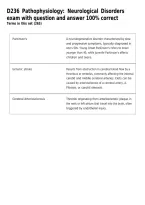
D236 Pathophysiology: Neurological Disorders
exam with question and answer 100% correct
Terms in this set (265)
Parkinson's A neurodegenerative disorder characterized by slow
and progressive symptoms, typically diagnosed in
one's 50s. Young Onset Parkinson's refers to onset
younger than 40, while Juvenile Parkinson's affects
children and teens.
Ischemic stroke Results from obstruction in cerebral blood flow by a
thrombus or embolus, commonly affecting the internal
carotid and middle cerebral arteries. Clots can be
caused by arteriosclerosis of a cerebral artery, A.
Fibrosis, or carotid stenosis.
Cerebral Arteriosclerosis Thrombi originating from arteriosclerotic plaque in
the neck or left atrium that travel into the brain, often
triggered by endothelial injury.
,A. Fib. Left-sided Atrial Fibrillation where the left atrium
inadequately contracts, increasing the risk of clot
formation.
Carotid Stenosis Arteriosclerosis of the carotid artery leading to
narrowing due to plaque buildup, promoting platelet
adherence and thrombus formation that can
obstruct blood flow.
Bradykinesia A symptom of Parkinson's characterized by slow
movements, often starting in distal muscles and
impacting independence.
Ischemia & Ischemic Penumbra Gradual onset of symptoms over hours to days due to
tissue ischemia, with survival depending on collateral
circulation and duration of ischemia. Treatment
involves restoring blood flow.
Glutamate toxicity Movement of potassium altering action potential,
leading to increased calcium influx and
glutamate release, contributing to cell
damage.
Posture Instability Loss of postural reflexes causing uncontrolled steps
forward/backward, often seen in Parkinson's.
Nonmotor Symptoms Symptoms not related to movement, including ANS-
related issues like constipation and orthostatic
hypotension, as well as sleep disturbances and
cognitive dysfunction.
Transient Ischemic Attack Temporary neurological symptoms lasting minutes
to hours, often a precursor to a stroke, caused by
sudden arterial blockage.
,Hemorrhagic Stroke Occurs when a cerebral artery ruptures, leading to
blood leakage, cerebral edema, increased pressure,
and tissue damage. Subarachnoid Hemorrhage
involves arterial branch rupture in the
subarachnoid space.
Cerebral Artery Rupture Leads to ischemia, edema, and vasospasm; may cause
Anoxic encephalopathy
Anoxic Encephalopathy Results from lack of cerebral circulation and oxygen
delivery
Cushing's Triad Symptoms include irregular respiration, bradycardia,
and hypertension
Guillain-Barre Syndrome Characterized by Acute Inflammatory demyelinating
polyradiculoneuropathy
Amyotrophic Lateral Sclerosis Rapidly progressive neurodegenerative disease
affecting motor neurons
ALS Etiology Classified as familial or sporadic; unknown cause
Axonal Neuropathy Involves acute motor or motor-sensory damage to
nerve axons
ALS Risk Factors Include heavy-metal exposure, smoking, and trauma
CMV Infections Associated with cytomegalovirus infections
Campylobacter Jejuni Linked to the etiology of certain neurological
conditions
, Peripheral Neuropathy Results in limb weakness due to autoimmune response
in nerves
Myasthenia Gravis Caused by dysfunctional Ach receptors at
neuromuscular junction
Multiple Sclerosis Epidemiology Affects young adults, more common in women, and
certain ethnicities
Ach Receptor Antibodies Lead to reduced Ach receptors and inefficient
neuromuscular transmission
Thymus Hyperplasia Associated with inefficient neuromuscular transmission
in certain disorders
MS Pathophysiology Involves autoimmune damage to CNS and peripheral
nerve myelin
MS Risk Factors Include genetic predisposition, infections, trauma, and
heavy metal exposure
MS Symptoms Varied presentation affecting muscles, vision, speech,
and swallowing
MS Worsening Factors Include stress, illness, hormonal changes, and
temperature fluctuations
MS Muscle Weakness Manifests as fatigue, weakness, and worsens with
exertion
Multiple Sclerosis Pathophysiology Activated T cells damage CNS myelin, affecting white
matter and disrupting impulse conduction.
exam with question and answer 100% correct
Terms in this set (265)
Parkinson's A neurodegenerative disorder characterized by slow
and progressive symptoms, typically diagnosed in
one's 50s. Young Onset Parkinson's refers to onset
younger than 40, while Juvenile Parkinson's affects
children and teens.
Ischemic stroke Results from obstruction in cerebral blood flow by a
thrombus or embolus, commonly affecting the internal
carotid and middle cerebral arteries. Clots can be
caused by arteriosclerosis of a cerebral artery, A.
Fibrosis, or carotid stenosis.
Cerebral Arteriosclerosis Thrombi originating from arteriosclerotic plaque in
the neck or left atrium that travel into the brain, often
triggered by endothelial injury.
,A. Fib. Left-sided Atrial Fibrillation where the left atrium
inadequately contracts, increasing the risk of clot
formation.
Carotid Stenosis Arteriosclerosis of the carotid artery leading to
narrowing due to plaque buildup, promoting platelet
adherence and thrombus formation that can
obstruct blood flow.
Bradykinesia A symptom of Parkinson's characterized by slow
movements, often starting in distal muscles and
impacting independence.
Ischemia & Ischemic Penumbra Gradual onset of symptoms over hours to days due to
tissue ischemia, with survival depending on collateral
circulation and duration of ischemia. Treatment
involves restoring blood flow.
Glutamate toxicity Movement of potassium altering action potential,
leading to increased calcium influx and
glutamate release, contributing to cell
damage.
Posture Instability Loss of postural reflexes causing uncontrolled steps
forward/backward, often seen in Parkinson's.
Nonmotor Symptoms Symptoms not related to movement, including ANS-
related issues like constipation and orthostatic
hypotension, as well as sleep disturbances and
cognitive dysfunction.
Transient Ischemic Attack Temporary neurological symptoms lasting minutes
to hours, often a precursor to a stroke, caused by
sudden arterial blockage.
,Hemorrhagic Stroke Occurs when a cerebral artery ruptures, leading to
blood leakage, cerebral edema, increased pressure,
and tissue damage. Subarachnoid Hemorrhage
involves arterial branch rupture in the
subarachnoid space.
Cerebral Artery Rupture Leads to ischemia, edema, and vasospasm; may cause
Anoxic encephalopathy
Anoxic Encephalopathy Results from lack of cerebral circulation and oxygen
delivery
Cushing's Triad Symptoms include irregular respiration, bradycardia,
and hypertension
Guillain-Barre Syndrome Characterized by Acute Inflammatory demyelinating
polyradiculoneuropathy
Amyotrophic Lateral Sclerosis Rapidly progressive neurodegenerative disease
affecting motor neurons
ALS Etiology Classified as familial or sporadic; unknown cause
Axonal Neuropathy Involves acute motor or motor-sensory damage to
nerve axons
ALS Risk Factors Include heavy-metal exposure, smoking, and trauma
CMV Infections Associated with cytomegalovirus infections
Campylobacter Jejuni Linked to the etiology of certain neurological
conditions
, Peripheral Neuropathy Results in limb weakness due to autoimmune response
in nerves
Myasthenia Gravis Caused by dysfunctional Ach receptors at
neuromuscular junction
Multiple Sclerosis Epidemiology Affects young adults, more common in women, and
certain ethnicities
Ach Receptor Antibodies Lead to reduced Ach receptors and inefficient
neuromuscular transmission
Thymus Hyperplasia Associated with inefficient neuromuscular transmission
in certain disorders
MS Pathophysiology Involves autoimmune damage to CNS and peripheral
nerve myelin
MS Risk Factors Include genetic predisposition, infections, trauma, and
heavy metal exposure
MS Symptoms Varied presentation affecting muscles, vision, speech,
and swallowing
MS Worsening Factors Include stress, illness, hormonal changes, and
temperature fluctuations
MS Muscle Weakness Manifests as fatigue, weakness, and worsens with
exertion
Multiple Sclerosis Pathophysiology Activated T cells damage CNS myelin, affecting white
matter and disrupting impulse conduction.


