
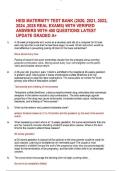
HESI Maternity Test Bank 2020, 2021, 2022, 2024 and 2025 Study Guide with Questions, Answers and Rationales
HESI Maternity Test Bank 2020, 2021, 2022, 2024 and 2025 Study Guide with Questions, Answers and Rationales Prepare for HESI maternity and maternal-newborn nursing examinations with this comprehensive study and review resource. This maternity test bank is designed to help nursing students strengthen their understanding of essential maternity concepts, practice examination-style questions, review important nursing interventions, and identify areas that require additional study. The resource provides a convenient way to review major maternity and maternal-newborn nursing topics in one place. It can be used for independent study, classroom revision, group discussions, examination preparation, and final review before a HESI-style assessment. Students can use the questions to test their knowledge of pregnancy, prenatal care, labor and delivery, postpartum nursing, newborn care, pregnancy complications, maternal health, fetal assessment, patient education, medications, and nursing interventions. The question-based format encourages active learning. Instead of simply reading textbook chapters, students can attempt questions, compare their responses with the provided answers, review rationales where available, and identify concepts that need additional attention. MATERNITY AND PRENATAL CARE The prenatal section helps students review normal pregnancy changes, maternal assessment, prenatal visits, nutritional requirements, fetal development, prenatal screening, health promotion, patient education, and common discomforts of pregnancy. Students can also review important considerations for high-risk pregnancies and recognize findings that require further assessment or intervention. PREGNANCY COMPLICATIONS Pregnancy complications are an important part of maternity nursing examinations. Review areas may include hypertensive disorders of pregnancy, gestational diabetes, bleeding during pregnancy, infections, preterm labor, premature rupture of membranes, and other high-risk conditions. The questions help students practice recognizing important assessment findings and understanding appropriate nursing priorities. LABOR AND DELIVERY The labor and delivery section focuses on the stages of labor, maternal assessment, fetal assessment, contractions, fetal heart-rate monitoring, pain management, labor support, delivery procedures, and nursing interventions. Students can practice identifying expected findings during labor and recognizing findings that may require immediate attention. Reviewing these concepts can help strengthen clinical judgment and prioritization skills. FETAL ASSESSMENT Fetal assessment is an essential component of maternity nursing. Students can review fetal heart-rate patterns, monitoring concepts, assessment findings, and appropriate nursing responses. The material provides opportunities to practice interpreting clinical information and determining which nursing action should be prioritized. POSTPARTUM NURSING Postpartum review includes maternal assessment, vital signs, uterine assessment, lochia, breast assessment, perineal care, pain management, breastfeeding support, emotional changes, postpartum complications, and discharge teaching. Students can use the questions to review normal postpartum findings as well as signs that may indicate a complication requiring additional assessment or intervention. NEWBORN CARE Newborn nursing is another important area covered in maternity examination preparation. Students can review newborn physical assessment, vital signs, thermoregulation, respiratory adaptation, feeding, elimination, cord care, newborn safety, screening procedures, and parent education. Questions may also address common newborn concerns and conditions requiring appropriate nursing care. BREASTFEEDING AND INFANT FEEDING Students can review breastfeeding education, positioning, feeding frequency, newborn nutritional needs, signs of adequate intake, common feeding concerns, and appropriate patient teaching. These concepts are useful for both maternity examinations and practical nursing care. MATERNAL MEDICATIONS Medication-related questions help students review commonly used medications and treatments in maternity nursing. Students can strengthen their understanding of medication indications, precautions, expected effects, adverse effects, and nursing responsibilities. Medication knowledge should always be reviewed together with current course materials and approved drug references. PATIENT EDUCATION Patient teaching is an important component of maternity nursing. Students can practice identifying appropriate education for pregnant patients, postpartum mothers, newborn parents, and families. Topics may include nutrition, prenatal care, warning signs, breastfeeding, newborn safety, follow-up care, medications, and discharge instructions. CLINICAL JUDGMENT AND PRIORITIZATION HESI-style nursing questions often require students to apply information to clinical situations. This resource can help students practice identifying important findings, determining priorities, selecting appropriate interventions, and recognizing when a patient requires further assessment. Students can improve their preparation by attempting questions independently before reviewing the answers and rationales. STUDY AND REVISION This resource can be used throughout a maternity nursing course or during final examination preparation. Students may divide the material into sections and study one topic at a time. For example, one study session can focus on prenatal care and pregnancy complications, another on labor and delivery, and another on postpartum and newborn care. Students can also use the questions for group study by discussing why particular answers are appropriate and reviewing the nursing principles behind each question. For final revision, students can use the resource to identify topics that remain difficult and return to their textbooks, lecture notes, and official HESI preparation materials for further study.
Document information
- Uploaded on
- September 25, 2026
- Number of pages
- 64
- Written in
- 2026/2027
- Type
- Exam (elaborations)
- Contains
- Questions & answers


