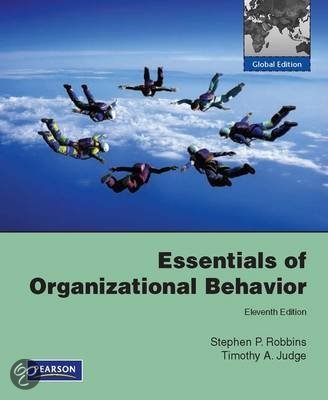
TEST BANK FOR ESSENTIALS OF
ORGANIZATIONAL BEHAVIOR,
16TH EDITION BY STEPHEN P.
ROBBINS & TIMOTHY A. JUDGE
Chapter 1: What Is Organizational Behavior?
1) The impact of what three areas are investigated in the study of Organizational Behavior?
A) Profit structure, organizational complexity, and job satisfaction
B) Individuals, profit structure, and job satisfaction
C) Individuals, groups, and job satisfaction
D) Groups, structure, and profit structure
E) Individuals, groups, and structure
Answer: E
Rationale: OB investigates the impact that individuals, groups, and structures have on behavior within
organizations.
2) Which of the following is NOT a core topic of organizational behavior?
A) Motivation
B) Attitude development
C) Conflict
D) Resource allocation
E) Work design
Answer: D
Rationale: OB includes the core topics of motivation, leader behavior and power, interpersonal
communication, group structure and processes, personality, emotions, and values, attitude
development and perception, change processes, conflict and negotiation, and work design. It does not
include resource allocation.
3) According to a study by Monster (a global employment company), the number one most frequently
desired skill in applicants was
A) ethical
B) technical
,C) communication
D) computer
E) accounting
Answer: C
Rationale: Monster mined data from nearly one million market-wide job postings to identify skills that
were most often sought by employers. At the top of the list was communication skills. This was also
reiterated by Jeff Weiner, the CEO of LinkedIn.
4) According to a recent large-scale survey, 58% of managers did NOT receive
A) pay incentives
B) training
C) administrative support
D) insurance
E) office space
Answer: B
Rationale: Fifty-eight percent of managers reported they had not received any training and 25%
admitted they were not ready to lead others when they were given the role.
5) There is a connection between companies which have ________ and their attention to
organizational behavior principles.
A) high turnover rates
B) specialized technical processes
C) superior financial performance
D) long-lasting CEOs
E) both high turnover rates and long-lasting CEOs
Answer: C
Rationale: Companies such as Lululemon, the Boston Consulting Group, LinkedIn, Zoom Video, Google,
Facebook, and Southwest Airlines all have incorporated the concepts of organizational behavior and
attribute it to their ability to generate high financial outcomes.
6) ________ is the study of the impact that individuals, groups, and structure have on behavior within
organizations.
A) Leadership
B) Organizational strategy
,C) Performance management
D) Employee relations
E) Organizational behavior
Answer: E
Rationale: Organizational behavior is the field of study that investigates the impact that individuals,
groups, and structure have on behavior within organizations, for the purpose of applying such
knowledge toward improving an organization's effectiveness.
7) What are the four main activities managers engage in?
A) Planning, budgeting, networking, hiring
B) Planning, organizing, leading, controlling
C) Controlling, innovating, hiring, quality control
D) Monitoring, scheduling, fund raising, leading
E) Interpersonal, informational, decisional, planning
Answer: B
Rationale: Managers' work can be categorized into four different activities: planning, organizing,
leading, and controlling.
8) The ultimate goal of organizational behavior is to
A) better understand management
B) improve an organization's effectiveness
C) balance diversity
D) create boilerplates
E) replace human resources
Answer: B
Rationale: OB studies the impact individuals, groups, and structure have on an organization with the
ultimate goal of improving effectiveness.
9) Which of the following is NOT a managerial activity that managers were engaged in, according to
Luthans and associates?
A) Human resource management
B) Networking
C) Communications
, D) Filing documents
E) Traditional management
Answer: D
Rationale: In Luthans and associates' study of 450 managers, traditional management, communication,
HR management, and networking were the four typical managerial activities. Filing documents was not
one of them.
10) Navar is a manager at a mid-sized consulting firm. Within Navar's role, Navar is responsible for
interacting with the other departments in the organization and with both vendors and customers of
the firm. Which of the four managerial activities is Navar exhibiting?
A) Traditional management
B) Communication
C) Human resource management
D) Networking
E) Systems
Answer: D
Rationale: Socializing, politicking, and interacting with outsiders are all networking activities that
managers do.
11) On average, managers spend most of their time doing which managerial activity?
A) Traditional management
B) Communication
C) Human resource management
D) Networking
E) Systems
Answer: A
Rationale: Thirty-two percent of a manager's time is spent doing traditional activities.
12) On average, managers spend the least amount of time doing which managerial activity?
A) Traditional management
B) Communication
C) Human resource management
D) Networking
E) Systems
ORGANIZATIONAL BEHAVIOR,
16TH EDITION BY STEPHEN P.
ROBBINS & TIMOTHY A. JUDGE
Chapter 1: What Is Organizational Behavior?
1) The impact of what three areas are investigated in the study of Organizational Behavior?
A) Profit structure, organizational complexity, and job satisfaction
B) Individuals, profit structure, and job satisfaction
C) Individuals, groups, and job satisfaction
D) Groups, structure, and profit structure
E) Individuals, groups, and structure
Answer: E
Rationale: OB investigates the impact that individuals, groups, and structures have on behavior within
organizations.
2) Which of the following is NOT a core topic of organizational behavior?
A) Motivation
B) Attitude development
C) Conflict
D) Resource allocation
E) Work design
Answer: D
Rationale: OB includes the core topics of motivation, leader behavior and power, interpersonal
communication, group structure and processes, personality, emotions, and values, attitude
development and perception, change processes, conflict and negotiation, and work design. It does not
include resource allocation.
3) According to a study by Monster (a global employment company), the number one most frequently
desired skill in applicants was
A) ethical
B) technical
,C) communication
D) computer
E) accounting
Answer: C
Rationale: Monster mined data from nearly one million market-wide job postings to identify skills that
were most often sought by employers. At the top of the list was communication skills. This was also
reiterated by Jeff Weiner, the CEO of LinkedIn.
4) According to a recent large-scale survey, 58% of managers did NOT receive
A) pay incentives
B) training
C) administrative support
D) insurance
E) office space
Answer: B
Rationale: Fifty-eight percent of managers reported they had not received any training and 25%
admitted they were not ready to lead others when they were given the role.
5) There is a connection between companies which have ________ and their attention to
organizational behavior principles.
A) high turnover rates
B) specialized technical processes
C) superior financial performance
D) long-lasting CEOs
E) both high turnover rates and long-lasting CEOs
Answer: C
Rationale: Companies such as Lululemon, the Boston Consulting Group, LinkedIn, Zoom Video, Google,
Facebook, and Southwest Airlines all have incorporated the concepts of organizational behavior and
attribute it to their ability to generate high financial outcomes.
6) ________ is the study of the impact that individuals, groups, and structure have on behavior within
organizations.
A) Leadership
B) Organizational strategy
,C) Performance management
D) Employee relations
E) Organizational behavior
Answer: E
Rationale: Organizational behavior is the field of study that investigates the impact that individuals,
groups, and structure have on behavior within organizations, for the purpose of applying such
knowledge toward improving an organization's effectiveness.
7) What are the four main activities managers engage in?
A) Planning, budgeting, networking, hiring
B) Planning, organizing, leading, controlling
C) Controlling, innovating, hiring, quality control
D) Monitoring, scheduling, fund raising, leading
E) Interpersonal, informational, decisional, planning
Answer: B
Rationale: Managers' work can be categorized into four different activities: planning, organizing,
leading, and controlling.
8) The ultimate goal of organizational behavior is to
A) better understand management
B) improve an organization's effectiveness
C) balance diversity
D) create boilerplates
E) replace human resources
Answer: B
Rationale: OB studies the impact individuals, groups, and structure have on an organization with the
ultimate goal of improving effectiveness.
9) Which of the following is NOT a managerial activity that managers were engaged in, according to
Luthans and associates?
A) Human resource management
B) Networking
C) Communications
, D) Filing documents
E) Traditional management
Answer: D
Rationale: In Luthans and associates' study of 450 managers, traditional management, communication,
HR management, and networking were the four typical managerial activities. Filing documents was not
one of them.
10) Navar is a manager at a mid-sized consulting firm. Within Navar's role, Navar is responsible for
interacting with the other departments in the organization and with both vendors and customers of
the firm. Which of the four managerial activities is Navar exhibiting?
A) Traditional management
B) Communication
C) Human resource management
D) Networking
E) Systems
Answer: D
Rationale: Socializing, politicking, and interacting with outsiders are all networking activities that
managers do.
11) On average, managers spend most of their time doing which managerial activity?
A) Traditional management
B) Communication
C) Human resource management
D) Networking
E) Systems
Answer: A
Rationale: Thirty-two percent of a manager's time is spent doing traditional activities.
12) On average, managers spend the least amount of time doing which managerial activity?
A) Traditional management
B) Communication
C) Human resource management
D) Networking
E) Systems