
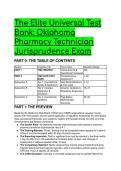
The Elite Universal Test
Bank: Oklahoma
Pharmacy Technician
Jurisprudence Exam
PART 0: THE TABLE OF CONTENTS
Section Cognitive Tier Focus Area Question Range
PART I THE PREVIEW Critical Axioms & N/A
Operational Framework
PART II THE ELITE TEST Comprehensive 1–55
BANK Assessment
Subsection A Tier 1: Foundational Hard Deck Definitions 1–18
Syntax & Application & Core Laws
Subsection B Tier 2: Complex Dynamic Variables & 19–37
Application & Regulatory Responses
Simulation
Subsection C Tier 3: Grandmaster High-Stakes 38–55
Synthesis Multi-Variable
Scenarios
PART I: THE PREVIEW
Mastering the Oklahoma State Board of Pharmacy (OSBP) jurisprudence requires moving
beyond rote memorization into the tactical application of regulatory frameworks. By internalizing
these operational thresholds, your academic mastery will translate directly into elite, error-free
clinical practice and flawless compliance.
● The Golden Ratio: An Oklahoma licensed retail pharmacy shall maintain a maximum
pharmacy technician-to-pharmacist ratio of 4:1.
● The Training Mandate: Phase I training must be completed before applying for a permit;
Phase II must be completed within 90 days of permit issuance.
● The Reporting Imperative: Theft or significant loss must be reported to the Board within
1 day, the DEA Form 106 submitted to the Board within 14 days, and changes of
employment or address reported within 10 days.
● The Competency Standard: Sterile compounding requires annual media-fill and glove
fingertip testing (semi-annually for high-risk), while immunization permits require current
CPR and 1 hour of specific CE annually.
● The CARA Exception: Schedule II controlled substances may be partially filled at the
, patient's request, but the remainder must be filled within 30 days of the written issue date
(72 hours for emergency oral prescriptions or inventory shortages).
PART II: THE ELITE TEST BANK
Tier 1 - Foundational Syntax & Application
Q1: A retail pharmacy manager is scheduling staff for the upcoming holiday weekend. Based on
the principles of the Oklahoma Pharmacy Act, what is the MAXIMUM allowable ratio of
pharmacy technicians to supervising pharmacists? A) 2:1 B) 3:1 C) 4:1 D) 6:1
● Answer: C (4:1)
● Distractor Analysis:
○ A is incorrect: This is a highly restrictive legacy ratio used in other jurisdictions but
does not apply to Oklahoma retail settings.
○ B is incorrect: This was the Oklahoma standard prior to the legislative change
effective November 1, 2025.
○ D is incorrect: This exceeds the legal supervisory limit, risking severe Board
disciplinary action for the pharmacist-in-charge (PIC).
The Mentor's Analysis: Safe delegation requires strictly defined limits. When facing staffing
shortages, the immediate priority is maintaining the 4:1 threshold. By utilizing this exact ratio,
you bypass the common trap of overextending pharmacist supervision. Professional Intuition:
Never exceed the 4:1 technician-to-pharmacist ratio under any operational duress.
Q2: An applicant is seeking employment as a pharmacy technician. Based on OAC 535
regulations, which action is the FIRST prerequisite before the applicant can legally apply for an
Oklahoma technician permit? A) Pass the Pharmacy Technician Certification Board (PTCB)
exam B) Complete Phase I didactic training C) Complete Phase II hands-on training D)
Complete 10 hours of continuing education
● Answer: B (Complete Phase I didactic training)
● Distractor Analysis:
○ A is incorrect: While employers highly value PTCB certification, Oklahoma law does
not require it for a standard technician permit.
○ C is incorrect: Phase II training occurs after the permit is issued, not before the
application.
○ D is incorrect: Continuing education is a renewal requirement for specific permits
(like immunizations), not a prerequisite for initial licensure.
The Mentor's Analysis: Regulatory sequencing is non-negotiable. When facing onboarding
protocols, the immediate priority is completing Phase I training. By utilizing this sequential
approach, you bypass the common trap of premature application rejection. Professional
Intuition: Phase I precedes the permit; Phase II follows the permit.
Q3: A newly permitted pharmacy technician begins hands-on dispensing tasks. Based on OAC
535:15-13, what is the ABSOLUTE deadline to complete Phase II training? A) 10 days after hire
B) 30 days after the permit is issued C) 90 days after the permit is issued D) By the last day of
the technician's birth month
● Answer: C (90 days after the permit is issued)
● Distractor Analysis:
○ A is incorrect: The pharmacy manager must document general training within 10
days of hire, but Phase II completion allows 90 days post-permit.
, ○ B is incorrect: 30 days is a common novice misconception regarding onboarding
periods but is not the statutory deadline.
○ D is incorrect: The birth month dictates the permit expiration/renewal date, not the
Phase II training deadline.
The Mentor's Analysis: Skill validation must occur rapidly but realistically. When facing new hire
integration, the immediate priority is closing out the training log. By utilizing the 90-day window,
you bypass the common trap of an automatically voided permit. Professional Intuition: Failure
to complete Phase II within 90 days automatically voids the technician permit.
Q4: A pharmacy technician is reviewing their permit status to ensure compliance. Based on
Oklahoma Board of Pharmacy rules, when is the EXACT expiration date of a standard
technician permit? A) December 31st annually B) Exactly one year from the date of issuance C)
The last day of the technician's birth month annually D) June 30th biennially
● Answer: C (The last day of the technician's birth month annually)
● Distractor Analysis:
○ A is incorrect: December 31st is a standard expiration for other licenses (like some
DEA registrations), not Oklahoma tech permits.
○ B is incorrect: Permits are synchronized to birth months to stagger Board
administrative workloads, not issue dates.
○ D is incorrect: Technician permits are renewed annually, not biennially.
The Mentor's Analysis: Administrative compliance requires calendar mastery. When facing
credential maintenance, the immediate priority is tracking your birth month. By utilizing this
personalized metric, you bypass the common trap of practicing on an expired permit.
Professional Intuition: Your birth month dictates your professional survival; renew before
the last day.
Q5: A high school student wishes to train as a pharmacy technician. Based on OAC 535 rules,
what is the MINIMUM age to obtain an educational-purposes permit if enrolled in a
Board-approved youth apprenticeship program? A) 16 years old B) 17 years old C) 18 years old
D) 21 years old
● Answer: B (17 years old)
● Distractor Analysis:
○ A is incorrect: 16 is below the minimum legal threshold for handling legend drugs
even in educational capacities.
○ C is incorrect: 18 is the standard minimum age, but a specific exception exists for
Board-approved CTE/apprenticeship enrollees.
○ D is incorrect: 21 is irrelevant to tech permits.
The Mentor's Analysis: Workforce pipeline development requires strict safeguards. When facing
underage applicants, the immediate priority is verifying enrollment in a Board-approved
program. By utilizing the 17-year-old educational exception, you bypass the common trap of
illegal employment. Professional Intuition: The standard age is 18; the educational
apprenticeship exception is 17.
Q6: A pharmacy technician changes jobs to work at a different retail chain. Based on OSBP
registrant conduct rules, what is the MAXIMUM timeframe allowed to notify the Board of this
employment change? A) 24 hours B) 10 days C) 14 days D) 30 days
● Answer: B (10 days)
● Distractor Analysis:
○ A is incorrect: 24 hours is the timeframe for reporting emergency pharmacy
closures, not employment changes.
○ C is incorrect: 14 days is the timeline for submitting a copy of the DEA 106 form to
Bank: Oklahoma
Pharmacy Technician
Jurisprudence Exam
PART 0: THE TABLE OF CONTENTS
Section Cognitive Tier Focus Area Question Range
PART I THE PREVIEW Critical Axioms & N/A
Operational Framework
PART II THE ELITE TEST Comprehensive 1–55
BANK Assessment
Subsection A Tier 1: Foundational Hard Deck Definitions 1–18
Syntax & Application & Core Laws
Subsection B Tier 2: Complex Dynamic Variables & 19–37
Application & Regulatory Responses
Simulation
Subsection C Tier 3: Grandmaster High-Stakes 38–55
Synthesis Multi-Variable
Scenarios
PART I: THE PREVIEW
Mastering the Oklahoma State Board of Pharmacy (OSBP) jurisprudence requires moving
beyond rote memorization into the tactical application of regulatory frameworks. By internalizing
these operational thresholds, your academic mastery will translate directly into elite, error-free
clinical practice and flawless compliance.
● The Golden Ratio: An Oklahoma licensed retail pharmacy shall maintain a maximum
pharmacy technician-to-pharmacist ratio of 4:1.
● The Training Mandate: Phase I training must be completed before applying for a permit;
Phase II must be completed within 90 days of permit issuance.
● The Reporting Imperative: Theft or significant loss must be reported to the Board within
1 day, the DEA Form 106 submitted to the Board within 14 days, and changes of
employment or address reported within 10 days.
● The Competency Standard: Sterile compounding requires annual media-fill and glove
fingertip testing (semi-annually for high-risk), while immunization permits require current
CPR and 1 hour of specific CE annually.
● The CARA Exception: Schedule II controlled substances may be partially filled at the
, patient's request, but the remainder must be filled within 30 days of the written issue date
(72 hours for emergency oral prescriptions or inventory shortages).
PART II: THE ELITE TEST BANK
Tier 1 - Foundational Syntax & Application
Q1: A retail pharmacy manager is scheduling staff for the upcoming holiday weekend. Based on
the principles of the Oklahoma Pharmacy Act, what is the MAXIMUM allowable ratio of
pharmacy technicians to supervising pharmacists? A) 2:1 B) 3:1 C) 4:1 D) 6:1
● Answer: C (4:1)
● Distractor Analysis:
○ A is incorrect: This is a highly restrictive legacy ratio used in other jurisdictions but
does not apply to Oklahoma retail settings.
○ B is incorrect: This was the Oklahoma standard prior to the legislative change
effective November 1, 2025.
○ D is incorrect: This exceeds the legal supervisory limit, risking severe Board
disciplinary action for the pharmacist-in-charge (PIC).
The Mentor's Analysis: Safe delegation requires strictly defined limits. When facing staffing
shortages, the immediate priority is maintaining the 4:1 threshold. By utilizing this exact ratio,
you bypass the common trap of overextending pharmacist supervision. Professional Intuition:
Never exceed the 4:1 technician-to-pharmacist ratio under any operational duress.
Q2: An applicant is seeking employment as a pharmacy technician. Based on OAC 535
regulations, which action is the FIRST prerequisite before the applicant can legally apply for an
Oklahoma technician permit? A) Pass the Pharmacy Technician Certification Board (PTCB)
exam B) Complete Phase I didactic training C) Complete Phase II hands-on training D)
Complete 10 hours of continuing education
● Answer: B (Complete Phase I didactic training)
● Distractor Analysis:
○ A is incorrect: While employers highly value PTCB certification, Oklahoma law does
not require it for a standard technician permit.
○ C is incorrect: Phase II training occurs after the permit is issued, not before the
application.
○ D is incorrect: Continuing education is a renewal requirement for specific permits
(like immunizations), not a prerequisite for initial licensure.
The Mentor's Analysis: Regulatory sequencing is non-negotiable. When facing onboarding
protocols, the immediate priority is completing Phase I training. By utilizing this sequential
approach, you bypass the common trap of premature application rejection. Professional
Intuition: Phase I precedes the permit; Phase II follows the permit.
Q3: A newly permitted pharmacy technician begins hands-on dispensing tasks. Based on OAC
535:15-13, what is the ABSOLUTE deadline to complete Phase II training? A) 10 days after hire
B) 30 days after the permit is issued C) 90 days after the permit is issued D) By the last day of
the technician's birth month
● Answer: C (90 days after the permit is issued)
● Distractor Analysis:
○ A is incorrect: The pharmacy manager must document general training within 10
days of hire, but Phase II completion allows 90 days post-permit.
, ○ B is incorrect: 30 days is a common novice misconception regarding onboarding
periods but is not the statutory deadline.
○ D is incorrect: The birth month dictates the permit expiration/renewal date, not the
Phase II training deadline.
The Mentor's Analysis: Skill validation must occur rapidly but realistically. When facing new hire
integration, the immediate priority is closing out the training log. By utilizing the 90-day window,
you bypass the common trap of an automatically voided permit. Professional Intuition: Failure
to complete Phase II within 90 days automatically voids the technician permit.
Q4: A pharmacy technician is reviewing their permit status to ensure compliance. Based on
Oklahoma Board of Pharmacy rules, when is the EXACT expiration date of a standard
technician permit? A) December 31st annually B) Exactly one year from the date of issuance C)
The last day of the technician's birth month annually D) June 30th biennially
● Answer: C (The last day of the technician's birth month annually)
● Distractor Analysis:
○ A is incorrect: December 31st is a standard expiration for other licenses (like some
DEA registrations), not Oklahoma tech permits.
○ B is incorrect: Permits are synchronized to birth months to stagger Board
administrative workloads, not issue dates.
○ D is incorrect: Technician permits are renewed annually, not biennially.
The Mentor's Analysis: Administrative compliance requires calendar mastery. When facing
credential maintenance, the immediate priority is tracking your birth month. By utilizing this
personalized metric, you bypass the common trap of practicing on an expired permit.
Professional Intuition: Your birth month dictates your professional survival; renew before
the last day.
Q5: A high school student wishes to train as a pharmacy technician. Based on OAC 535 rules,
what is the MINIMUM age to obtain an educational-purposes permit if enrolled in a
Board-approved youth apprenticeship program? A) 16 years old B) 17 years old C) 18 years old
D) 21 years old
● Answer: B (17 years old)
● Distractor Analysis:
○ A is incorrect: 16 is below the minimum legal threshold for handling legend drugs
even in educational capacities.
○ C is incorrect: 18 is the standard minimum age, but a specific exception exists for
Board-approved CTE/apprenticeship enrollees.
○ D is incorrect: 21 is irrelevant to tech permits.
The Mentor's Analysis: Workforce pipeline development requires strict safeguards. When facing
underage applicants, the immediate priority is verifying enrollment in a Board-approved
program. By utilizing the 17-year-old educational exception, you bypass the common trap of
illegal employment. Professional Intuition: The standard age is 18; the educational
apprenticeship exception is 17.
Q6: A pharmacy technician changes jobs to work at a different retail chain. Based on OSBP
registrant conduct rules, what is the MAXIMUM timeframe allowed to notify the Board of this
employment change? A) 24 hours B) 10 days C) 14 days D) 30 days
● Answer: B (10 days)
● Distractor Analysis:
○ A is incorrect: 24 hours is the timeframe for reporting emergency pharmacy
closures, not employment changes.
○ C is incorrect: 14 days is the timeline for submitting a copy of the DEA 106 form to


