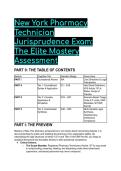
New York Pharmacy
Technician
Jurisprudence Exam:
The Elite Mastery
Assessment
PART 0: THE TABLE OF CONTENTS
Section Cognitive Tier Question Range Focus Area
PART I Foundational Axioms N/A Core Directives & Legal
Frameworks
PART II Tier 1: Foundational Q1 – Q18 Hard Deck Definitions,
Syntax & Application NYS Article 137-A,
Ratios, Scope of
Practice
PART II Tier 2: Complex Q19 – Q37 Scenario-Based Triage,
Application & Code A-F Limits, PMP
Simulation Mandates, NYCRR
Part 80
PART II Tier 3: Grandmaster Q38 – Q55 Multi-Variable Legal
Synthesis Synthesis,
Telepharmacy,
Institutional
Compliance
PART I: THE PREVIEW
Mastery of New York pharmacy jurisprudence is not merely about memorizing statutes; it is
about protecting the public and shielding the pharmacy from catastrophic liability. By
internalizing the rigid structures of Article 137-A and Title 10 NYCRR Part 80, you forge an
analytical framework that translates directly to elite operational competence.
● Critical Axioms:
○ The Scope Mandate: Registered Pharmacy Technicians (Article 137-A) may assist
in compounding, preparing, labeling, and dispensing under direct pharmacist
supervision; unlicensed personnel may never compound.
, ○ The Ratio Law: A New York pharmacist may supervise a maximum of two (2)
Registered Pharmacy Technicians performing licensed duties, with a hard cap of
four (4) total staff if the remaining two are unlicensed personnel.
○ The Island of I-STOP: Registered Pharmacy Technicians are strictly prohibited by
law from being designated to consult the Prescription Monitoring Program (PMP)
registry on behalf of a pharmacist; this task is reserved for pharmacists and
licensed pharmacy interns.
○ The Transfer Boundary: New York State regulations dictate that pharmacies may
only transfer one refill at a time to another pharmacy, keeping all remaining refills
at the originating pharmacy.
○ The 5-Year Rule: All prescription records, controlled substance inventory records,
and loss reports (DOH-2094) must be maintained and readily retrievable for exactly
five (5) years.
PART II: THE ELITE TEST BANK
Q1: An independent community pharmacy in New York employs a pharmacist, two licensed
pharmacy interns, two Registered Pharmacy Technicians, and one unlicensed clerk. Based on
the principles of New York State Education Law Article 137, which conclusion regarding staffing
ratios is the MOST ACCURATE? A) The pharmacy is in violation because a pharmacist may
only supervise two total assisting personnel at any time. B) The pharmacy is in compliance
because pharmacy interns do not count toward the unlicensed or technician supervision ratios.
C) The pharmacy is in violation because the total number of non-pharmacist staff exceeds four
individuals. D) The pharmacy is in compliance because the pharmacist is permitted to supervise
up to four Registered Pharmacy Technicians simultaneously.
● Answer: B (The pharmacy is in compliance because pharmacy interns do not count
toward the unlicensed or technician supervision ratios.)
● Distractor Analysis:
○ A is incorrect: A pharmacist may supervise up to four individuals total, provided no
more than two are performing Registered Pharmacy Technician duties.
○ C is incorrect: Pharmacy interns are legally exempt from the strict
unlicensed/technician supervisory ratio limits in New York.
○ D is incorrect: A pharmacist may never supervise four Registered Pharmacy
Technicians performing licensed tasks; the limit is firmly capped at two.
The Mentor's Analysis: New York law rigidly defines the supervisory span of control to ensure
patient safety. When assessing staffing ratios, the immediate priority is identifying the licensure
status of the personnel. By utilizing the intern exemption rule, you bypass the common trap of
miscalculating the four-person hard cap. Professional Intuition: Interns are exempt from the
2:4 ratio calculus.
Q2: A patient presents a prescription for alprazolam (Schedule IV) to a New York pharmacy. The
prescription was written exactly 45 days ago. Based on the principles of Title 10 NYCRR Part
80, which action is REQUIRED? A) Dispense the medication, as Schedule IV prescriptions
remain valid for 6 months. B) Dispense the medication only after contacting the prescriber to
verify the intent. C) Refuse the prescription, as it is invalid because it was presented more than
30 days after the date of issuance. D) Transfer the prescription to a pharmacy located in a
bordering state where 60-day validity applies.
● Answer: C (Refuse the prescription, as it is invalid because it was presented more than 30
, days after the date of issuance.)
● Distractor Analysis:
○ A is incorrect: New York law dictates that all controlled substance prescriptions
(Schedules II-V) expire 30 days from the date of issuance for the initial fill.
○ B is incorrect: A pharmacist cannot validate an expired controlled substance
prescription via verbal confirmation; a newly generated prescription is required.
○ D is incorrect: Transferring an invalid, expired prescription to evade state law is an
egregious violation of federal and state jurisprudence.
The Mentor's Analysis: Unlike federal law or other states where Schedule III-V prescriptions
may be valid for up to six months, New York implements a draconian 30-day expiration window
for the initial fill of all controlled substance prescriptions. When evaluating Rx validity, the
immediate priority is checking the issuance date against the 30-day mandate. By utilizing
state-specific limits, you bypass the common trap of applying looser federal standards.
Professional Intuition: In New York, the clock stops at 30 days for every single controlled
substance prescription's initial fill.
Q3: A pharmacist is overwhelmed during a peak rush and asks the Registered Pharmacy
Technician to quickly log into the Health Commerce System to check a patient's controlled
substance history. Based on the principles of the I-STOP mandate, which action is the FIRST
priority? A) The technician must log in using their own credentials to maintain an audit trail. B)
The technician must log in using the pharmacist's credentials, provided it is documented. C) The
technician must refuse, as only licensed pharmacy interns or other pharmacists may be
designated to access the PMP. D) The technician must refuse, as only the prescribing physician
can access the PMP prior to dispensing.
● Answer: C (The technician must refuse, as only licensed pharmacy interns or other
pharmacists may be designated to access the PMP.)
● Distractor Analysis:
○ A is incorrect: Technicians are legally barred from accessing the PMP registry in
New York, regardless of credentialing.
○ B is incorrect: Sharing credentials is a severe HIPAA and state security violation,
compounding the unauthorized access violation.
○ D is incorrect: While prescribers must consult the PMP, pharmacists are also
authorized and encouraged to do so, but they may only delegate this to another
pharmacist or an intern.
The Mentor's Analysis: The Prescription Monitoring Program (PMP) contains highly sensitive
data. When designating tasks, the immediate priority is confirming delegation legality. By
utilizing the strict PMP access hierarchy, you bypass the common trap of assuming technicians
hold broad administrative access. Professional Intuition: Technicians cannot touch the
PMP; the delegation boundary stops at the pharmacy intern.
Q4: A pharmacy discovers that 100 tablets of Oxycodone 10mg are missing from the safe.
Based on the principles of the Bureau of Narcotic Enforcement (BNE), which action is the MOST
APPROPRIATE? A) Submit form DOH-2094 to the BNE within 30 days of discovery. B) Submit
form DOH-2094 to the BNE within one business day of discovery. C) Submit DEA Form 106 to
the BNE within 14 days of discovery. D) Document the loss in the biennial inventory log and
alert local law enforcement within one week.
● Answer: B (Submit form DOH-2094 to the BNE within one business day of discovery.)
● Distractor Analysis:
○ A is incorrect: 30 days is a dangerous delay; New York requires immediate
reporting for missing controlled substances.
Technician
Jurisprudence Exam:
The Elite Mastery
Assessment
PART 0: THE TABLE OF CONTENTS
Section Cognitive Tier Question Range Focus Area
PART I Foundational Axioms N/A Core Directives & Legal
Frameworks
PART II Tier 1: Foundational Q1 – Q18 Hard Deck Definitions,
Syntax & Application NYS Article 137-A,
Ratios, Scope of
Practice
PART II Tier 2: Complex Q19 – Q37 Scenario-Based Triage,
Application & Code A-F Limits, PMP
Simulation Mandates, NYCRR
Part 80
PART II Tier 3: Grandmaster Q38 – Q55 Multi-Variable Legal
Synthesis Synthesis,
Telepharmacy,
Institutional
Compliance
PART I: THE PREVIEW
Mastery of New York pharmacy jurisprudence is not merely about memorizing statutes; it is
about protecting the public and shielding the pharmacy from catastrophic liability. By
internalizing the rigid structures of Article 137-A and Title 10 NYCRR Part 80, you forge an
analytical framework that translates directly to elite operational competence.
● Critical Axioms:
○ The Scope Mandate: Registered Pharmacy Technicians (Article 137-A) may assist
in compounding, preparing, labeling, and dispensing under direct pharmacist
supervision; unlicensed personnel may never compound.
, ○ The Ratio Law: A New York pharmacist may supervise a maximum of two (2)
Registered Pharmacy Technicians performing licensed duties, with a hard cap of
four (4) total staff if the remaining two are unlicensed personnel.
○ The Island of I-STOP: Registered Pharmacy Technicians are strictly prohibited by
law from being designated to consult the Prescription Monitoring Program (PMP)
registry on behalf of a pharmacist; this task is reserved for pharmacists and
licensed pharmacy interns.
○ The Transfer Boundary: New York State regulations dictate that pharmacies may
only transfer one refill at a time to another pharmacy, keeping all remaining refills
at the originating pharmacy.
○ The 5-Year Rule: All prescription records, controlled substance inventory records,
and loss reports (DOH-2094) must be maintained and readily retrievable for exactly
five (5) years.
PART II: THE ELITE TEST BANK
Q1: An independent community pharmacy in New York employs a pharmacist, two licensed
pharmacy interns, two Registered Pharmacy Technicians, and one unlicensed clerk. Based on
the principles of New York State Education Law Article 137, which conclusion regarding staffing
ratios is the MOST ACCURATE? A) The pharmacy is in violation because a pharmacist may
only supervise two total assisting personnel at any time. B) The pharmacy is in compliance
because pharmacy interns do not count toward the unlicensed or technician supervision ratios.
C) The pharmacy is in violation because the total number of non-pharmacist staff exceeds four
individuals. D) The pharmacy is in compliance because the pharmacist is permitted to supervise
up to four Registered Pharmacy Technicians simultaneously.
● Answer: B (The pharmacy is in compliance because pharmacy interns do not count
toward the unlicensed or technician supervision ratios.)
● Distractor Analysis:
○ A is incorrect: A pharmacist may supervise up to four individuals total, provided no
more than two are performing Registered Pharmacy Technician duties.
○ C is incorrect: Pharmacy interns are legally exempt from the strict
unlicensed/technician supervisory ratio limits in New York.
○ D is incorrect: A pharmacist may never supervise four Registered Pharmacy
Technicians performing licensed tasks; the limit is firmly capped at two.
The Mentor's Analysis: New York law rigidly defines the supervisory span of control to ensure
patient safety. When assessing staffing ratios, the immediate priority is identifying the licensure
status of the personnel. By utilizing the intern exemption rule, you bypass the common trap of
miscalculating the four-person hard cap. Professional Intuition: Interns are exempt from the
2:4 ratio calculus.
Q2: A patient presents a prescription for alprazolam (Schedule IV) to a New York pharmacy. The
prescription was written exactly 45 days ago. Based on the principles of Title 10 NYCRR Part
80, which action is REQUIRED? A) Dispense the medication, as Schedule IV prescriptions
remain valid for 6 months. B) Dispense the medication only after contacting the prescriber to
verify the intent. C) Refuse the prescription, as it is invalid because it was presented more than
30 days after the date of issuance. D) Transfer the prescription to a pharmacy located in a
bordering state where 60-day validity applies.
● Answer: C (Refuse the prescription, as it is invalid because it was presented more than 30
, days after the date of issuance.)
● Distractor Analysis:
○ A is incorrect: New York law dictates that all controlled substance prescriptions
(Schedules II-V) expire 30 days from the date of issuance for the initial fill.
○ B is incorrect: A pharmacist cannot validate an expired controlled substance
prescription via verbal confirmation; a newly generated prescription is required.
○ D is incorrect: Transferring an invalid, expired prescription to evade state law is an
egregious violation of federal and state jurisprudence.
The Mentor's Analysis: Unlike federal law or other states where Schedule III-V prescriptions
may be valid for up to six months, New York implements a draconian 30-day expiration window
for the initial fill of all controlled substance prescriptions. When evaluating Rx validity, the
immediate priority is checking the issuance date against the 30-day mandate. By utilizing
state-specific limits, you bypass the common trap of applying looser federal standards.
Professional Intuition: In New York, the clock stops at 30 days for every single controlled
substance prescription's initial fill.
Q3: A pharmacist is overwhelmed during a peak rush and asks the Registered Pharmacy
Technician to quickly log into the Health Commerce System to check a patient's controlled
substance history. Based on the principles of the I-STOP mandate, which action is the FIRST
priority? A) The technician must log in using their own credentials to maintain an audit trail. B)
The technician must log in using the pharmacist's credentials, provided it is documented. C) The
technician must refuse, as only licensed pharmacy interns or other pharmacists may be
designated to access the PMP. D) The technician must refuse, as only the prescribing physician
can access the PMP prior to dispensing.
● Answer: C (The technician must refuse, as only licensed pharmacy interns or other
pharmacists may be designated to access the PMP.)
● Distractor Analysis:
○ A is incorrect: Technicians are legally barred from accessing the PMP registry in
New York, regardless of credentialing.
○ B is incorrect: Sharing credentials is a severe HIPAA and state security violation,
compounding the unauthorized access violation.
○ D is incorrect: While prescribers must consult the PMP, pharmacists are also
authorized and encouraged to do so, but they may only delegate this to another
pharmacist or an intern.
The Mentor's Analysis: The Prescription Monitoring Program (PMP) contains highly sensitive
data. When designating tasks, the immediate priority is confirming delegation legality. By
utilizing the strict PMP access hierarchy, you bypass the common trap of assuming technicians
hold broad administrative access. Professional Intuition: Technicians cannot touch the
PMP; the delegation boundary stops at the pharmacy intern.
Q4: A pharmacy discovers that 100 tablets of Oxycodone 10mg are missing from the safe.
Based on the principles of the Bureau of Narcotic Enforcement (BNE), which action is the MOST
APPROPRIATE? A) Submit form DOH-2094 to the BNE within 30 days of discovery. B) Submit
form DOH-2094 to the BNE within one business day of discovery. C) Submit DEA Form 106 to
the BNE within 14 days of discovery. D) Document the loss in the biennial inventory log and
alert local law enforcement within one week.
● Answer: B (Submit form DOH-2094 to the BNE within one business day of discovery.)
● Distractor Analysis:
○ A is incorrect: 30 days is a dangerous delay; New York requires immediate
reporting for missing controlled substances.