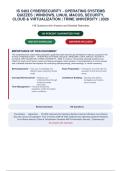
IS 5403 CYBERSECURITY - OPERATING SYSTEMS
QUIZZES | WINDOWS, LINUX, MACOS, SECURITY,
CLOUD & VIRTUALIZATION | TRINE UNIVERSITY | 2026
149 Questions with Answers and Detailed Rationales
100 PERCENT GUARANTEED PASS
INSTANT DOWNLOAD ANSWERS INCLUDED
IMPORTANCE OF THIS DOCUMENT
This comprehensive examination preparation guide has been meticulously developed to help you succeed in the
IS 5403 CYBERSECURITY - OPERATING SYSTEMS QUIZZES | WINDOWS, LINUX, MACOS, SECURITY,
CLOUD & VIRTUALIZATION | TRINE UNIVERSITY | 2026. It contains 149 carefully selected questions that
reflect the most current exam content and testing strategies. Each question is accompanied by a correct answer
and a detailed rationale that explains the underlying pathophysiology, pharmacology, or clinical reasoning.
Self-Assessment – Test your knowledge and Exam Preparation – Familiarize yourself with the
identify areas requiring further question format and content
study areas
Concept Reinforcement – Deepen your Confidence Building – Develop test-taking
understanding through strategies and reduce
evidence-based exam anxiety
rationales
Time Management – Practice answering
questions under simulated
exam conditions
Review Summary 149 Questions
Foundations - Application - IS 5403 Cybersecurity Operating Systems Quizzes Windows Linux Macos
Security Cloud & Virtualization Trine University 2026 IS 5403 Cybersecurity Operating Systems Windows
Linux Macos Security Cloud & Virtualization Graduate MS IN Information Security / Cybersecurity
All answers with rationales
,Table of Contents
Content Area Questions Key Topics
Windows Operating System 1-25 Linux, Windows, Process, Security, Server
Fundamentals AND Security
Linux Operating System 26-50 Windows, Administrator, Linux, Security, Cloud
Fundamentals AND Security
Macos Operating System 51-75 Security, Linux, Windows, Feature, Macos
Fundamentals AND Security
Operating System Security 76-100 Security, Linux, Windows, Wants, Administrator
Principles AND Access
Control
Cloud Computing Security 101-125 Security, Windows, Wants, Macos, Administrator
AND Shared Responsibility
Virtualization Technologies 126-149 Security, Hypervisor, Linux, System, Windows
AND Security
TOTAL 149 All questions include answers and detailed rationales
,Section A - Windows Operating System Fundamentals
AND Security
Q1.
A Linux server must enforce that only the process owning a file can change its
permissions, even if another user has write access to the directory. Which file attribute
should be set?
A. Set the sticky bit (chmod +t) on the B. Set the immutable attribute (chattr +i) on
directory. the file.
C. Set the setgid bit (chmod g+s) on the D. Set the append-only attribute (chattr +a)
directory. on the file.
Correct: A - Set the sticky bit (chmod +t) on the directory.
Rationale:The sticky bit on a directory restricts deletion and renaming of files to the file
owner, directory owner, or root-directly enforcing the stated requirement.
Immutable/append-only attributes affect file modification, not permission changes by others.
Setgid controls group inheritance, not ownership-based permission control.
Why the other answers are wrong:
B. Immutable prevents file modification but does not restrict who can change permissions.
C. Setgid only ensures new files inherit the directory's group; it does not limit permission
changes.
D. Append-only allows additions but does not prevent permission changes by other users.
Reference: Nemeth, E. et al. (2025). UNIX and Linux System Administration Handbook, 6th Ed., Ch. 5.
Q2.
In Windows, which mechanism primarily prevents a standard user from injecting code into
a high-integrity process?
A. User Account Control (UAC) elevation B. Mandatory Integrity Control (MIC)
prompt
C. BitLocker drive encryption D. Credential Guard
Correct: B - Mandatory Integrity Control (MIC)
Rationale:Mandatory Integrity Control assigns integrity levels and enforces no-write-up,
blocking lower-integrity processes from modifying higher-integrity ones. UAC governs
elevation, not cross-integrity writes. BitLocker protects data at rest, and Credential Guard
isolates secrets, not process injection.
Why the other answers are wrong:
A. UAC handles privilege elevation, not integrity-based write restrictions between processes.
Page 3
, Section A - Windows Operating System Fundamentals AND Security
C. BitLocker encrypts volumes; it does not mediate process integrity.
D. Credential Guard protects credential material, not process memory integrity.
Reference: Microsoft (2025). Windows Internals, 8th Ed., Part 1, Ch. 7.
Q3.
Which macOS feature enforces code signing and runtime hardening for all executables,
even those launched outside the App Store?
A. System Integrity Protection (SIP) B. Gatekeeper
C. Notarization D. FileVault
Correct: B - Gatekeeper
Rationale:Gatekeeper verifies code signatures and notarization for all executables,
regardless of distribution channel. SIP protects system files, not general executables.
Notarization is a prerequisite checked by Gatekeeper, and FileVault provides disk encryption.
Why the other answers are wrong:
A. SIP restricts modifications to protected system paths, not general executable signing.
C. Notarization is a developer submission process; Gatekeeper enforces it at launch.
D. FileVault encrypts the startup disk and does not validate code signatures.
Reference: Apple (2025). macOS Security Guide: Gatekeeper and Runtime Protection.
Q4.
A cloud tenant needs strong isolation between workloads while minimizing hypervisor
attack surface. Which approach best aligns with NIST SP 800-190?
A. Run all workloads in privileged containers B. Use Type 1 hypervisors with
on a shared kernel. hardware-assisted virtualization and
separate VMs per tenant.
C. Deploy Type 2 hypervisors on D. Rely on OS-level namespaces alone for
general-purpose OSes for flexibility. multi-tenant separation.
Correct: B - Use Type 1 hypervisors with hardware-assisted virtualization and separate
VMs per tenant.
Rationale:Type 1 hypervisors with hardware virtualization (Intel VT-x/AMD-V) provide strong
isolation and a smaller attack surface, as recommended by NIST SP 800-190. Privileged
containers and namespaces share the kernel, weakening isolation. Type 2 hypervisors add
overhead and a larger attack surface.
Why the other answers are wrong:
A. Privileged containers share the host kernel, increasing breakout risk.
C. Type 2 hypervisors run atop a general OS, expanding the attack surface.
D. Namespaces alone do not provide strong isolation for hostile multi-tenancy.
Page 4
QUIZZES | WINDOWS, LINUX, MACOS, SECURITY,
CLOUD & VIRTUALIZATION | TRINE UNIVERSITY | 2026
149 Questions with Answers and Detailed Rationales
100 PERCENT GUARANTEED PASS
INSTANT DOWNLOAD ANSWERS INCLUDED
IMPORTANCE OF THIS DOCUMENT
This comprehensive examination preparation guide has been meticulously developed to help you succeed in the
IS 5403 CYBERSECURITY - OPERATING SYSTEMS QUIZZES | WINDOWS, LINUX, MACOS, SECURITY,
CLOUD & VIRTUALIZATION | TRINE UNIVERSITY | 2026. It contains 149 carefully selected questions that
reflect the most current exam content and testing strategies. Each question is accompanied by a correct answer
and a detailed rationale that explains the underlying pathophysiology, pharmacology, or clinical reasoning.
Self-Assessment – Test your knowledge and Exam Preparation – Familiarize yourself with the
identify areas requiring further question format and content
study areas
Concept Reinforcement – Deepen your Confidence Building – Develop test-taking
understanding through strategies and reduce
evidence-based exam anxiety
rationales
Time Management – Practice answering
questions under simulated
exam conditions
Review Summary 149 Questions
Foundations - Application - IS 5403 Cybersecurity Operating Systems Quizzes Windows Linux Macos
Security Cloud & Virtualization Trine University 2026 IS 5403 Cybersecurity Operating Systems Windows
Linux Macos Security Cloud & Virtualization Graduate MS IN Information Security / Cybersecurity
All answers with rationales
,Table of Contents
Content Area Questions Key Topics
Windows Operating System 1-25 Linux, Windows, Process, Security, Server
Fundamentals AND Security
Linux Operating System 26-50 Windows, Administrator, Linux, Security, Cloud
Fundamentals AND Security
Macos Operating System 51-75 Security, Linux, Windows, Feature, Macos
Fundamentals AND Security
Operating System Security 76-100 Security, Linux, Windows, Wants, Administrator
Principles AND Access
Control
Cloud Computing Security 101-125 Security, Windows, Wants, Macos, Administrator
AND Shared Responsibility
Virtualization Technologies 126-149 Security, Hypervisor, Linux, System, Windows
AND Security
TOTAL 149 All questions include answers and detailed rationales
,Section A - Windows Operating System Fundamentals
AND Security
Q1.
A Linux server must enforce that only the process owning a file can change its
permissions, even if another user has write access to the directory. Which file attribute
should be set?
A. Set the sticky bit (chmod +t) on the B. Set the immutable attribute (chattr +i) on
directory. the file.
C. Set the setgid bit (chmod g+s) on the D. Set the append-only attribute (chattr +a)
directory. on the file.
Correct: A - Set the sticky bit (chmod +t) on the directory.
Rationale:The sticky bit on a directory restricts deletion and renaming of files to the file
owner, directory owner, or root-directly enforcing the stated requirement.
Immutable/append-only attributes affect file modification, not permission changes by others.
Setgid controls group inheritance, not ownership-based permission control.
Why the other answers are wrong:
B. Immutable prevents file modification but does not restrict who can change permissions.
C. Setgid only ensures new files inherit the directory's group; it does not limit permission
changes.
D. Append-only allows additions but does not prevent permission changes by other users.
Reference: Nemeth, E. et al. (2025). UNIX and Linux System Administration Handbook, 6th Ed., Ch. 5.
Q2.
In Windows, which mechanism primarily prevents a standard user from injecting code into
a high-integrity process?
A. User Account Control (UAC) elevation B. Mandatory Integrity Control (MIC)
prompt
C. BitLocker drive encryption D. Credential Guard
Correct: B - Mandatory Integrity Control (MIC)
Rationale:Mandatory Integrity Control assigns integrity levels and enforces no-write-up,
blocking lower-integrity processes from modifying higher-integrity ones. UAC governs
elevation, not cross-integrity writes. BitLocker protects data at rest, and Credential Guard
isolates secrets, not process injection.
Why the other answers are wrong:
A. UAC handles privilege elevation, not integrity-based write restrictions between processes.
Page 3
, Section A - Windows Operating System Fundamentals AND Security
C. BitLocker encrypts volumes; it does not mediate process integrity.
D. Credential Guard protects credential material, not process memory integrity.
Reference: Microsoft (2025). Windows Internals, 8th Ed., Part 1, Ch. 7.
Q3.
Which macOS feature enforces code signing and runtime hardening for all executables,
even those launched outside the App Store?
A. System Integrity Protection (SIP) B. Gatekeeper
C. Notarization D. FileVault
Correct: B - Gatekeeper
Rationale:Gatekeeper verifies code signatures and notarization for all executables,
regardless of distribution channel. SIP protects system files, not general executables.
Notarization is a prerequisite checked by Gatekeeper, and FileVault provides disk encryption.
Why the other answers are wrong:
A. SIP restricts modifications to protected system paths, not general executable signing.
C. Notarization is a developer submission process; Gatekeeper enforces it at launch.
D. FileVault encrypts the startup disk and does not validate code signatures.
Reference: Apple (2025). macOS Security Guide: Gatekeeper and Runtime Protection.
Q4.
A cloud tenant needs strong isolation between workloads while minimizing hypervisor
attack surface. Which approach best aligns with NIST SP 800-190?
A. Run all workloads in privileged containers B. Use Type 1 hypervisors with
on a shared kernel. hardware-assisted virtualization and
separate VMs per tenant.
C. Deploy Type 2 hypervisors on D. Rely on OS-level namespaces alone for
general-purpose OSes for flexibility. multi-tenant separation.
Correct: B - Use Type 1 hypervisors with hardware-assisted virtualization and separate
VMs per tenant.
Rationale:Type 1 hypervisors with hardware virtualization (Intel VT-x/AMD-V) provide strong
isolation and a smaller attack surface, as recommended by NIST SP 800-190. Privileged
containers and namespaces share the kernel, weakening isolation. Type 2 hypervisors add
overhead and a larger attack surface.
Why the other answers are wrong:
A. Privileged containers share the host kernel, increasing breakout risk.
C. Type 2 hypervisors run atop a general OS, expanding the attack surface.
D. Namespaces alone do not provide strong isolation for hostile multi-tenancy.
Page 4