
BIOD 171 — Essential Microbiology | Module 2 Examination Portage Learning | 2026/2027
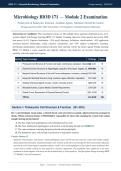
Microbiology BIOD 171 — Module 2 Examination
Prokaryotic & Eukaryotic Structure, Acellular Agents, Nutrition, Growth & Control
Portage Learning | Actual Exam | 100 Questions | Verified Answers & Rationales
Instructions to Candidates: This examination consists of 100 multiple-choice questions distributed across seven
sections aligned with Portage Learning BIOD 171 Module 2 learning objectives. Each question has exactly ONE
best answer (A–D). Cognitive distribution: ~35% recall (structures, definitions, classifications), ~45% application
(structure–function relationships, media selection, calculations), and ~20% analysis (comparative reasoning,
growth-data interpretation, control-method selection). Each rationale verifies the answer against Portage Learning
BIOD 171 Module 2 course materials and explicitly addresses why distractors are incorrect. Read each stem
carefully; select the single best response.
Section Topic Coverage Q Range Items
1 Prokaryotic Cell Structure & Function (cell walls, membranes, cytoplasm, ribosomes)
Q1–Q16 16
2 Bacterial Surface Structures & Appendages (capsules, slime layers, flagella, pili, Q17–Q32
fimbriae) 16
3 Bacterial Internal Structures & Survival Forms (endospores, inclusions, nucleoid) Q33–Q46 14
4 Eukaryotic Microbial Structure (fungi, protozoa, algae, helminths, organelles) Q47–Q62 16
5 Acellular Infectious Agents (viruses, viroids, virusoids, prions) Q63–Q78 16
6 Microbial Nutrition, Culture Media & Growth Requirements Q79–Q90 12
7 Growth Curve, Enumeration & Physical/Chemical Control Q91–Q100 10
TOTAL Q1–Q100 100
Section 1: Prokaryotic Cell Structure & Function (Q1–Q16)
Q1: A microbiologist Gram-stains a clinical throat swab and observes purple, spherical bacteria arranged in
chains. Which structural feature is PRIMARILY responsible for these cells retaining the crystal violet–iodine
complex during decolorization?
A. The thin, single-layer peptidoglycan with embedded teichoic acids
B. The thick, multilayered peptidoglycan with teichoic acids threading through it [CORRECT]
C. The outer membrane containing lipopolysaccharide and phospholipids
D. The periplasmic space with its high concentration of degradative enzymes
Correct Answer: B
Rationale: Gram-positive cells possess a thick peptidoglycan layer (20–80 nm) that traps the crystal violet–iodine complex
during ethanol decolorization, retaining the purple color. Teichoic acids interwoven through this thick mesh further dehydrate
and seal the wall. Gram-negative organisms (options A and C) have a thin peptidoglycan layer plus an outer membrane; their
crystal violet is readily washed out and replaced by safranin counterstain. The periplasmic space (option D) is far more
prominent in Gram-negative cells and is not the structural basis of Gram positivity. Verified against Portage Learning BIOD
171 Module 2 cell-wall comparison.
Page 1 | Actual Exam — Verified Answers & Rationales
,BIOD 171 — Essential Microbiology | Module 2 Examination Portage Learning | 2026/2027
Q2: Which molecule, unique to the outer membrane of Gram-negative bacteria, is responsible for endotoxic
shock when released into the human bloodstream during bacterial lysis?
A. Teichoic acid
B. Lipoteichoic acid
C. Lipopolysaccharide (LPS) [CORRECT]
D. Mycolic acid
Correct Answer: C
Rationale: Lipopolysaccharide (LPS), specifically its lipid A moiety, is the endotoxin that triggers TLR4-mediated
inflammatory cytokine release and septic shock. LPS is found ONLY in the Gram-negative outer membrane. Teichoic and
lipoteichoic acids (options A, B) are Gram-positive wall polymers that do not cause endotoxic shock. Mycolic acids (option D)
are wax-like components of acid-fast cell walls (e.g., Mycobacterium), not LPS. Verified against BIOD 171 Module 2
Gram-negative outer membrane content.
Q3: The LPS molecule of a Gram-negative bacterium is correctly described as containing three covalently
linked regions. Which ordered set lists them from the most exterior (environment-facing) to the most interior
(membrane-embedded) portion?
A. Lipid A → Core polysaccharide → O antigen
B. O antigen → Core polysaccharide → Lipid A [CORRECT]
C. Core polysaccharide → O antigen → Lipid A
D. Lipid A → O antigen → Core polysaccharide
Correct Answer: B
Rationale: The LPS structure, from exterior to interior, is: O antigen (variable repeating sugar units, used for serotyping) →
core polysaccharide (relatively conserved) → lipid A (the membrane-embedded endotoxic moiety anchored into the outer
membrane). Lipid A is the innermost portion and is the actual toxin. Options A, C, and D scramble this ordering. Verified
against BIOD 171 Module 2 LPS structural description.
Q4: A student fixes a smear of an unknown bacillus, applies crystal violet, then iodine, then alcohol, and finally
safranin. The smear appears pink under oil immersion. The MOST accurate interpretation is that the
organism:
A. Is Gram-positive because the crystal violet was retained
B. Is Gram-negative because crystal violet was decolorized and safranin counterstain became visible [CORRECT]
C. Is acid-fast because it resisted decolorization by acid-alcohol
D. Lacks a cell wall and therefore cannot be Gram-stained
Correct Answer: B
Rationale: Pink/red appearance after the full Gram sequence indicates the crystal violet–iodine complex was washed out
during ethanol decolorization and the cells then took up the safranin counterstain. This is the hallmark of Gram-negative
bacteria, whose thin peptidoglycan cannot retain the dye. Gram-positive cells would appear purple (option A). Acid-fast
staining (option C) is a separate procedure using carbolfuchsin and acid-alcohol. Cell-wall-deficient organisms (option D)
such as Mycoplasma stain poorly and irregularly, not uniformly pink. Verified against BIOD 171 Module 2 Gram stain
protocol.
Page 2 | Actual Exam — Verified Answers & Rationales
,BIOD 171 — Essential Microbiology | Module 2 Examination Portage Learning | 2026/2027
Q5: Teichoic acids are ionized polymers found covalently linked to N-acetylmuramic acid and, in their
lipoteichoic form, to the cytoplasmic membrane. In which organismal group are these molecules a diagnostic
feature?
A. Gram-negative rods only
B. Acid-fast bacilli only
C. Gram-positive bacteria [CORRECT]
D. Archaea
Correct Answer: C
Rationale: Teichoic acids (wall teichoic acids and lipoteichoic acids) are diagnostic polymers of Gram-positive cell walls.
Wall teichoic acids link to peptidoglycan, while lipoteichoic acids span to the cytoplasmic membrane. They contribute to wall
rigidity, antigenicity, and adhesion. Gram-negative cells (option A) lack teichoic acids; instead they have LPS in the outer
membrane. Acid-fast bacteria (option B) contain mycolic acids. Archaea (option D) have pseudopeptidoglycan with
different sugar and linkage chemistry. Verified against BIOD 171 Module 2 Gram-positive wall composition.
Q6: The bacterial cytoplasmic membrane is best described as a fluid phospholipid bilayer in which integral
proteins are embedded. Which chemical feature of phospholipids allows the bilayer to remain stable yet fluid at
physiological temperature?
A. Ester-linked linear hydrocarbon chains and a polar phosphate head group [CORRECT]
B. Ether-linked branched isoprenoid chains and a non-polar head group
C. Peptide cross-links between adjacent lipid tails
D. Covalent disulfide bonds between head groups
Correct Answer: A
Rationale: Bacterial phospholipids consist of a glycerol backbone ester-linked to two fatty acid tails (hydrophobic,
inward-facing) and a negatively charged phosphate-containing head group (hydrophilic, outward-facing). This amphipathic
structure spontaneously forms a bilayer in aqueous environments while remaining fluid. Option B describes archaeal
ether-linked isoprenoid lipids, not bacterial. Options C and D do not occur in membrane phospholipids. Verified against
BIOD 171 Module 2 membrane structure.
Q7: Which transport mechanism allows a bacterium to accumulate glucose against its concentration gradient
by coupling glucose movement to the downhill movement of previously imported sodium ions?
A. Simple diffusion
B. Facilitated diffusion
C. Group translocation (phosphotransferase system)
D. Symport using a concentration gradient [CORRECT]
Correct Answer: D
Rationale: Symport is a form of secondary active transport that moves two solutes in the same direction; one (Na+) moves
down its gradient, providing energy to drive the other (glucose) up its gradient. Simple diffusion (A) and facilitated diffusion
(B) cannot concentrate solutes against gradients. Group translocation (C), such as the bacterial phosphotransferase system,
chemically modifies glucose to glucose-6-phosphate during import — different from Na+-coupled symport. Verified against
BIOD 171 Module 2 transport mechanisms.
Page 3 | Actual Exam — Verified Answers & Rationales
, BIOD 171 — Essential Microbiology | Module 2 Examination Portage Learning | 2026/2027
Q8: A laboratory strain of E. coli is grown in medium containing lactose as the sole carbon source. Analysis
reveals lactose is transported into the cell and chemically modified to lactose-6-phosphate during passage.
Which transport system is operating?
A. Symport with H+
B. ABC transporter using ATP
C. Group translocation via the phosphotransferase system (PTS) [CORRECT]
D. Facilitated diffusion through a porin
Correct Answer: C
Rationale: The bacterial phosphotransferase system (PTS) is the prototype of group translocation: the solute is chemically
modified (phosphorylated) during transport, which traps it inside the cell and prevents efflux. Lactose uptake in enteric
bacteria is a classic PTS application. Symport (A) and ABC transporters (B) do not chemically modify the substrate.
Facilitated diffusion (D) is passive and only moves solutes down their gradient. Verified against BIOD 171 Module 2
active-transport comparison.
Q9: The nucleoid of a prokaryotic cell differs from a eukaryotic nucleus in which of the following ways?
A. It is surrounded by a double-membrane nuclear envelope with pores
B. It consists of a single circular chromosome associated with histone-like proteins but lacking a membrane
[CORRECT]
C. It contains multiple linear chromosomes packaged with true histones
D. It contains 80S ribosomes bound to its outer surface
Correct Answer: B
Rationale: The prokaryotic nucleoid is an irregularly shaped region of the cytoplasm containing the single circular
chromosome, associated with histone-like proteins (HU, H-NS) but NOT enclosed by a nuclear membrane. Option A
describes a eukaryotic nucleus. Option C is incorrect: prokaryotes typically have ONE circular chromosome, not multiple
linear ones, and lack true histones. Option D confuses the prokaryotic nucleoid with the eukaryotic rough ER. Verified
against BIOD 171 Module 2 nucleoid structure.
Q10: A small, circular, extrachromosomal DNA molecule carrying a gene for beta-lactamase is transferred
from one E. coli cell to another by conjugation. What is the MOST accurate name for this DNA element?
A. Chromosomal episome
B. Plasmid [CORRECT]
C. Transposon
D. Integron
Correct Answer: B
Rationale: Plasmids are small, circular, self-replicating extrachromosomal DNA molecules that frequently carry accessory
genes such as antibiotic resistance (e.g., beta-lactamase). Many plasmids can transfer via conjugation. A transposon (C) is a
mobile DNA segment that moves within/between DNA molecules; an integron (D) is a gene-capture element. Although some
plasmids can integrate into the chromosome and be called episomes (A), the most general and accurate term here is plasmid.
Verified against BIOD 171 Module 2 plasmid content.
Page 4 | Actual Exam — Verified Answers & Rationales
Microbiology BIOD 171 — Module 2 Examination
Prokaryotic & Eukaryotic Structure, Acellular Agents, Nutrition, Growth & Control
Portage Learning | Actual Exam | 100 Questions | Verified Answers & Rationales
Instructions to Candidates: This examination consists of 100 multiple-choice questions distributed across seven
sections aligned with Portage Learning BIOD 171 Module 2 learning objectives. Each question has exactly ONE
best answer (A–D). Cognitive distribution: ~35% recall (structures, definitions, classifications), ~45% application
(structure–function relationships, media selection, calculations), and ~20% analysis (comparative reasoning,
growth-data interpretation, control-method selection). Each rationale verifies the answer against Portage Learning
BIOD 171 Module 2 course materials and explicitly addresses why distractors are incorrect. Read each stem
carefully; select the single best response.
Section Topic Coverage Q Range Items
1 Prokaryotic Cell Structure & Function (cell walls, membranes, cytoplasm, ribosomes)
Q1–Q16 16
2 Bacterial Surface Structures & Appendages (capsules, slime layers, flagella, pili, Q17–Q32
fimbriae) 16
3 Bacterial Internal Structures & Survival Forms (endospores, inclusions, nucleoid) Q33–Q46 14
4 Eukaryotic Microbial Structure (fungi, protozoa, algae, helminths, organelles) Q47–Q62 16
5 Acellular Infectious Agents (viruses, viroids, virusoids, prions) Q63–Q78 16
6 Microbial Nutrition, Culture Media & Growth Requirements Q79–Q90 12
7 Growth Curve, Enumeration & Physical/Chemical Control Q91–Q100 10
TOTAL Q1–Q100 100
Section 1: Prokaryotic Cell Structure & Function (Q1–Q16)
Q1: A microbiologist Gram-stains a clinical throat swab and observes purple, spherical bacteria arranged in
chains. Which structural feature is PRIMARILY responsible for these cells retaining the crystal violet–iodine
complex during decolorization?
A. The thin, single-layer peptidoglycan with embedded teichoic acids
B. The thick, multilayered peptidoglycan with teichoic acids threading through it [CORRECT]
C. The outer membrane containing lipopolysaccharide and phospholipids
D. The periplasmic space with its high concentration of degradative enzymes
Correct Answer: B
Rationale: Gram-positive cells possess a thick peptidoglycan layer (20–80 nm) that traps the crystal violet–iodine complex
during ethanol decolorization, retaining the purple color. Teichoic acids interwoven through this thick mesh further dehydrate
and seal the wall. Gram-negative organisms (options A and C) have a thin peptidoglycan layer plus an outer membrane; their
crystal violet is readily washed out and replaced by safranin counterstain. The periplasmic space (option D) is far more
prominent in Gram-negative cells and is not the structural basis of Gram positivity. Verified against Portage Learning BIOD
171 Module 2 cell-wall comparison.
Page 1 | Actual Exam — Verified Answers & Rationales
,BIOD 171 — Essential Microbiology | Module 2 Examination Portage Learning | 2026/2027
Q2: Which molecule, unique to the outer membrane of Gram-negative bacteria, is responsible for endotoxic
shock when released into the human bloodstream during bacterial lysis?
A. Teichoic acid
B. Lipoteichoic acid
C. Lipopolysaccharide (LPS) [CORRECT]
D. Mycolic acid
Correct Answer: C
Rationale: Lipopolysaccharide (LPS), specifically its lipid A moiety, is the endotoxin that triggers TLR4-mediated
inflammatory cytokine release and septic shock. LPS is found ONLY in the Gram-negative outer membrane. Teichoic and
lipoteichoic acids (options A, B) are Gram-positive wall polymers that do not cause endotoxic shock. Mycolic acids (option D)
are wax-like components of acid-fast cell walls (e.g., Mycobacterium), not LPS. Verified against BIOD 171 Module 2
Gram-negative outer membrane content.
Q3: The LPS molecule of a Gram-negative bacterium is correctly described as containing three covalently
linked regions. Which ordered set lists them from the most exterior (environment-facing) to the most interior
(membrane-embedded) portion?
A. Lipid A → Core polysaccharide → O antigen
B. O antigen → Core polysaccharide → Lipid A [CORRECT]
C. Core polysaccharide → O antigen → Lipid A
D. Lipid A → O antigen → Core polysaccharide
Correct Answer: B
Rationale: The LPS structure, from exterior to interior, is: O antigen (variable repeating sugar units, used for serotyping) →
core polysaccharide (relatively conserved) → lipid A (the membrane-embedded endotoxic moiety anchored into the outer
membrane). Lipid A is the innermost portion and is the actual toxin. Options A, C, and D scramble this ordering. Verified
against BIOD 171 Module 2 LPS structural description.
Q4: A student fixes a smear of an unknown bacillus, applies crystal violet, then iodine, then alcohol, and finally
safranin. The smear appears pink under oil immersion. The MOST accurate interpretation is that the
organism:
A. Is Gram-positive because the crystal violet was retained
B. Is Gram-negative because crystal violet was decolorized and safranin counterstain became visible [CORRECT]
C. Is acid-fast because it resisted decolorization by acid-alcohol
D. Lacks a cell wall and therefore cannot be Gram-stained
Correct Answer: B
Rationale: Pink/red appearance after the full Gram sequence indicates the crystal violet–iodine complex was washed out
during ethanol decolorization and the cells then took up the safranin counterstain. This is the hallmark of Gram-negative
bacteria, whose thin peptidoglycan cannot retain the dye. Gram-positive cells would appear purple (option A). Acid-fast
staining (option C) is a separate procedure using carbolfuchsin and acid-alcohol. Cell-wall-deficient organisms (option D)
such as Mycoplasma stain poorly and irregularly, not uniformly pink. Verified against BIOD 171 Module 2 Gram stain
protocol.
Page 2 | Actual Exam — Verified Answers & Rationales
,BIOD 171 — Essential Microbiology | Module 2 Examination Portage Learning | 2026/2027
Q5: Teichoic acids are ionized polymers found covalently linked to N-acetylmuramic acid and, in their
lipoteichoic form, to the cytoplasmic membrane. In which organismal group are these molecules a diagnostic
feature?
A. Gram-negative rods only
B. Acid-fast bacilli only
C. Gram-positive bacteria [CORRECT]
D. Archaea
Correct Answer: C
Rationale: Teichoic acids (wall teichoic acids and lipoteichoic acids) are diagnostic polymers of Gram-positive cell walls.
Wall teichoic acids link to peptidoglycan, while lipoteichoic acids span to the cytoplasmic membrane. They contribute to wall
rigidity, antigenicity, and adhesion. Gram-negative cells (option A) lack teichoic acids; instead they have LPS in the outer
membrane. Acid-fast bacteria (option B) contain mycolic acids. Archaea (option D) have pseudopeptidoglycan with
different sugar and linkage chemistry. Verified against BIOD 171 Module 2 Gram-positive wall composition.
Q6: The bacterial cytoplasmic membrane is best described as a fluid phospholipid bilayer in which integral
proteins are embedded. Which chemical feature of phospholipids allows the bilayer to remain stable yet fluid at
physiological temperature?
A. Ester-linked linear hydrocarbon chains and a polar phosphate head group [CORRECT]
B. Ether-linked branched isoprenoid chains and a non-polar head group
C. Peptide cross-links between adjacent lipid tails
D. Covalent disulfide bonds between head groups
Correct Answer: A
Rationale: Bacterial phospholipids consist of a glycerol backbone ester-linked to two fatty acid tails (hydrophobic,
inward-facing) and a negatively charged phosphate-containing head group (hydrophilic, outward-facing). This amphipathic
structure spontaneously forms a bilayer in aqueous environments while remaining fluid. Option B describes archaeal
ether-linked isoprenoid lipids, not bacterial. Options C and D do not occur in membrane phospholipids. Verified against
BIOD 171 Module 2 membrane structure.
Q7: Which transport mechanism allows a bacterium to accumulate glucose against its concentration gradient
by coupling glucose movement to the downhill movement of previously imported sodium ions?
A. Simple diffusion
B. Facilitated diffusion
C. Group translocation (phosphotransferase system)
D. Symport using a concentration gradient [CORRECT]
Correct Answer: D
Rationale: Symport is a form of secondary active transport that moves two solutes in the same direction; one (Na+) moves
down its gradient, providing energy to drive the other (glucose) up its gradient. Simple diffusion (A) and facilitated diffusion
(B) cannot concentrate solutes against gradients. Group translocation (C), such as the bacterial phosphotransferase system,
chemically modifies glucose to glucose-6-phosphate during import — different from Na+-coupled symport. Verified against
BIOD 171 Module 2 transport mechanisms.
Page 3 | Actual Exam — Verified Answers & Rationales
, BIOD 171 — Essential Microbiology | Module 2 Examination Portage Learning | 2026/2027
Q8: A laboratory strain of E. coli is grown in medium containing lactose as the sole carbon source. Analysis
reveals lactose is transported into the cell and chemically modified to lactose-6-phosphate during passage.
Which transport system is operating?
A. Symport with H+
B. ABC transporter using ATP
C. Group translocation via the phosphotransferase system (PTS) [CORRECT]
D. Facilitated diffusion through a porin
Correct Answer: C
Rationale: The bacterial phosphotransferase system (PTS) is the prototype of group translocation: the solute is chemically
modified (phosphorylated) during transport, which traps it inside the cell and prevents efflux. Lactose uptake in enteric
bacteria is a classic PTS application. Symport (A) and ABC transporters (B) do not chemically modify the substrate.
Facilitated diffusion (D) is passive and only moves solutes down their gradient. Verified against BIOD 171 Module 2
active-transport comparison.
Q9: The nucleoid of a prokaryotic cell differs from a eukaryotic nucleus in which of the following ways?
A. It is surrounded by a double-membrane nuclear envelope with pores
B. It consists of a single circular chromosome associated with histone-like proteins but lacking a membrane
[CORRECT]
C. It contains multiple linear chromosomes packaged with true histones
D. It contains 80S ribosomes bound to its outer surface
Correct Answer: B
Rationale: The prokaryotic nucleoid is an irregularly shaped region of the cytoplasm containing the single circular
chromosome, associated with histone-like proteins (HU, H-NS) but NOT enclosed by a nuclear membrane. Option A
describes a eukaryotic nucleus. Option C is incorrect: prokaryotes typically have ONE circular chromosome, not multiple
linear ones, and lack true histones. Option D confuses the prokaryotic nucleoid with the eukaryotic rough ER. Verified
against BIOD 171 Module 2 nucleoid structure.
Q10: A small, circular, extrachromosomal DNA molecule carrying a gene for beta-lactamase is transferred
from one E. coli cell to another by conjugation. What is the MOST accurate name for this DNA element?
A. Chromosomal episome
B. Plasmid [CORRECT]
C. Transposon
D. Integron
Correct Answer: B
Rationale: Plasmids are small, circular, self-replicating extrachromosomal DNA molecules that frequently carry accessory
genes such as antibiotic resistance (e.g., beta-lactamase). Many plasmids can transfer via conjugation. A transposon (C) is a
mobile DNA segment that moves within/between DNA molecules; an integron (D) is a gene-capture element. Although some
plasmids can integrate into the chromosome and be called episomes (A), the most general and accurate term here is plasmid.
Verified against BIOD 171 Module 2 plasmid content.
Page 4 | Actual Exam — Verified Answers & Rationales


