
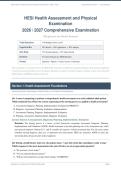
HESI Health Assessment and Physical Examination Comprehensive Exam | 130 Questions
HESI Health Assessment and Physical
Examination
Comprehensive Examination
With Questions and Detailed Rationales
Total Questions 130 Multiple Choice (A-D)
Cognitive Mix 30% Recall • 50% Application • 20% Analysis
Item Style 75% Scenario-Based • 25% Direct Recall
Sections 9 Content Domains per HESI Blueprint
Format Question + Options + Correct Answer + Rationale
This examination is structured to mirror the HESI Health Assessment and Physical Examination blueprint. Each item tests application
of nursing assessment principles across the lifespan. Rationales incorporate assessment-sequence rationale, normal versus abnormal
differentiation, and HESI test-taking strategy cues.
Section 1: Health Assessment Foundations
Nursing Process, Interviewing, Health History, and Cultural Considerations
Q1: A nurse is preparing to perform a comprehensive health assessment on a newly admitted adult patient.
Which statement best reflects the correct sequencing of the nursing process as applied to health assessment?
A. Assessment, Diagnosis, Planning, Implementation, Evaluation [CORRECT]
B. Diagnosis, Assessment, Planning, Evaluation, Implementation
C. Assessment, Planning, Diagnosis, Implementation, Evaluation
D. Planning, Assessment, Implementation, Diagnosis, Evaluation
Correct Answer: A. Assessment, Diagnosis, Planning, Implementation, Evaluation
Rationale: The nursing process is a linear, cyclical framework comprising Assessment, Diagnosis, Planning,
Implementation, and Evaluation (ADPIE). Health assessment is the data-gathering arm of the Assessment step, which
must precede diagnosis. Options B, C, and D scramble the sequence; without assessment data first, the nurse cannot
formulate nursing diagnoses, plan care, or implement safe interventions. HESI cue: memorize ADPIE in order; the
assessment phase always precedes clinical judgment.
Q2: During a health history interview, the patient states, "I just feel awful, like something is really wrong."
Which response by the nurse demonstrates the most effective use of an open-ended question?
A. "Do you have a fever today?"
B. "Are you experiencing any nausea?"
C. "Tell me more about how you have been feeling." [CORRECT]
Questions & Answers with Detailed Rationales Page 1
,HESI Health Assessment and Physical Examination Comprehensive Exam | 130 Questions
D. "Have you been taking your medications as prescribed?"
Correct Answer: C. "Tell me more about how you have been feeling."
Rationale: Open-ended questions invite the patient to elaborate in their own words and are the cornerstone of
therapeutic interviewing. Option C encourages narrative description of symptoms without limiting the response.
Options A, B, and D are closed (yes/no) questions that constrain the patient's response and are appropriate only when
collecting specific focused data. HESI cue: open-ended first, then closed for clarification; use silence to encourage
further disclosure.
Q3: A 68-year-old male patient says, "There is no point in continuing these tests. I am just going to die
anyway." Which is the most therapeutic nursing response?
A. "Don't talk like that; you have a lot to live for."
B. "You sound discouraged. Tell me what is making you feel this way." [CORRECT]
C. "I will notify the provider that you want to stop testing."
D. "Most patients with your diagnosis do quite well with treatment."
Correct Answer: B. "You sound discouraged. Tell me what is making you feel this way."
Rationale: Option B uses reflection and an open-ended prompt to validate the patient's feelings and encourage
exploration without judgment or false reassurance. Option A is dismissive (false reassurance), Option C acts
prematurely without clarifying the patient's meaning, and Option D offers generalized reassurance that minimizes the
patient's experience. HESI cue: therapeutic communication prioritizes acknowledgment of feeling before
problem-solving.
Q4: A nurse is interviewing a patient who is angry, pacing the room, and shouting. Which action should the
nurse take first to maintain a therapeutic environment?
A. Call security and ask the patient to sit down immediately.
B. Stand between the patient and the door to block the exit.
C. Maintain a calm demeanor, ensure personal safety, and set clear, respectful limits. [CORRECT]
D. Leave the room quietly without saying anything to avoid escalation.
Correct Answer: C. Maintain a calm demeanor, ensure personal safety, and set clear, respectful limits.
Rationale: When a patient is escalating, the nurse must first ensure safety (self and patient), maintain a calm
nonthreatening posture, and set behavioral limits respectfully. Option A is confrontational and may escalate. Option B
is physically threatening and could be interpreted as assaultive. Option D abandons the patient without therapeutic
communication. HESI cue: with an angry patient, stay calm, maintain distance, keep an exit accessible, and use verbal
de-escalation.
Q5: When obtaining biographical data during a comprehensive health history, which piece of information is
most essential for the nurse to collect first?
A. Occupation and education level
B. Patient's full name, date of birth, and a verified identifier [CORRECT]
C. Insurance information and emergency contact
D. Religious affiliation and primary language
Correct Answer: B. Patient's full name, date of birth, and a verified identifier
Rationale: Biographical data begins with patient identification using at least two identifiers (e.g., full name and date of
birth) per Joint Commission National Patient Safety Goals. Without correct identification, every subsequent assessment
Questions & Answers with Detailed Rationales Page 2
,HESI Health Assessment and Physical Examination Comprehensive Exam | 130 Questions
and intervention is unsafe. Options A, C, and D provide useful contextual data but are secondary to identity
verification. HESI cue: patient safety standards require two-identifier verification before any assessment or care.
Q6: A patient presents to the emergency department stating, "I have had chest pressure for the past 3 hours."
The nurse documents this as the chief complaint. Which statement best describes the purpose of the chief
complaint?
A. It is the nurse's interpretation of the patient's primary medical diagnosis.
B. It is the patient's own statement of the reason for seeking care, recorded in quotes. [CORRECT]
C. It is the primary care provider's working diagnosis after the physical exam.
D. It is the most urgent nursing diagnosis identified during triage.
Correct Answer: B. It is the patient's own statement of the reason for seeking care, recorded in quotes.
Rationale: The chief complaint is a brief, direct statement of the patient's primary reason for seeking care, ideally
recorded in the patient's own words using quotation marks. It is not a diagnosis or interpretation. Options A, C, and D
confuse the chief complaint with diagnostic conclusions. The chief complaint guides the focus of the history of present
illness (HPI) and the entire encounter. HESI cue: always quote the patient verbatim and avoid medical jargon.
Q7: A nurse is exploring the history of present illness (HPI) for a patient with abdominal pain. Which
framework should the nurse use to ensure a complete characterization of the symptom?
A. SBAR (Situation, Background, Assessment, Recommendation)
B. OLDCARTS (Onset, Location, Duration, Character, Aggravating/Alleviating, Radiation, Timing, Severity)
[CORRECT]
C. PQRST (Provokes, Quality, Radiation, Severity, Time)
D. SOAP (Subjective, Objective, Assessment, Plan)
Correct Answer: B. OLDCARTS (Onset, Location, Duration, Character, Aggravating/Alleviating,
Radiation, Timing, Severity)
Rationale: OLDCARTS is a comprehensive symptom analysis framework capturing onset, location, duration,
character, aggravating/alleviating factors, radiation, timing, and severity. Option A (SBAR) is for handoff
communication. Option C (PQRST) overlaps but is less comprehensive than OLDCARTS. Option D (SOAP) is a
documentation format, not a symptom analysis tool. HESI cue: OLDCARTS ensures every symptom dimension is
explored before physical exam.
Q8: When eliciting a past medical history (PMH), which question most directly gathers information about
adult immunization status?
A. "Have you ever been hospitalized overnight?"
B. "Have you received the influenza and pneumococcal vaccines as recommended?" [CORRECT]
C. "Do you have any allergies to medications or foods?"
D. "What childhood illnesses did you have, such as chickenpox or measles?"
Correct Answer: B. "Have you received the influenza and pneumococcal vaccines as recommended?"
Rationale: Past medical history includes childhood illnesses, adult illness, hospitalizations, surgeries, injuries,
immunizations, allergies, and last exam date. Option B directly addresses adult immunizations, a key PMH element and
important health promotion indicator. Options A and D address hospitalizations and childhood illnesses respectively,
not immunization status. Option C addresses allergies, a separate PMH subsection. HESI cue: immunization history is
frequently tested; ask specifically about influenza, pneumococcal, Tdap, zoster, and COVID-19 vaccines.
Questions & Answers with Detailed Rationales Page 3
, HESI Health Assessment and Physical Examination Comprehensive Exam | 130 Questions
Q9: A nurse is taking a family history. To be thorough, the nurse should document the health status of which
relatives at minimum?
A. Only the patient's parents
B. Only the patient's siblings and children
C. Parents, siblings, children, grandparents, and aunts/uncles, including age and cause of death if deceased
[CORRECT]
D. The patient's spouse and spouse's parents
Correct Answer: C. Parents, siblings, children, grandparents, and aunts/uncles, including age and
cause of death if deceased
Rationale: A complete family history includes at least three generations: parents, siblings, children, grandparents, and
aunts/uncles, with notation of age, living status, and cause of death. This identifies familial patterns of conditions such
as cardiovascular disease, diabetes, cancer, and genetic disorders. Options A, B, and D are incomplete subsets. HESI
cue: use a genogram to visualize inheritance patterns and identify risk stratification.
Q10: When performing a review of systems (ROS), the nurse asks the patient about frequent headaches,
dizziness, and vision changes. Which body system is being reviewed?
A. Cardiovascular
B. Neurological [CORRECT]
C. Gastrointestinal
D. Musculoskeletal
Correct Answer: B. Neurological
Rationale: Headaches, dizziness, and vision changes are symptoms of the neurological system, which also encompasses
syncope, weakness, numbness, seizures, and mental status changes. The ROS is a systematic head-to-toe questioning
about common symptoms in each body system. Options A, C, and D represent other systems (cardiovascular includes
chest pain and palpitations; gastrointestinal includes nausea and abdominal pain; musculoskeletal includes joint pain and
stiffness). HESI cue: organize ROS by body system to avoid omissions.
Q11: A nurse is caring for a patient whose cultural background differs from their own. The nurse wishes to
use the LEARN model to enhance cultural competence. Which action corresponds to the "A" in LEARN?
A. Acknowledge the patient's cultural beliefs as legitimate and valid [CORRECT]
B. Advise the patient to follow the standard medical plan only
C. Argue against the patient's cultural practices if they conflict with care
D. Assess the patient's financial resources and insurance status
Correct Answer: A. Acknowledge the patient's cultural beliefs as legitimate and valid
Rationale: The LEARN model stands for Listen, Explain, Acknowledge, Recommend, and Negotiate. "Acknowledge"
means recognizing the patient's cultural beliefs and practices as legitimate and incorporating them into care planning.
Options B and C are culturally insensitive and counter-therapeutic. Option D addresses financial assessment, not
cultural acknowledgment. HESI cue: LEARN is a core cultural-competence communication tool and is frequently
tested.
Q12: A nurse is assessing a patient who recently emigrated from Southeast Asia and has been using herbal
remedies for joint pain. Which statement best reflects culturally competent assessment?
A. "Herbal remedies are not scientifically proven; you should stop using them immediately."
Questions & Answers with Detailed Rationales Page 4
HESI Health Assessment and Physical
Examination
Comprehensive Examination
With Questions and Detailed Rationales
Total Questions 130 Multiple Choice (A-D)
Cognitive Mix 30% Recall • 50% Application • 20% Analysis
Item Style 75% Scenario-Based • 25% Direct Recall
Sections 9 Content Domains per HESI Blueprint
Format Question + Options + Correct Answer + Rationale
This examination is structured to mirror the HESI Health Assessment and Physical Examination blueprint. Each item tests application
of nursing assessment principles across the lifespan. Rationales incorporate assessment-sequence rationale, normal versus abnormal
differentiation, and HESI test-taking strategy cues.
Section 1: Health Assessment Foundations
Nursing Process, Interviewing, Health History, and Cultural Considerations
Q1: A nurse is preparing to perform a comprehensive health assessment on a newly admitted adult patient.
Which statement best reflects the correct sequencing of the nursing process as applied to health assessment?
A. Assessment, Diagnosis, Planning, Implementation, Evaluation [CORRECT]
B. Diagnosis, Assessment, Planning, Evaluation, Implementation
C. Assessment, Planning, Diagnosis, Implementation, Evaluation
D. Planning, Assessment, Implementation, Diagnosis, Evaluation
Correct Answer: A. Assessment, Diagnosis, Planning, Implementation, Evaluation
Rationale: The nursing process is a linear, cyclical framework comprising Assessment, Diagnosis, Planning,
Implementation, and Evaluation (ADPIE). Health assessment is the data-gathering arm of the Assessment step, which
must precede diagnosis. Options B, C, and D scramble the sequence; without assessment data first, the nurse cannot
formulate nursing diagnoses, plan care, or implement safe interventions. HESI cue: memorize ADPIE in order; the
assessment phase always precedes clinical judgment.
Q2: During a health history interview, the patient states, "I just feel awful, like something is really wrong."
Which response by the nurse demonstrates the most effective use of an open-ended question?
A. "Do you have a fever today?"
B. "Are you experiencing any nausea?"
C. "Tell me more about how you have been feeling." [CORRECT]
Questions & Answers with Detailed Rationales Page 1
,HESI Health Assessment and Physical Examination Comprehensive Exam | 130 Questions
D. "Have you been taking your medications as prescribed?"
Correct Answer: C. "Tell me more about how you have been feeling."
Rationale: Open-ended questions invite the patient to elaborate in their own words and are the cornerstone of
therapeutic interviewing. Option C encourages narrative description of symptoms without limiting the response.
Options A, B, and D are closed (yes/no) questions that constrain the patient's response and are appropriate only when
collecting specific focused data. HESI cue: open-ended first, then closed for clarification; use silence to encourage
further disclosure.
Q3: A 68-year-old male patient says, "There is no point in continuing these tests. I am just going to die
anyway." Which is the most therapeutic nursing response?
A. "Don't talk like that; you have a lot to live for."
B. "You sound discouraged. Tell me what is making you feel this way." [CORRECT]
C. "I will notify the provider that you want to stop testing."
D. "Most patients with your diagnosis do quite well with treatment."
Correct Answer: B. "You sound discouraged. Tell me what is making you feel this way."
Rationale: Option B uses reflection and an open-ended prompt to validate the patient's feelings and encourage
exploration without judgment or false reassurance. Option A is dismissive (false reassurance), Option C acts
prematurely without clarifying the patient's meaning, and Option D offers generalized reassurance that minimizes the
patient's experience. HESI cue: therapeutic communication prioritizes acknowledgment of feeling before
problem-solving.
Q4: A nurse is interviewing a patient who is angry, pacing the room, and shouting. Which action should the
nurse take first to maintain a therapeutic environment?
A. Call security and ask the patient to sit down immediately.
B. Stand between the patient and the door to block the exit.
C. Maintain a calm demeanor, ensure personal safety, and set clear, respectful limits. [CORRECT]
D. Leave the room quietly without saying anything to avoid escalation.
Correct Answer: C. Maintain a calm demeanor, ensure personal safety, and set clear, respectful limits.
Rationale: When a patient is escalating, the nurse must first ensure safety (self and patient), maintain a calm
nonthreatening posture, and set behavioral limits respectfully. Option A is confrontational and may escalate. Option B
is physically threatening and could be interpreted as assaultive. Option D abandons the patient without therapeutic
communication. HESI cue: with an angry patient, stay calm, maintain distance, keep an exit accessible, and use verbal
de-escalation.
Q5: When obtaining biographical data during a comprehensive health history, which piece of information is
most essential for the nurse to collect first?
A. Occupation and education level
B. Patient's full name, date of birth, and a verified identifier [CORRECT]
C. Insurance information and emergency contact
D. Religious affiliation and primary language
Correct Answer: B. Patient's full name, date of birth, and a verified identifier
Rationale: Biographical data begins with patient identification using at least two identifiers (e.g., full name and date of
birth) per Joint Commission National Patient Safety Goals. Without correct identification, every subsequent assessment
Questions & Answers with Detailed Rationales Page 2
,HESI Health Assessment and Physical Examination Comprehensive Exam | 130 Questions
and intervention is unsafe. Options A, C, and D provide useful contextual data but are secondary to identity
verification. HESI cue: patient safety standards require two-identifier verification before any assessment or care.
Q6: A patient presents to the emergency department stating, "I have had chest pressure for the past 3 hours."
The nurse documents this as the chief complaint. Which statement best describes the purpose of the chief
complaint?
A. It is the nurse's interpretation of the patient's primary medical diagnosis.
B. It is the patient's own statement of the reason for seeking care, recorded in quotes. [CORRECT]
C. It is the primary care provider's working diagnosis after the physical exam.
D. It is the most urgent nursing diagnosis identified during triage.
Correct Answer: B. It is the patient's own statement of the reason for seeking care, recorded in quotes.
Rationale: The chief complaint is a brief, direct statement of the patient's primary reason for seeking care, ideally
recorded in the patient's own words using quotation marks. It is not a diagnosis or interpretation. Options A, C, and D
confuse the chief complaint with diagnostic conclusions. The chief complaint guides the focus of the history of present
illness (HPI) and the entire encounter. HESI cue: always quote the patient verbatim and avoid medical jargon.
Q7: A nurse is exploring the history of present illness (HPI) for a patient with abdominal pain. Which
framework should the nurse use to ensure a complete characterization of the symptom?
A. SBAR (Situation, Background, Assessment, Recommendation)
B. OLDCARTS (Onset, Location, Duration, Character, Aggravating/Alleviating, Radiation, Timing, Severity)
[CORRECT]
C. PQRST (Provokes, Quality, Radiation, Severity, Time)
D. SOAP (Subjective, Objective, Assessment, Plan)
Correct Answer: B. OLDCARTS (Onset, Location, Duration, Character, Aggravating/Alleviating,
Radiation, Timing, Severity)
Rationale: OLDCARTS is a comprehensive symptom analysis framework capturing onset, location, duration,
character, aggravating/alleviating factors, radiation, timing, and severity. Option A (SBAR) is for handoff
communication. Option C (PQRST) overlaps but is less comprehensive than OLDCARTS. Option D (SOAP) is a
documentation format, not a symptom analysis tool. HESI cue: OLDCARTS ensures every symptom dimension is
explored before physical exam.
Q8: When eliciting a past medical history (PMH), which question most directly gathers information about
adult immunization status?
A. "Have you ever been hospitalized overnight?"
B. "Have you received the influenza and pneumococcal vaccines as recommended?" [CORRECT]
C. "Do you have any allergies to medications or foods?"
D. "What childhood illnesses did you have, such as chickenpox or measles?"
Correct Answer: B. "Have you received the influenza and pneumococcal vaccines as recommended?"
Rationale: Past medical history includes childhood illnesses, adult illness, hospitalizations, surgeries, injuries,
immunizations, allergies, and last exam date. Option B directly addresses adult immunizations, a key PMH element and
important health promotion indicator. Options A and D address hospitalizations and childhood illnesses respectively,
not immunization status. Option C addresses allergies, a separate PMH subsection. HESI cue: immunization history is
frequently tested; ask specifically about influenza, pneumococcal, Tdap, zoster, and COVID-19 vaccines.
Questions & Answers with Detailed Rationales Page 3
, HESI Health Assessment and Physical Examination Comprehensive Exam | 130 Questions
Q9: A nurse is taking a family history. To be thorough, the nurse should document the health status of which
relatives at minimum?
A. Only the patient's parents
B. Only the patient's siblings and children
C. Parents, siblings, children, grandparents, and aunts/uncles, including age and cause of death if deceased
[CORRECT]
D. The patient's spouse and spouse's parents
Correct Answer: C. Parents, siblings, children, grandparents, and aunts/uncles, including age and
cause of death if deceased
Rationale: A complete family history includes at least three generations: parents, siblings, children, grandparents, and
aunts/uncles, with notation of age, living status, and cause of death. This identifies familial patterns of conditions such
as cardiovascular disease, diabetes, cancer, and genetic disorders. Options A, B, and D are incomplete subsets. HESI
cue: use a genogram to visualize inheritance patterns and identify risk stratification.
Q10: When performing a review of systems (ROS), the nurse asks the patient about frequent headaches,
dizziness, and vision changes. Which body system is being reviewed?
A. Cardiovascular
B. Neurological [CORRECT]
C. Gastrointestinal
D. Musculoskeletal
Correct Answer: B. Neurological
Rationale: Headaches, dizziness, and vision changes are symptoms of the neurological system, which also encompasses
syncope, weakness, numbness, seizures, and mental status changes. The ROS is a systematic head-to-toe questioning
about common symptoms in each body system. Options A, C, and D represent other systems (cardiovascular includes
chest pain and palpitations; gastrointestinal includes nausea and abdominal pain; musculoskeletal includes joint pain and
stiffness). HESI cue: organize ROS by body system to avoid omissions.
Q11: A nurse is caring for a patient whose cultural background differs from their own. The nurse wishes to
use the LEARN model to enhance cultural competence. Which action corresponds to the "A" in LEARN?
A. Acknowledge the patient's cultural beliefs as legitimate and valid [CORRECT]
B. Advise the patient to follow the standard medical plan only
C. Argue against the patient's cultural practices if they conflict with care
D. Assess the patient's financial resources and insurance status
Correct Answer: A. Acknowledge the patient's cultural beliefs as legitimate and valid
Rationale: The LEARN model stands for Listen, Explain, Acknowledge, Recommend, and Negotiate. "Acknowledge"
means recognizing the patient's cultural beliefs and practices as legitimate and incorporating them into care planning.
Options B and C are culturally insensitive and counter-therapeutic. Option D addresses financial assessment, not
cultural acknowledgment. HESI cue: LEARN is a core cultural-competence communication tool and is frequently
tested.
Q12: A nurse is assessing a patient who recently emigrated from Southeast Asia and has been using herbal
remedies for joint pain. Which statement best reflects culturally competent assessment?
A. "Herbal remedies are not scientifically proven; you should stop using them immediately."
Questions & Answers with Detailed Rationales Page 4


