
[STUDY GUIDE] • HIGH-YIELD PRACTICE & REVIEW EDITION
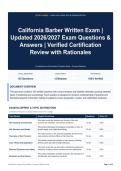
California Barber Written Exam |
Updated 2026/2027 Exam Questions &
Answers | Verified Certification
Review with Rationales
Comprehensive Examination Question Bank • Concept Mapping
TOTAL QUESTIONS EXAM TOPICS RATIONALES
153 Questions 12 Modules 100% Verified
DOCUMENT OVERVIEW
This document contains 153 verified questions with correct answers and detailed rationales covering essential
topics in barbering and cosmetology. Each question is designed to enhance understanding of practical and
theoretical aspects of the field, making it suitable for exam preparation, review, and certification readiness.
EXAM BLUEPRINT & TOPIC DISTRIBUTION
Systematic breakdown of subject domains and exam coverage.
Topic Module Scope & Core Focus Questions Share (%)
This topic covers the structure and function of the skin,
Skin Anatomy and Disorders common skin disorders, and relevant symptoms. 13 Qs 8.5%
This section addresses the biological composition of hair, its
Hair Structure and Growth growth stages, and related terminology. 13 Qs 8.5%
This topic focuses on the chemical properties and pH of hair
Chemistry of Hair Products care products and their effects on hair structure. 13 Qs 8.5%
This section covers the principles of color theory, including
Color Theory and Application primary colors and color mixing techniques. 13 Qs 8.5%
This topic covers the use and safety of electrical equipment in
Electrical Equipment and Safety barbering, including various currents and their applications. 13 Qs 8.5%
This section addresses sanitation practices, the importance of
Sanitation and Disinfection disinfectants, and regulatory standards. 13 Qs 8.5%
Confidential • Student Study Edition • Practice & Review Guide Page 1 of 41
,STUDENT STUDY & MASTERY EDITION PRACTICE & REVIEW GUIDE
Muscles and Nerves in This topic explores the muscles and nerves relevant to
Barbering barbering practices and their physiological functions. 13 Qs 8.5%
Microbiology in Hair and Skin This section discusses microorganisms, their effects on skin
Care and hair, and infection control. 13 Qs 8.5%
This topic includes various barbering techniques, tools used,
Barbering Techniques and Tools and their proper handling. 13 Qs 8.5%
Regulatory Agencies and This section covers the roles of regulatory bodies like OSHA
Guidelines and the EPA in the beauty industry. 12 Qs 7.8%
This topic discusses treatments for various hair and scalp
Hair and Scalp Treatments conditions, including the application of products. 12 Qs 7.8%
This section focuses on haircutting techniques and design
Hair Cutting and Styling principles for effective hairstyling. 12 Qs 7.8%
Total Exam Coverage 12 Integrated Topic Modules 153 Qs 100.0%
Confidential • Student Study Edition • Practice & Review Guide Page 2 of 41
,STUDENT STUDY & MASTERY EDITION PRACTICE & REVIEW GUIDE
TOPIC 1: SKIN ANATOMY AND DISORDERS
13 Questions • 8.5% of Exam • This topic covers the structure and function of the skin, common skin disorders, and relevant
symptoms.
QUESTION 1
What is a steatoma?
Answer: Sebaceous cyst of subcutaneous tumor filled with sebum.
Rationale: A steatoma is a benign subcutaneous tumor characterized by its cyst-like structure filled with keratinous material
and sebum, arising from a blocked sebaceous gland. This diagnostic criterion distinguishes it from other epidermal cysts or
lipomas.
QUESTION 2
The cause of acne vulgaris is
Answer: Chronic inflammation of hair follicles and associated sebaceous glands, 1. hormone associated
increase in sebum production and excess keratin production block follicles, forming comedones.
Rationale: Acne vulgaris arises from pilosebaceous unit inflammation, triggered by hormonal increases in sebum and
keratin, leading to follicular obstruction and comedone formation. This pathophysiology explains the characteristic lesions of
acne.
QUESTION 3
What is a subjective symptom found during a skin analysis?
Answer: Inflamed skin.
Rationale: Inflamed skin is a subjective symptom reported by the patient, indicating an internal response to irritation or
injury, whereas other findings like dryness or scaling are objective observations. The key concept tested is the distinction
between subjective patient-reported symptoms and objective clinician-observed signs during a skin assessment.
Confidential • Student Study Edition • Practice & Review Guide Page 3 of 41
, STUDENT STUDY & MASTERY EDITION PRACTICE & REVIEW GUIDE
QUESTION 4
Tinea favosa
Answer: (Tinea favus) fungal infection characterized by dry, sulfur-yellow, cup-like crusts on the scalp called
scutula.
Rationale: Tinea favus, also known as tinea favus, is a specific type of fungal infection characterized by the formation of
dry, sulfur-yellow, cup-shaped crusts called scutula, typically on the scalp. This clinical presentation is the hallmark
diagnostic feature of this dermatophytosis.
QUESTION 5
What is alopecia?
Answer: Abnormal hair loss.
Rationale: Alopecia is a medical term denoting abnormal hair loss from the scalp or body. This condition can stem from
various factors including genetics, hormonal changes, medical conditions, or medications.
QUESTION 6
Bulla
Answer: Large blister containing watery fluid.
Rationale: A bulla is a circumscribed, elevated lesion measuring greater than 1 cm in diameter, characterized by a
collection of serous fluid within the epidermis or beneath it. This key dermatological concept distinguishes bullae from
smaller vesicles based on size.
QUESTION 7
What lesions should barbers be aware of?
Answer: Primary and secondary.
Rationale: Barbers must recognize primary and secondary syphilis lesions to prevent transmission, as these stages are
highly infectious and manifest on skin and mucous membranes. This highlights the importance of dermatological awareness
in preventing the spread of sexually transmitted infections.
Confidential • Student Study Edition • Practice & Review Guide Page 4 of 41
California Barber Written Exam |
Updated 2026/2027 Exam Questions &
Answers | Verified Certification
Review with Rationales
Comprehensive Examination Question Bank • Concept Mapping
TOTAL QUESTIONS EXAM TOPICS RATIONALES
153 Questions 12 Modules 100% Verified
DOCUMENT OVERVIEW
This document contains 153 verified questions with correct answers and detailed rationales covering essential
topics in barbering and cosmetology. Each question is designed to enhance understanding of practical and
theoretical aspects of the field, making it suitable for exam preparation, review, and certification readiness.
EXAM BLUEPRINT & TOPIC DISTRIBUTION
Systematic breakdown of subject domains and exam coverage.
Topic Module Scope & Core Focus Questions Share (%)
This topic covers the structure and function of the skin,
Skin Anatomy and Disorders common skin disorders, and relevant symptoms. 13 Qs 8.5%
This section addresses the biological composition of hair, its
Hair Structure and Growth growth stages, and related terminology. 13 Qs 8.5%
This topic focuses on the chemical properties and pH of hair
Chemistry of Hair Products care products and their effects on hair structure. 13 Qs 8.5%
This section covers the principles of color theory, including
Color Theory and Application primary colors and color mixing techniques. 13 Qs 8.5%
This topic covers the use and safety of electrical equipment in
Electrical Equipment and Safety barbering, including various currents and their applications. 13 Qs 8.5%
This section addresses sanitation practices, the importance of
Sanitation and Disinfection disinfectants, and regulatory standards. 13 Qs 8.5%
Confidential • Student Study Edition • Practice & Review Guide Page 1 of 41
,STUDENT STUDY & MASTERY EDITION PRACTICE & REVIEW GUIDE
Muscles and Nerves in This topic explores the muscles and nerves relevant to
Barbering barbering practices and their physiological functions. 13 Qs 8.5%
Microbiology in Hair and Skin This section discusses microorganisms, their effects on skin
Care and hair, and infection control. 13 Qs 8.5%
This topic includes various barbering techniques, tools used,
Barbering Techniques and Tools and their proper handling. 13 Qs 8.5%
Regulatory Agencies and This section covers the roles of regulatory bodies like OSHA
Guidelines and the EPA in the beauty industry. 12 Qs 7.8%
This topic discusses treatments for various hair and scalp
Hair and Scalp Treatments conditions, including the application of products. 12 Qs 7.8%
This section focuses on haircutting techniques and design
Hair Cutting and Styling principles for effective hairstyling. 12 Qs 7.8%
Total Exam Coverage 12 Integrated Topic Modules 153 Qs 100.0%
Confidential • Student Study Edition • Practice & Review Guide Page 2 of 41
,STUDENT STUDY & MASTERY EDITION PRACTICE & REVIEW GUIDE
TOPIC 1: SKIN ANATOMY AND DISORDERS
13 Questions • 8.5% of Exam • This topic covers the structure and function of the skin, common skin disorders, and relevant
symptoms.
QUESTION 1
What is a steatoma?
Answer: Sebaceous cyst of subcutaneous tumor filled with sebum.
Rationale: A steatoma is a benign subcutaneous tumor characterized by its cyst-like structure filled with keratinous material
and sebum, arising from a blocked sebaceous gland. This diagnostic criterion distinguishes it from other epidermal cysts or
lipomas.
QUESTION 2
The cause of acne vulgaris is
Answer: Chronic inflammation of hair follicles and associated sebaceous glands, 1. hormone associated
increase in sebum production and excess keratin production block follicles, forming comedones.
Rationale: Acne vulgaris arises from pilosebaceous unit inflammation, triggered by hormonal increases in sebum and
keratin, leading to follicular obstruction and comedone formation. This pathophysiology explains the characteristic lesions of
acne.
QUESTION 3
What is a subjective symptom found during a skin analysis?
Answer: Inflamed skin.
Rationale: Inflamed skin is a subjective symptom reported by the patient, indicating an internal response to irritation or
injury, whereas other findings like dryness or scaling are objective observations. The key concept tested is the distinction
between subjective patient-reported symptoms and objective clinician-observed signs during a skin assessment.
Confidential • Student Study Edition • Practice & Review Guide Page 3 of 41
, STUDENT STUDY & MASTERY EDITION PRACTICE & REVIEW GUIDE
QUESTION 4
Tinea favosa
Answer: (Tinea favus) fungal infection characterized by dry, sulfur-yellow, cup-like crusts on the scalp called
scutula.
Rationale: Tinea favus, also known as tinea favus, is a specific type of fungal infection characterized by the formation of
dry, sulfur-yellow, cup-shaped crusts called scutula, typically on the scalp. This clinical presentation is the hallmark
diagnostic feature of this dermatophytosis.
QUESTION 5
What is alopecia?
Answer: Abnormal hair loss.
Rationale: Alopecia is a medical term denoting abnormal hair loss from the scalp or body. This condition can stem from
various factors including genetics, hormonal changes, medical conditions, or medications.
QUESTION 6
Bulla
Answer: Large blister containing watery fluid.
Rationale: A bulla is a circumscribed, elevated lesion measuring greater than 1 cm in diameter, characterized by a
collection of serous fluid within the epidermis or beneath it. This key dermatological concept distinguishes bullae from
smaller vesicles based on size.
QUESTION 7
What lesions should barbers be aware of?
Answer: Primary and secondary.
Rationale: Barbers must recognize primary and secondary syphilis lesions to prevent transmission, as these stages are
highly infectious and manifest on skin and mucous membranes. This highlights the importance of dermatological awareness
in preventing the spread of sexually transmitted infections.
Confidential • Student Study Edition • Practice & Review Guide Page 4 of 41


