
NR569 Final Exam - Differential Diagnosis in Acute Care Practicum | Weeks 5-8 Chamberlain University | 2026/2027 Edition
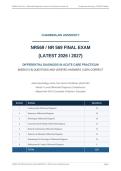
CHAMBERLAIN UNIVERSITY
NR569 / NR 569 FINAL EXAM
(LATEST )
DIFFERENTIAL DIAGNOSIS IN ACUTE CARE PRACTICUM
|WEEKS 5-8| QUESTIONS AND VERIFIED ANSWERS | 100% CORRECT
Adult-Gerontology Acute Care Nurse Practitioner (AGACNP)
Master’s-Level Differential Diagnosis Competencies
Aligned with AACN Essentials of Master’s Education
Section Domain Questions
1 Cardiovascular Differential Diagnosis 20
2 Respiratory Differential Diagnosis 18
3 Neurological Differential Diagnosis 18
4 Gastrointestinal & Hepatic Differential Diagnosis 15
5 Renal & Genitourinary Differential Diagnosis 15
6 Endocrine & Metabolic Differential Diagnosis 15
7 Hematological & Oncological Differential Diagnosis 10
8 Multisystem & Complex Differential Diagnosis 9
TOTAL 120
NR569 / NR 569 Final Exam (Latest 2026/2027) - 100% Correct Verified Answers Page 1
,NR569 Final Exam - Differential Diagnosis in Acute Care Practicum | Weeks 5-8 Chamberlain University | 2026/2027 Edition
Cognitive Level Distribution: 20% Recall | 50% Application | 30% Analysis (Clinical
Reasoning & Differential Construction)
Question Style: 80% Scenario-Based Clinical Decision-Making | 20% Direct Knowledge
Special Inclusions: 20 Complex Clinical Reasoning Scenarios, 15
Cardiovascular/Respiratory/Neurological DDx Items, 10 Diagnostic Testing & Interpretation Items
NR569 / NR 569 Final Exam (Latest 2026/2027) - 100% Correct Verified Answers Page 2
,NR569 Final Exam - Differential Diagnosis in Acute Care Practicum | Weeks 5-8 Chamberlain University | 2026/2027 Edition
Section 1: Cardiovascular Differential Diagnosis
Questions 1-20 cover acute coronary syndromes, pericardial disease, valvular pathology, shock states, hypertensive
emergencies, peripheral vascular disorders, and ECG/biomarker interpretation consistent with AGACNP differential
diagnosis competencies.
Q1: A 58-year-old male presents with substernal chest pressure radiating down the left arm,
diaphoresis, and dyspnea for 45 minutes. ECG shows 2 mm ST elevation in leads II, III, and aVF.
What is the most likely diagnosis and required immediate intervention?
A. Stable angina; discharge with outpatient stress testing
B. NSTEMI; start dual antiplatelet and admit for medical management
C. Inferior STEMI; activate catheterization lab for emergent reperfusion *[CORRECT]*
D. Acute pericarditis; prescribe NSAIDs and colchicine
Correct Answer: C
Rationale: ST elevation in the inferior leads (II, III, aVF) with ongoing ischemic symptoms greater than 20 minutes is
diagnostic of an acute inferior STEMI requiring immediate reperfusion therapy per ACC/AHA guidelines. Stable angina
resolves within 10 minutes of rest or nitrate use; NSTEMI presents without ST elevation; pericarditis demonstrates diffuse
PR depression and ST elevation.
Q2: A 67-year-old female with hypertension presents with sudden tearing chest pain radiating
to the back between the scapulae. Blood pressure is 180/110 mmHg in the right arm and 95/60
mmHg in the left arm. ECG shows non-specific ST-T changes. Which diagnosis must be
suspected first?
A. Acute myocardial infarction
B. Aortic dissection *[CORRECT]*
C. Massive pulmonary embolism
D. Boerhaave syndrome (esophageal rupture)
Correct Answer: B
Rationale: Tearing chest/back pain with a blood pressure differential greater than 20 mmHg between arms is the classic
presentation of aortic dissection, which is a surgical emergency requiring immediate CT angiography. Acute MI would
produce localized ST changes with equal bilateral blood pressures; massive PE presents with hypoxia and right heart
strain; Boerhaave syndrome follows forceful vomiting with subcutaneous emphysema.
Q3: A 45-year-old male presents with pleuritic chest pain that worsens when supine and
improves when sitting forward. ECG shows diffuse ST elevation with PR depression in the limb
leads. Troponin is mildly elevated. What is the most likely diagnosis?
A. Acute pericarditis *[CORRECT]*
B. Anterior STEMI
C. Pulmonary embolism with right heart strain
D. Tension pneumothorax
Correct Answer: A
Rationale: Diffuse ST elevation with PR depression, positional chest pain relieved by sitting forward, and a mild troponin
rise (due to associated myocarditis) are hallmark features of acute pericarditis. Anterior STEMI localizes to precordial
leads; PE produces S1Q3T3 and right-axis deviation; tension pneumothorax presents with tracheal deviation and absent
breath sounds.
NR569 / NR 569 Final Exam (Latest 2026/2027) - 100% Correct Verified Answers Page 3
, NR569 Final Exam - Differential Diagnosis in Acute Care Practicum | Weeks 5-8 Chamberlain University | 2026/2027 Edition
Q4: A 72-year-old male with history of heart failure presents with progressively worsening
dyspnea, orthopnea, bilateral basilar crackles, jugular venous distention, and 2+ pitting edema.
BNP is 1,200 pg/mL. Which diagnostic study best assesses the underlying cardiac mechanism?
A. CT chest with contrast
B. Transthoracic echocardiogram *[CORRECT]*
C. Cardiac MRI
D. Right heart catheterization
Correct Answer: B
Rationale: Transthoracic echocardiography is the standard non-invasive modality for evaluating left ventricular ejection
fraction, valvular function, and wall motion abnormalities in suspected heart failure exacerbation per AGACNP
competencies. CT chest evaluates pulmonary pathology but not cardiac function; cardiac MRI is reserved for complex
cardiomyopathy evaluation; right heart catheterization is invasive and used when hemodynamic data are required.
Q5: A 65-year-old male presents hypotensive with cool extremities, jugular venous distention,
and muffled heart sounds. Blood pressure is 80/50 mmHg. Which clinical triad is described and
what is the diagnosis?
A. Beck's triad; cardiac tamponade *[CORRECT]*
B. Cullen's triad; hemorrhagic pancreatitis
C. Grey-Turner's triad; retroperitoneal hemorrhage
D. Kehr's triad; splenic rupture
Correct Answer: A
Rationale: Beck's triad (hypotension, JVD, muffled heart sounds) indicates cardiac tamponade requiring emergent
pericardiocentesis. Cullen's sign (periumbilical bruising) and Grey-Turner's sign (flank bruising) are associated with
hemorrhagic pancreatitis or retroperitoneal bleed; Kehr's sign is referred left shoulder pain from diaphragmatic irritation
in splenic rupture.
Q6: A 54-year-old female presents with acute onset of palpitations, lightheadedness, and
dyspnea. ECG shows a regular narrow-complex tachycardia at 180 bpm with no visible P
waves. Vagal maneuvers are unsuccessful. What is the next best intervention?
A. Synchronized cardioversion at 200 joules
B. Adenosine 6 mg IV push followed by 12 mg if needed *[CORRECT]*
C. IV metoprolol 5 mg push
D. IV diltiazem 0.25 mg/kg
Correct Answer: B
Rationale: Regular narrow-complex tachycardia without visible P waves is most consistent with AV nodal reentrant
tachycardia (AVNRT); adenosine is the first-line pharmacologic therapy after vagal maneuvers fail per ACLS guidelines.
Synchronized cardioversion is reserved for unstable patients; metoprolol or diltiazem are second-line agents when
adenosine is contraindicated or ineffective.
Q7: A 60-year-old male with hypertension presents with a 2-week history of tearing headache,
palpitations, and episodic diaphoresis. Blood pressure is 210/120 mmHg. CT abdomen shows a
4 cm adrenal mass. What is the most likely diagnosis and best initial medication?
A. Primary aldosteronism; start spironolactone
B. Pheochromocytoma; start phenoxybenzamine (alpha-blocker) *[CORRECT]*
NR569 / NR 569 Final Exam (Latest 2026/2027) - 100% Correct Verified Answers Page 4
CHAMBERLAIN UNIVERSITY
NR569 / NR 569 FINAL EXAM
(LATEST )
DIFFERENTIAL DIAGNOSIS IN ACUTE CARE PRACTICUM
|WEEKS 5-8| QUESTIONS AND VERIFIED ANSWERS | 100% CORRECT
Adult-Gerontology Acute Care Nurse Practitioner (AGACNP)
Master’s-Level Differential Diagnosis Competencies
Aligned with AACN Essentials of Master’s Education
Section Domain Questions
1 Cardiovascular Differential Diagnosis 20
2 Respiratory Differential Diagnosis 18
3 Neurological Differential Diagnosis 18
4 Gastrointestinal & Hepatic Differential Diagnosis 15
5 Renal & Genitourinary Differential Diagnosis 15
6 Endocrine & Metabolic Differential Diagnosis 15
7 Hematological & Oncological Differential Diagnosis 10
8 Multisystem & Complex Differential Diagnosis 9
TOTAL 120
NR569 / NR 569 Final Exam (Latest 2026/2027) - 100% Correct Verified Answers Page 1
,NR569 Final Exam - Differential Diagnosis in Acute Care Practicum | Weeks 5-8 Chamberlain University | 2026/2027 Edition
Cognitive Level Distribution: 20% Recall | 50% Application | 30% Analysis (Clinical
Reasoning & Differential Construction)
Question Style: 80% Scenario-Based Clinical Decision-Making | 20% Direct Knowledge
Special Inclusions: 20 Complex Clinical Reasoning Scenarios, 15
Cardiovascular/Respiratory/Neurological DDx Items, 10 Diagnostic Testing & Interpretation Items
NR569 / NR 569 Final Exam (Latest 2026/2027) - 100% Correct Verified Answers Page 2
,NR569 Final Exam - Differential Diagnosis in Acute Care Practicum | Weeks 5-8 Chamberlain University | 2026/2027 Edition
Section 1: Cardiovascular Differential Diagnosis
Questions 1-20 cover acute coronary syndromes, pericardial disease, valvular pathology, shock states, hypertensive
emergencies, peripheral vascular disorders, and ECG/biomarker interpretation consistent with AGACNP differential
diagnosis competencies.
Q1: A 58-year-old male presents with substernal chest pressure radiating down the left arm,
diaphoresis, and dyspnea for 45 minutes. ECG shows 2 mm ST elevation in leads II, III, and aVF.
What is the most likely diagnosis and required immediate intervention?
A. Stable angina; discharge with outpatient stress testing
B. NSTEMI; start dual antiplatelet and admit for medical management
C. Inferior STEMI; activate catheterization lab for emergent reperfusion *[CORRECT]*
D. Acute pericarditis; prescribe NSAIDs and colchicine
Correct Answer: C
Rationale: ST elevation in the inferior leads (II, III, aVF) with ongoing ischemic symptoms greater than 20 minutes is
diagnostic of an acute inferior STEMI requiring immediate reperfusion therapy per ACC/AHA guidelines. Stable angina
resolves within 10 minutes of rest or nitrate use; NSTEMI presents without ST elevation; pericarditis demonstrates diffuse
PR depression and ST elevation.
Q2: A 67-year-old female with hypertension presents with sudden tearing chest pain radiating
to the back between the scapulae. Blood pressure is 180/110 mmHg in the right arm and 95/60
mmHg in the left arm. ECG shows non-specific ST-T changes. Which diagnosis must be
suspected first?
A. Acute myocardial infarction
B. Aortic dissection *[CORRECT]*
C. Massive pulmonary embolism
D. Boerhaave syndrome (esophageal rupture)
Correct Answer: B
Rationale: Tearing chest/back pain with a blood pressure differential greater than 20 mmHg between arms is the classic
presentation of aortic dissection, which is a surgical emergency requiring immediate CT angiography. Acute MI would
produce localized ST changes with equal bilateral blood pressures; massive PE presents with hypoxia and right heart
strain; Boerhaave syndrome follows forceful vomiting with subcutaneous emphysema.
Q3: A 45-year-old male presents with pleuritic chest pain that worsens when supine and
improves when sitting forward. ECG shows diffuse ST elevation with PR depression in the limb
leads. Troponin is mildly elevated. What is the most likely diagnosis?
A. Acute pericarditis *[CORRECT]*
B. Anterior STEMI
C. Pulmonary embolism with right heart strain
D. Tension pneumothorax
Correct Answer: A
Rationale: Diffuse ST elevation with PR depression, positional chest pain relieved by sitting forward, and a mild troponin
rise (due to associated myocarditis) are hallmark features of acute pericarditis. Anterior STEMI localizes to precordial
leads; PE produces S1Q3T3 and right-axis deviation; tension pneumothorax presents with tracheal deviation and absent
breath sounds.
NR569 / NR 569 Final Exam (Latest 2026/2027) - 100% Correct Verified Answers Page 3
, NR569 Final Exam - Differential Diagnosis in Acute Care Practicum | Weeks 5-8 Chamberlain University | 2026/2027 Edition
Q4: A 72-year-old male with history of heart failure presents with progressively worsening
dyspnea, orthopnea, bilateral basilar crackles, jugular venous distention, and 2+ pitting edema.
BNP is 1,200 pg/mL. Which diagnostic study best assesses the underlying cardiac mechanism?
A. CT chest with contrast
B. Transthoracic echocardiogram *[CORRECT]*
C. Cardiac MRI
D. Right heart catheterization
Correct Answer: B
Rationale: Transthoracic echocardiography is the standard non-invasive modality for evaluating left ventricular ejection
fraction, valvular function, and wall motion abnormalities in suspected heart failure exacerbation per AGACNP
competencies. CT chest evaluates pulmonary pathology but not cardiac function; cardiac MRI is reserved for complex
cardiomyopathy evaluation; right heart catheterization is invasive and used when hemodynamic data are required.
Q5: A 65-year-old male presents hypotensive with cool extremities, jugular venous distention,
and muffled heart sounds. Blood pressure is 80/50 mmHg. Which clinical triad is described and
what is the diagnosis?
A. Beck's triad; cardiac tamponade *[CORRECT]*
B. Cullen's triad; hemorrhagic pancreatitis
C. Grey-Turner's triad; retroperitoneal hemorrhage
D. Kehr's triad; splenic rupture
Correct Answer: A
Rationale: Beck's triad (hypotension, JVD, muffled heart sounds) indicates cardiac tamponade requiring emergent
pericardiocentesis. Cullen's sign (periumbilical bruising) and Grey-Turner's sign (flank bruising) are associated with
hemorrhagic pancreatitis or retroperitoneal bleed; Kehr's sign is referred left shoulder pain from diaphragmatic irritation
in splenic rupture.
Q6: A 54-year-old female presents with acute onset of palpitations, lightheadedness, and
dyspnea. ECG shows a regular narrow-complex tachycardia at 180 bpm with no visible P
waves. Vagal maneuvers are unsuccessful. What is the next best intervention?
A. Synchronized cardioversion at 200 joules
B. Adenosine 6 mg IV push followed by 12 mg if needed *[CORRECT]*
C. IV metoprolol 5 mg push
D. IV diltiazem 0.25 mg/kg
Correct Answer: B
Rationale: Regular narrow-complex tachycardia without visible P waves is most consistent with AV nodal reentrant
tachycardia (AVNRT); adenosine is the first-line pharmacologic therapy after vagal maneuvers fail per ACLS guidelines.
Synchronized cardioversion is reserved for unstable patients; metoprolol or diltiazem are second-line agents when
adenosine is contraindicated or ineffective.
Q7: A 60-year-old male with hypertension presents with a 2-week history of tearing headache,
palpitations, and episodic diaphoresis. Blood pressure is 210/120 mmHg. CT abdomen shows a
4 cm adrenal mass. What is the most likely diagnosis and best initial medication?
A. Primary aldosteronism; start spironolactone
B. Pheochromocytoma; start phenoxybenzamine (alpha-blocker) *[CORRECT]*
NR569 / NR 569 Final Exam (Latest 2026/2027) - 100% Correct Verified Answers Page 4


