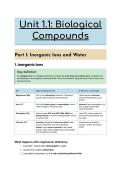
Unit 1.1: Biological
Compounds
Part 1: Inorganic Ions and Water
1. Inorganic ions
Key definition
An inorganic ion is a charged particle that contains no more than one carbon atom. Inorganic ions
are dissolved in the cytoplasm and body fluids. Some are needed in large amounts, others only in tiny
(trace) amounts.
Ion Main biological role If there is a shortage
Magnesium, Mg2+ Part of the chlorophyll molecule. Chlorophyll Yellow leaves (chlorosis),
absorbs light energy for photosynthesis. slower photosynthesis, poor
growth
Iron, Fe2+ Part of the haem group in haemoglobin, which Anaemia: less haemoglobin, so
carries oxygen in red blood cells. less oxygen transported,
causing tiredness
Phosphate, PO43- Used to make ATP and ADP, DNA, RNA and Less ATP, nucleic acids and
phospholipids. Forms the phosphodiester bonds membrane phospholipids can
in nucleic acids. be made
Calcium, Ca2+ Animals: strengthens bones and teeth, helps Weak bones and teeth in
muscle contraction and nerve signalling. animals, weaker cell walls in
Plants: forms calcium pectate in the middle plants
lamella, which sticks neighbouring cells together
and strengthens cell walls.
What happens with magnesium deficiency
1. Less Mg2+ means less chlorophyll is made.
2. Leaves turn yellow (chlorosis).
3. Less light is absorbed, so the rate of photosynthesis falls.
, 4. The plant makes less glucose, so growth is poor.
Why phosphate is so useful
• ATP contains three phosphate groups. Energy is transferred when a phosphate
group is removed (ATP hydrolysis).
• Phosphate joins the sugar of one nucleotide to the next, forming the
phosphodiester bonds in DNA and RNA.
• The phosphate head of a phospholipid is the water-loving part of a cell membrane.
Watch out! Marks get lost here
• Say calcium ions strengthen bones and teeth. Do not write that they 'make bones'.
• Do not say 'iron makes blood'. Say iron is a component of the haem group in haemoglobin.
• Always link the ion to its job. 'Magnesium is needed for chlorophyll' is not enough, say why
chlorophyll matters (absorbs light for photosynthesis).
2. Water
Polarity and hydrogen bonding
• A water molecule is one oxygen atom and two hydrogen atoms joined by polar
covalent bonds.
• Oxygen pulls the shared electrons more strongly than hydrogen does. So oxygen is
slightly negative (δ-) and hydrogen is slightly positive (δ+).
• This uneven charge is a dipole, which makes water a polar molecule.
• The δ+ hydrogen of one water molecule is attracted to the δ- oxygen of another. This
attraction is a hydrogen bond.
• One hydrogen bond is weak, but huge numbers of them together give water its
special properties.
Property Why it happens Why it matters for living things
Good solvent Water is polar, so its δ+ and δ- ends Transport of glucose in blood plasma,
attract and surround ions and other mineral ions in xylem, sucrose in phloem
polar molecules, dissolving them. and solutes in tissue fluid. Reactions in
cells happen in solution. Non-polar lipids
do not dissolve.
Metabolite Water takes part directly in chemical Used in hydrolysis and photosynthesis.
reactions. Produced in condensation reactions and
aerobic respiration.
Compounds
Part 1: Inorganic Ions and Water
1. Inorganic ions
Key definition
An inorganic ion is a charged particle that contains no more than one carbon atom. Inorganic ions
are dissolved in the cytoplasm and body fluids. Some are needed in large amounts, others only in tiny
(trace) amounts.
Ion Main biological role If there is a shortage
Magnesium, Mg2+ Part of the chlorophyll molecule. Chlorophyll Yellow leaves (chlorosis),
absorbs light energy for photosynthesis. slower photosynthesis, poor
growth
Iron, Fe2+ Part of the haem group in haemoglobin, which Anaemia: less haemoglobin, so
carries oxygen in red blood cells. less oxygen transported,
causing tiredness
Phosphate, PO43- Used to make ATP and ADP, DNA, RNA and Less ATP, nucleic acids and
phospholipids. Forms the phosphodiester bonds membrane phospholipids can
in nucleic acids. be made
Calcium, Ca2+ Animals: strengthens bones and teeth, helps Weak bones and teeth in
muscle contraction and nerve signalling. animals, weaker cell walls in
Plants: forms calcium pectate in the middle plants
lamella, which sticks neighbouring cells together
and strengthens cell walls.
What happens with magnesium deficiency
1. Less Mg2+ means less chlorophyll is made.
2. Leaves turn yellow (chlorosis).
3. Less light is absorbed, so the rate of photosynthesis falls.
, 4. The plant makes less glucose, so growth is poor.
Why phosphate is so useful
• ATP contains three phosphate groups. Energy is transferred when a phosphate
group is removed (ATP hydrolysis).
• Phosphate joins the sugar of one nucleotide to the next, forming the
phosphodiester bonds in DNA and RNA.
• The phosphate head of a phospholipid is the water-loving part of a cell membrane.
Watch out! Marks get lost here
• Say calcium ions strengthen bones and teeth. Do not write that they 'make bones'.
• Do not say 'iron makes blood'. Say iron is a component of the haem group in haemoglobin.
• Always link the ion to its job. 'Magnesium is needed for chlorophyll' is not enough, say why
chlorophyll matters (absorbs light for photosynthesis).
2. Water
Polarity and hydrogen bonding
• A water molecule is one oxygen atom and two hydrogen atoms joined by polar
covalent bonds.
• Oxygen pulls the shared electrons more strongly than hydrogen does. So oxygen is
slightly negative (δ-) and hydrogen is slightly positive (δ+).
• This uneven charge is a dipole, which makes water a polar molecule.
• The δ+ hydrogen of one water molecule is attracted to the δ- oxygen of another. This
attraction is a hydrogen bond.
• One hydrogen bond is weak, but huge numbers of them together give water its
special properties.
Property Why it happens Why it matters for living things
Good solvent Water is polar, so its δ+ and δ- ends Transport of glucose in blood plasma,
attract and surround ions and other mineral ions in xylem, sucrose in phloem
polar molecules, dissolving them. and solutes in tissue fluid. Reactions in
cells happen in solution. Non-polar lipids
do not dissolve.
Metabolite Water takes part directly in chemical Used in hydrolysis and photosynthesis.
reactions. Produced in condensation reactions and
aerobic respiration.