
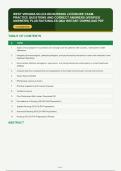
,This study document brings together 145 carefully worded exam questions drawn from West
Virginia NCLEX-RN Nursing Licensure Exam- Practice Questions And Correct Answers (Verified
Answers) Plus Rationales Q&A Instant Download Pdf, with the strongest emphasis placed on
Apply clinical judgment to prioritize and manage care for patients with complex, multisystem health
alterations, Integrate pharmacological, pathophysiological, and psychosocial principles to make
safe medication and treatment decisions, Demonstrate effective delegation, supervision and and
interprofessional collaboration in varied healthcare settings. Every item follows the wording style
and level of reasoning you meet in the real paper, and each one is paired with a clear rationale so
the correct choice is never a guess. Work through the set at your own pace, mark the questions
that slow you down, then come back to them until the reasoning feels automatic. Learners who
revise this way walk into the exam room recognising the pattern behind the questions instead of
meeting them for the first time. Keep going - steady, honest practice is what turns a difficult paper
into a comfortable pass.
Q1 APPLY CLINICAL JUDGMENT TO PRIORITIZE AND MANAGE CARE FOR PATIENTS WITH
COMPLEX, MULTISYSTEM HEALTH ALTERATIONS
Which action by the nurse best demonstrates the principle of nonmaleficence
when a patient with a do-not-resuscitate (DNR) order develops respiratory
distress?
A. Withholding all pain medication to avoid respiratory depression.
B. Administering prescribed morphine for comfort while monitoring respiratory status.
CORRECT
C. Initiating CPR despite the DNR order.
D. Transferring the patient to the intensive care unit for intubation.
RATIONALE: Nonmaleficence requires avoiding harm; administering prescribed morphine for
comfort while monitoring is appropriate palliative care and does not hasten death. Withholding
pain medication (A) causes unnecessary suffering, initiating CPR (C) violates the DNR order and
autonomy, and transfer for intubation (D) contradicts the DNR and may cause harm.
Page 2
,Q2 APPLY CLINICAL JUDGMENT TO PRIORITIZE AND MANAGE CARE FOR PATIENTS WITH
COMPLEX, MULTISYSTEM HEALTH ALTERATIONS
A nurse is calculating the dose of a continuous IV heparin infusion for a patient
with a pulmonary embolism. The order is 18 units/kg/hr. The patient weighs 70 kg.
The pharmacy supplies heparin 25,000 units in 250 mL D5W. What is the flow rate
in mL/hr?
A. 12.6 mL/hr CORRECT
B. 18.9 mL/hr
C. 25.2 mL/hr
D. 31.5 mL/hr
RATIONALE: Dose = 18 units/kg/hr × 70 kg = 1260 units/hr. Concentration = 25,000 units/250
mL = 100 units/mL. Flow rate = 1260 units/hr ÷ 100 units/mL = 12.6 mL/hr. Options B, C, and D
result from calculation errors.
Q3 APPLY CLINICAL JUDGMENT TO PRIORITIZE AND MANAGE CARE FOR PATIENTS WITH
COMPLEX, MULTISYSTEM HEALTH ALTERATIONS
Which assessment finding is most concerning in a patient receiving a blood
transfusion?
A. Temperature increase from 37.0°C to 37.8°C after 15 minutes.
B. Urticaria and pruritus without fever.
C. Low back pain and dark urine. CORRECT
D. Mild dyspnea relieved by sitting upright.
RATIONALE: Low back pain and dark urine suggest an acute hemolytic transfusion reaction, a
life-threatening emergency requiring immediate cessation of transfusion. A mild temperature rise
(A) may be a febrile non-hemolytic reaction, urticaria (B) indicates a mild allergic reaction, and
mild dyspnea (D) may be due to fluid overload or positioning, but hemolysis is most critical.
Page 3
, Q4 APPLY CLINICAL JUDGMENT TO PRIORITIZE AND MANAGE CARE FOR PATIENTS WITH
COMPLEX, MULTISYSTEM HEALTH ALTERATIONS
A nurse is prioritizing care for four patients. Which patient should the nurse
assess first after receiving handoff report?
A. A patient with chronic obstructive pulmonary disease who has an oxygen saturation of 89%
on 2 L nasal cannula.
B. A patient with diabetes who has a blood glucose of 250 mg/dL and is due for insulin.
C. A patient with a new onset of chest pain and diaphoresis. CORRECT
D. A patient with a fractured femur requesting pain medication.
RATIONALE: New chest pain with diaphoresis suggests acute coronary syndrome, a
life-threatening emergency requiring immediate assessment. Oxygen saturation of 89% (A) is
concerning but may be baseline for COPD; glucose of 250 mg/dL (B) is not immediately
life-threatening; pain from fracture (D) is important but not the priority over cardiac ischemia.
Q5 APPLY CLINICAL JUDGMENT TO PRIORITIZE AND MANAGE CARE FOR PATIENTS WITH
COMPLEX, MULTISYSTEM HEALTH ALTERATIONS
A nurse is teaching a patient about newly prescribed warfarin. Which statement by
the patient indicates a need for further teaching?
A. I will use an electric razor to shave.
B. I will increase my intake of green leafy vegetables. CORRECT
C. I will report any unusual bleeding or bruising.
D. I will keep my follow-up appointments for blood tests.
RATIONALE: Green leafy vegetables are high in vitamin K, which antagonizes warfarin and can
decrease its effectiveness. Patients should maintain consistent intake, not increase it. Using an
electric razor (A), reporting bleeding (C), and keeping follow-up appointments (D) are correct
self-care measures.
Page 4
Virginia NCLEX-RN Nursing Licensure Exam- Practice Questions And Correct Answers (Verified
Answers) Plus Rationales Q&A Instant Download Pdf, with the strongest emphasis placed on
Apply clinical judgment to prioritize and manage care for patients with complex, multisystem health
alterations, Integrate pharmacological, pathophysiological, and psychosocial principles to make
safe medication and treatment decisions, Demonstrate effective delegation, supervision and and
interprofessional collaboration in varied healthcare settings. Every item follows the wording style
and level of reasoning you meet in the real paper, and each one is paired with a clear rationale so
the correct choice is never a guess. Work through the set at your own pace, mark the questions
that slow you down, then come back to them until the reasoning feels automatic. Learners who
revise this way walk into the exam room recognising the pattern behind the questions instead of
meeting them for the first time. Keep going - steady, honest practice is what turns a difficult paper
into a comfortable pass.
Q1 APPLY CLINICAL JUDGMENT TO PRIORITIZE AND MANAGE CARE FOR PATIENTS WITH
COMPLEX, MULTISYSTEM HEALTH ALTERATIONS
Which action by the nurse best demonstrates the principle of nonmaleficence
when a patient with a do-not-resuscitate (DNR) order develops respiratory
distress?
A. Withholding all pain medication to avoid respiratory depression.
B. Administering prescribed morphine for comfort while monitoring respiratory status.
CORRECT
C. Initiating CPR despite the DNR order.
D. Transferring the patient to the intensive care unit for intubation.
RATIONALE: Nonmaleficence requires avoiding harm; administering prescribed morphine for
comfort while monitoring is appropriate palliative care and does not hasten death. Withholding
pain medication (A) causes unnecessary suffering, initiating CPR (C) violates the DNR order and
autonomy, and transfer for intubation (D) contradicts the DNR and may cause harm.
Page 2
,Q2 APPLY CLINICAL JUDGMENT TO PRIORITIZE AND MANAGE CARE FOR PATIENTS WITH
COMPLEX, MULTISYSTEM HEALTH ALTERATIONS
A nurse is calculating the dose of a continuous IV heparin infusion for a patient
with a pulmonary embolism. The order is 18 units/kg/hr. The patient weighs 70 kg.
The pharmacy supplies heparin 25,000 units in 250 mL D5W. What is the flow rate
in mL/hr?
A. 12.6 mL/hr CORRECT
B. 18.9 mL/hr
C. 25.2 mL/hr
D. 31.5 mL/hr
RATIONALE: Dose = 18 units/kg/hr × 70 kg = 1260 units/hr. Concentration = 25,000 units/250
mL = 100 units/mL. Flow rate = 1260 units/hr ÷ 100 units/mL = 12.6 mL/hr. Options B, C, and D
result from calculation errors.
Q3 APPLY CLINICAL JUDGMENT TO PRIORITIZE AND MANAGE CARE FOR PATIENTS WITH
COMPLEX, MULTISYSTEM HEALTH ALTERATIONS
Which assessment finding is most concerning in a patient receiving a blood
transfusion?
A. Temperature increase from 37.0°C to 37.8°C after 15 minutes.
B. Urticaria and pruritus without fever.
C. Low back pain and dark urine. CORRECT
D. Mild dyspnea relieved by sitting upright.
RATIONALE: Low back pain and dark urine suggest an acute hemolytic transfusion reaction, a
life-threatening emergency requiring immediate cessation of transfusion. A mild temperature rise
(A) may be a febrile non-hemolytic reaction, urticaria (B) indicates a mild allergic reaction, and
mild dyspnea (D) may be due to fluid overload or positioning, but hemolysis is most critical.
Page 3
, Q4 APPLY CLINICAL JUDGMENT TO PRIORITIZE AND MANAGE CARE FOR PATIENTS WITH
COMPLEX, MULTISYSTEM HEALTH ALTERATIONS
A nurse is prioritizing care for four patients. Which patient should the nurse
assess first after receiving handoff report?
A. A patient with chronic obstructive pulmonary disease who has an oxygen saturation of 89%
on 2 L nasal cannula.
B. A patient with diabetes who has a blood glucose of 250 mg/dL and is due for insulin.
C. A patient with a new onset of chest pain and diaphoresis. CORRECT
D. A patient with a fractured femur requesting pain medication.
RATIONALE: New chest pain with diaphoresis suggests acute coronary syndrome, a
life-threatening emergency requiring immediate assessment. Oxygen saturation of 89% (A) is
concerning but may be baseline for COPD; glucose of 250 mg/dL (B) is not immediately
life-threatening; pain from fracture (D) is important but not the priority over cardiac ischemia.
Q5 APPLY CLINICAL JUDGMENT TO PRIORITIZE AND MANAGE CARE FOR PATIENTS WITH
COMPLEX, MULTISYSTEM HEALTH ALTERATIONS
A nurse is teaching a patient about newly prescribed warfarin. Which statement by
the patient indicates a need for further teaching?
A. I will use an electric razor to shave.
B. I will increase my intake of green leafy vegetables. CORRECT
C. I will report any unusual bleeding or bruising.
D. I will keep my follow-up appointments for blood tests.
RATIONALE: Green leafy vegetables are high in vitamin K, which antagonizes warfarin and can
decrease its effectiveness. Patients should maintain consistent intake, not increase it. Using an
electric razor (A), reporting bleeding (C), and keeping follow-up appointments (D) are correct
self-care measures.
Page 4


