
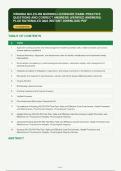
,This study document brings together 143 carefully worded exam questions drawn from Virginia
NCLEX-RN Nursing Licensure Exam- Practice Questions And Correct Answers (Verified Answers)
Plus Rationales Q&A Instant Download Pdf, with the strongest emphasis placed on Apply the
nursing process and clinical judgment model to prioritize safe, evidence-based care across diverse
patient populations, Analyze laboratory, diagnostic, and assessment data to identify complications
and implement timely interventions, Demonstrate competency in pharmacological calculations,
medication safety and and management of adverse drug events. Every item follows the wording
style and level of reasoning you meet in the real paper, and each one is paired with a clear
rationale so the correct choice is never a guess. Work through the set at your own pace, mark the
questions that slow you down, then come back to them until the reasoning feels automatic.
Learners who revise this way walk into the exam room recognising the pattern behind the
questions instead of meeting them for the first time. Keep going - steady, honest practice is what
turns a difficult paper into a comfortable pass.
Q1 APPLY THE NURSING PROCESS AND CLINICAL JUDGMENT MODEL TO PRIORITIZE
SAFE, EVIDENCE-BASED CARE ACROSS DIVERSE PATIENT POPULATIONS
A patient with acute decompensated heart failure receiving intravenous
furosemide has a serum potassium of 3.1 mEq/L and a digoxin level of 2.8 ng/mL.
Which assessment finding most urgently indicates a need for immediate
intervention?
A. Heart rate of 58 beats/min with frequent premature ventricular contractions CORRECT
B. Blood pressure of 98/62 mm Hg with orthostatic dizziness
C. Serum creatinine increase from 1.0 to 1.4 mg/dL
D. Urine output of 40 mL/hr over the past 4 hours
RATIONALE: Hypokalemia potentiates digoxin toxicity, and a digoxin level of 2.8 ng/mL is above
therapeutic range, increasing risk for life-threatening ventricular dysrhythmias. Bradycardia with
PVCs reflects digoxin toxicity exacerbated by hypokalemia and requires immediate intervention.
The other findings are concerning but less immediately lethal.
Page 2
,Q2 APPLY THE NURSING PROCESS AND CLINICAL JUDGMENT MODEL TO PRIORITIZE
SAFE, EVIDENCE-BASED CARE ACROSS DIVERSE PATIENT POPULATIONS
A nurse manager is assigning patient care on a medical-surgical unit. Which task
is most appropriate to delegate to a licensed practical nurse (LPN)?
A. Administering the first dose of intravenous antibiotics to a patient with a new central line
B. Performing a sterile dressing change on a surgical incision CORRECT
C. Assessing a patient with new-onset confusion and agitation
D. Teaching a patient about a new prescription for warfarin
RATIONALE: LPNs can perform sterile dressing changes on stable wounds within their scope.
Administering first-dose IV antibiotics via a new central line, assessing new-onset confusion, and
patient teaching require the assessment and critical judgment of an RN. Delegation must align
with the LPN's scope of practice and patient acuity.
Q3 APPLY THE NURSING PROCESS AND CLINICAL JUDGMENT MODEL TO PRIORITIZE
SAFE, EVIDENCE-BASED CARE ACROSS DIVERSE PATIENT POPULATIONS
A patient with septic shock is receiving norepinephrine and vasopressin infusions.
Which combination of parameters best reflects adequate tissue perfusion?
A. Mean arterial pressure 65 mm Hg and central venous oxygen saturation 70% CORRECT
B. Systolic blood pressure 90 mm Hg and urine output 20 mL/hr
C. Heart rate 110 beats/min and capillary refill <3 seconds
D. Central venous pressure 4 mm Hg and serum lactate 4 mmol/L
RATIONALE: A mean arterial pressure of at least 65 mm Hg and central venous oxygen
saturation above 70% indicate adequate perfusion pressure and oxygen delivery in septic shock.
Low CVP and elevated lactate indicate hypoperfusion, while systolic pressure alone and oliguria
do not confirm adequate tissue perfusion.
Page 3
, Q4 APPLY THE NURSING PROCESS AND CLINICAL JUDGMENT MODEL TO PRIORITIZE
SAFE, EVIDENCE-BASED CARE ACROSS DIVERSE PATIENT POPULATIONS
A patient receiving a blood transfusion develops fever, chills, and flank pain 15
minutes into the infusion. Which action should the nurse take first?
A. Administer acetaminophen as prescribed for the febrile reaction
B. Stop the transfusion and maintain intravenous access with normal saline CORRECT
C. Slow the transfusion rate and reassess vital signs in 15 minutes
D. Collect a urine specimen for hemoglobinuria before stopping the transfusion
RATIONALE: Fever, chills, and flank pain suggest an acute hemolytic transfusion reaction, which
requires immediate cessation of the transfusion and maintenance of IV access with normal
saline. Slowing the infusion or administering antipyretics delays life-saving intervention. Urine
collection can occur after stopping the transfusion.
Q5 APPLY THE NURSING PROCESS AND CLINICAL JUDGMENT MODEL TO PRIORITIZE
SAFE, EVIDENCE-BASED CARE ACROSS DIVERSE PATIENT POPULATIONS
A patient with major depressive disorder has been taking sertraline for 3 weeks.
Which patient statement most urgently requires follow-up?
A. I have been having trouble sleeping through the night.
B. I feel a little more energetic, but I still feel sad.
C. I have been thinking about how everyone would be better off without me. CORRECT
D. I have had some nausea and diarrhea since starting the medication.
RATIONALE: Emerging energy during antidepressant therapy increases suicide risk, and passive
suicidal ideation requires immediate assessment and intervention. Insomnia, residual sadness,
and GI side effects are common and important but do not indicate imminent danger. The nurse
must prioritize safety.
Page 4
NCLEX-RN Nursing Licensure Exam- Practice Questions And Correct Answers (Verified Answers)
Plus Rationales Q&A Instant Download Pdf, with the strongest emphasis placed on Apply the
nursing process and clinical judgment model to prioritize safe, evidence-based care across diverse
patient populations, Analyze laboratory, diagnostic, and assessment data to identify complications
and implement timely interventions, Demonstrate competency in pharmacological calculations,
medication safety and and management of adverse drug events. Every item follows the wording
style and level of reasoning you meet in the real paper, and each one is paired with a clear
rationale so the correct choice is never a guess. Work through the set at your own pace, mark the
questions that slow you down, then come back to them until the reasoning feels automatic.
Learners who revise this way walk into the exam room recognising the pattern behind the
questions instead of meeting them for the first time. Keep going - steady, honest practice is what
turns a difficult paper into a comfortable pass.
Q1 APPLY THE NURSING PROCESS AND CLINICAL JUDGMENT MODEL TO PRIORITIZE
SAFE, EVIDENCE-BASED CARE ACROSS DIVERSE PATIENT POPULATIONS
A patient with acute decompensated heart failure receiving intravenous
furosemide has a serum potassium of 3.1 mEq/L and a digoxin level of 2.8 ng/mL.
Which assessment finding most urgently indicates a need for immediate
intervention?
A. Heart rate of 58 beats/min with frequent premature ventricular contractions CORRECT
B. Blood pressure of 98/62 mm Hg with orthostatic dizziness
C. Serum creatinine increase from 1.0 to 1.4 mg/dL
D. Urine output of 40 mL/hr over the past 4 hours
RATIONALE: Hypokalemia potentiates digoxin toxicity, and a digoxin level of 2.8 ng/mL is above
therapeutic range, increasing risk for life-threatening ventricular dysrhythmias. Bradycardia with
PVCs reflects digoxin toxicity exacerbated by hypokalemia and requires immediate intervention.
The other findings are concerning but less immediately lethal.
Page 2
,Q2 APPLY THE NURSING PROCESS AND CLINICAL JUDGMENT MODEL TO PRIORITIZE
SAFE, EVIDENCE-BASED CARE ACROSS DIVERSE PATIENT POPULATIONS
A nurse manager is assigning patient care on a medical-surgical unit. Which task
is most appropriate to delegate to a licensed practical nurse (LPN)?
A. Administering the first dose of intravenous antibiotics to a patient with a new central line
B. Performing a sterile dressing change on a surgical incision CORRECT
C. Assessing a patient with new-onset confusion and agitation
D. Teaching a patient about a new prescription for warfarin
RATIONALE: LPNs can perform sterile dressing changes on stable wounds within their scope.
Administering first-dose IV antibiotics via a new central line, assessing new-onset confusion, and
patient teaching require the assessment and critical judgment of an RN. Delegation must align
with the LPN's scope of practice and patient acuity.
Q3 APPLY THE NURSING PROCESS AND CLINICAL JUDGMENT MODEL TO PRIORITIZE
SAFE, EVIDENCE-BASED CARE ACROSS DIVERSE PATIENT POPULATIONS
A patient with septic shock is receiving norepinephrine and vasopressin infusions.
Which combination of parameters best reflects adequate tissue perfusion?
A. Mean arterial pressure 65 mm Hg and central venous oxygen saturation 70% CORRECT
B. Systolic blood pressure 90 mm Hg and urine output 20 mL/hr
C. Heart rate 110 beats/min and capillary refill <3 seconds
D. Central venous pressure 4 mm Hg and serum lactate 4 mmol/L
RATIONALE: A mean arterial pressure of at least 65 mm Hg and central venous oxygen
saturation above 70% indicate adequate perfusion pressure and oxygen delivery in septic shock.
Low CVP and elevated lactate indicate hypoperfusion, while systolic pressure alone and oliguria
do not confirm adequate tissue perfusion.
Page 3
, Q4 APPLY THE NURSING PROCESS AND CLINICAL JUDGMENT MODEL TO PRIORITIZE
SAFE, EVIDENCE-BASED CARE ACROSS DIVERSE PATIENT POPULATIONS
A patient receiving a blood transfusion develops fever, chills, and flank pain 15
minutes into the infusion. Which action should the nurse take first?
A. Administer acetaminophen as prescribed for the febrile reaction
B. Stop the transfusion and maintain intravenous access with normal saline CORRECT
C. Slow the transfusion rate and reassess vital signs in 15 minutes
D. Collect a urine specimen for hemoglobinuria before stopping the transfusion
RATIONALE: Fever, chills, and flank pain suggest an acute hemolytic transfusion reaction, which
requires immediate cessation of the transfusion and maintenance of IV access with normal
saline. Slowing the infusion or administering antipyretics delays life-saving intervention. Urine
collection can occur after stopping the transfusion.
Q5 APPLY THE NURSING PROCESS AND CLINICAL JUDGMENT MODEL TO PRIORITIZE
SAFE, EVIDENCE-BASED CARE ACROSS DIVERSE PATIENT POPULATIONS
A patient with major depressive disorder has been taking sertraline for 3 weeks.
Which patient statement most urgently requires follow-up?
A. I have been having trouble sleeping through the night.
B. I feel a little more energetic, but I still feel sad.
C. I have been thinking about how everyone would be better off without me. CORRECT
D. I have had some nausea and diarrhea since starting the medication.
RATIONALE: Emerging energy during antidepressant therapy increases suicide risk, and passive
suicidal ideation requires immediate assessment and intervention. Insomnia, residual sadness,
and GI side effects are common and important but do not indicate imminent danger. The nurse
must prioritize safety.
Page 4


