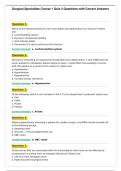
Surgical Specialties Course 1 Quiz 2 Questions with Correct Answers
Question 1.
Which of the following allows for the most stable and rigid fixation of a fracture? Select
one:
a. Locked plating system
b. Dynamic compression plating
c. Semi-tubular plates
d. Placement of a lag screw across the fracture
Correct Answer: a. Locked plating system
Question 2.
During the cementing of components during total joint replacement, a new CRNA who has
never worked in orthopedics before begins to panic. A side effect that possibly occurred
with this patient as a result of the cement is: Select one:
a. Hypotension
b. Hypertension
c. Hyperthermia
d. Increase airway resistance
Correct Answer: a. Hypotension
Question 3.
Of the following, which is not included in the 5 P's of compartment syndrome? Select one:
a. Pain
b. Pallor
c. Pulses
d. Paresis
Correct Answer: c. Pulses
Question 4.
When preoperatively assessing a patient for cardiac surgery, the RNFA should consider all
of the following except:
a. Bleeding times
b. Glucose c. Immunosuppressant use
d. RBC count
Correct Answer: d. RBC count
Question 5.
Of the nerves that are associated with the thyroid gland, which one can be affected by
compression re-sulting from an enlarged left atrium? Select one:
a. Left recurrent laryngeal nerve
b. Right recurrent laryngeal nerve
, c. Superior laryngeal nerve
d. Inferior recurrent laryngeal nerve
Correct Answer: a. Left recurrent laryngeal nerve
Question 6.
Injury to this particular layer of vascular tissue can initiate spasm and thrombosis. Which
layer must the RNFA be especially careful when handling?
a. Endothelium
b. Subendothelium
c. Tunica Externa
d. Tunica Media
Correct Answer:
Question 7.
Hesselbach triangle describes the location of the her-nia. Which of the following structures
compromise the medial border of the triangle?
a. Lateral edge of the rectus abdominus muscle
b. Inferior border of the inguinal ligament
c. Anterior edge of the transversalis fascia
d. Inferior edge of the transversalis fascia
Correct Answer: a. Lateral edge of the rec-tus abdominus muscle
Question 8.
During mastectomy, injury to which of the following nerves can result in a "winged
scapula". Choose the correct nerve the RNFA must help protect.
a. Thoracodorsal nerve b. Long thoracic nerve
c. Brachial plexus
d. Supraclavicular nerve
Correct Answer: b. Long thoracic nerve
Question 9.
Nipple discharge is more commonly associated with benign breast lesions than with
cancer; however, dis-charge is usually significant only if it is spontaneous, persistent, and:
a. chronic
b. unilateral
c. bloody
d. milky
Correct Answer: c. bloody
Question 10.
Which of the following is the surgical goal for breast conserving surgery?
a. Removal of cancerous mass with a margin of normal tissue
b. Removal of cancerous mass only and fair cosmetic results
c. Removal of cancerous mass with extra posterior margins of normal tissue
Question 1.
Which of the following allows for the most stable and rigid fixation of a fracture? Select
one:
a. Locked plating system
b. Dynamic compression plating
c. Semi-tubular plates
d. Placement of a lag screw across the fracture
Correct Answer: a. Locked plating system
Question 2.
During the cementing of components during total joint replacement, a new CRNA who has
never worked in orthopedics before begins to panic. A side effect that possibly occurred
with this patient as a result of the cement is: Select one:
a. Hypotension
b. Hypertension
c. Hyperthermia
d. Increase airway resistance
Correct Answer: a. Hypotension
Question 3.
Of the following, which is not included in the 5 P's of compartment syndrome? Select one:
a. Pain
b. Pallor
c. Pulses
d. Paresis
Correct Answer: c. Pulses
Question 4.
When preoperatively assessing a patient for cardiac surgery, the RNFA should consider all
of the following except:
a. Bleeding times
b. Glucose c. Immunosuppressant use
d. RBC count
Correct Answer: d. RBC count
Question 5.
Of the nerves that are associated with the thyroid gland, which one can be affected by
compression re-sulting from an enlarged left atrium? Select one:
a. Left recurrent laryngeal nerve
b. Right recurrent laryngeal nerve
, c. Superior laryngeal nerve
d. Inferior recurrent laryngeal nerve
Correct Answer: a. Left recurrent laryngeal nerve
Question 6.
Injury to this particular layer of vascular tissue can initiate spasm and thrombosis. Which
layer must the RNFA be especially careful when handling?
a. Endothelium
b. Subendothelium
c. Tunica Externa
d. Tunica Media
Correct Answer:
Question 7.
Hesselbach triangle describes the location of the her-nia. Which of the following structures
compromise the medial border of the triangle?
a. Lateral edge of the rectus abdominus muscle
b. Inferior border of the inguinal ligament
c. Anterior edge of the transversalis fascia
d. Inferior edge of the transversalis fascia
Correct Answer: a. Lateral edge of the rec-tus abdominus muscle
Question 8.
During mastectomy, injury to which of the following nerves can result in a "winged
scapula". Choose the correct nerve the RNFA must help protect.
a. Thoracodorsal nerve b. Long thoracic nerve
c. Brachial plexus
d. Supraclavicular nerve
Correct Answer: b. Long thoracic nerve
Question 9.
Nipple discharge is more commonly associated with benign breast lesions than with
cancer; however, dis-charge is usually significant only if it is spontaneous, persistent, and:
a. chronic
b. unilateral
c. bloody
d. milky
Correct Answer: c. bloody
Question 10.
Which of the following is the surgical goal for breast conserving surgery?
a. Removal of cancerous mass with a margin of normal tissue
b. Removal of cancerous mass only and fair cosmetic results
c. Removal of cancerous mass with extra posterior margins of normal tissue