
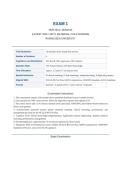
EXAM 1
NUR 2513 / NUR2513
(LATEST ): MATERNAL CHILD NURSING
RASMUSSEN UNIVERSITY
Total Questions: 120 multiple choice (single-best-answer)
Number of Sections: 8
Cognitive Level Distribution: 20% Recall | 50% Application | 30% Analysis
Question Style: 75% Scenario-Based | 25% Direct Knowledge
Time Allocation: Approx. 2.5 hours (75 seconds per item)
Special Inclusions: 20 clinical reasoning, 15 fetal monitoring / antepartum testing, 10 high-risk pregnancy
Aligned With: NCLEX-RN Test Plan, QSEN Competencies, AWHONN Standards, ACOG Guidelines
Format: Question + 4 options (A-D) + Correct Answer + Rationale
Examination Instructions
1. This examination contains 120 multiple-choice questions distributed across 8 content sections.
2. Each question has ONE correct answer. Select the single best response from options A–D.
3. The correct answer and a 2–4 sentence rationale (with curriculum, AWHONN, and evidence-based references)
follow each question.
4. Scenario-based questions present patient situations requiring clinical reasoning, prioritization, and
management decisions per the NCLEX-RN Test Plan.
5. Cognitive levels: Recall (knowledge/comprehension), Application (clinical application), Analysis (clinical
reasoning, prioritization, management).
6. Recommended pace: approximately 75 seconds per question (2.5 hours total).
7. Alignment: NUR 2513 Rasmussen course syllabus, NCLEX-RN Test Plan, QSEN Competencies, AWHONN
Standards of Practice, and current ACOG guidance.
Begin Examination
,Section 1: Foundations of Maternal-Child Nursing
15 questions
*Q1:* A labor and delivery nurse is caring for a Somali refugee who refuses epidural anesthesia despite
reporting severe pain at 8 cm dilation. The patient states, "In my culture, women must endure labor pain
to be considered strong mothers." Which action by the nurse best demonstrates culturally congruent
care aligned with QSEN competencies?
A. Document the refusal and provide no further pain management options to respect cultural beliefs
B. Educate the patient about the risks of uncontrolled pain and strongly recommend the epidural
C. Acknowledge the cultural belief, explore non-pharmacological comfort measures, and offer IV opioids as
a middle-ground option *[CORRECT]*
D. Contact the provider to override the patient's decision based on maternal-fetal safety concerns
Correct Answer: C
Rationale: Culturally congruent care (per Leininger's theory and QSEN patient-centered care competency) requires
the nurse to acknowledge the patient's cultural framework, then negotiate acceptable care options. Providing
non-pharmacological interventions (hydrotherapy, breathing, position changes) and offering a less-invasive
pharmacological option respects the patient's autonomy while addressing pain. Option A abandons the patient to
untreated pain, violating the obligation to relieve suffering. Option B is paternalistic and may erode trust. Option D
violates informed consent; cultural beliefs alone do not constitute competence concerns warranting provider override.
*Q2:* A nurse is preparing to obtain informed consent from a 17-year-old primigravida at 39 weeks
gestation for an emergency cesarean section for fetal distress. The patient is alert and oriented. Which
legal principle governs this situation in most U.S. jurisdictions?
A. Minors cannot provide informed consent; only a parent or legal guardian may sign
B. An emancipated minor or mature minor doctrine may apply, allowing the patient to consent for her own
prenatal and labor-related care *[CORRECT]*
C. Two physicians must sign the consent form to override the patient's minor status
D. The nursing staff may witness the consent without verifying the patient's legal capacity
Correct Answer: B
Rationale: Under the mature minor doctrine and many state-specific statutes governing prenatal care, pregnant
adolescents may consent to medical care related to pregnancy, labor, and delivery without parental notification. The
nurse must verify the patient understands the procedure, alternatives, and risks before witnessing the signature. Option
A is incorrect for prenatal care in most states; option C describes emergency exception rules that vary by jurisdiction.
Option D is incomplete — the nurse witnessing consent must verify comprehension and voluntariness, not just observe
the signature.
,*Q3:* Which statement best reflects the QSEN competency of safety as applied to maternal-child nursing
practice?
A. Documenting all medication administrations within 24 hours of administration
B. Using two patient identifiers and bar-code scanning before administering oxytocin during labor induction
*[CORRECT]*
C. Attending annual competency fairs to maintain licensure
D. Reviewing the most recent AWHONN staffing standards during unit meetings
Correct Answer: B
Rationale: The QSEN safety competency emphasizes minimizing risk of harm through both individual performance
and system effectiveness. Using two identifiers and bar-code medication administration (BCMA) for high-alert
medications like oxytocin is a direct patient-safety intervention aligned with The Joint Commission National Patient
Safety Goals. Option A is too vague and delayed; documentation should occur immediately. Option C reflects
competency maintenance but not direct patient safety action. Option D addresses workforce standards, not bedside
safety behaviors.
*Q4:* A nurse is implementing the nursing process during a postpartum home visit. After assessing a
mother who reports tearing episiotomy sutures and dyspareunia at 4 weeks postpartum, which step of
the nursing process should occur next?
A. Implementing sitz baths three times daily
B. Diagnosing the problem as Acute Pain related to perineal trauma *[CORRECT]*
C. Establishing outcomes such as "Patient will report pain ≤3/10 within 1 week"
D. Evaluating the effectiveness of the prior prenatal education on perineal care
Correct Answer: B
Rationale: The nursing process is sequential: assessment → diagnosis → planning → implementation → evaluation.
After completing the assessment (subjective complaint of torn sutures and pain), the nurse must formulate a nursing
diagnosis before establishing outcomes or interventions. Option A jumps to implementation without a diagnosis or
plan. Option C is planning, which requires a diagnosis first. Option D is evaluation, which occurs after
implementation. The correct sequence ensures evidence-based, individualized care.
*Q5:* The maternal mortality rate for non-Hispanic Black women in the United States is approximately
2.6 times higher than for non-Hispanic White women. Which combination of factors best explains this
persistent health disparity according to the CDC and AWHONN?
A. Differences in genetic predisposition to hypertensive disorders of pregnancy
B. Structural racism, implicit bias in clinical encounters, delayed recognition of warning signs, and barriers
to quality prenatal care *[CORRECT]*
C. Higher rates of adolescent pregnancy and lower rates of contraceptive use
D. Cultural preferences for home birth over hospital-based obstetric care
Correct Answer: B
Rationale: The CDC and AWHONN identify structural racism, implicit clinician bias leading to dismissal of
symptoms, fragmented prenatal care access, and social determinants of health (housing, transportation, food security)
as primary drivers of Black maternal mortality disparity. Genetic factors do not account for the gap; preeclampsia
rates differ modestly but management quality differs more dramatically. Option C is overly reductionist; adolescent
pregnancy is not the primary driver. Option D mischaracterizes the disparity as a patient preference issue rather than
a system failure.
, *Q6:* A nurse caring for a patient in active labor recognizes the need to escalate care for suspected
chorioamnionitis. Using the SBAR communication framework, which statement best represents the
'Recommendation' component?
A. "The patient is a 28-year-old G2P1 at 39 weeks with a temperature of 38.6°C and fetal tachycardia to 175 bpm."
B. "I'm concerned the patient may be developing chorioamnionitis."
C. "I think we should initiate broad-spectrum antibiotics and prepare for possible cesarean delivery."
*[CORRECT]*
D. "The fetal heart rate has been trending upward over the last 90 minutes, and maternal pulse is 102."
Correct Answer: C
Rationale: SBAR = Situation, Background, Assessment, Recommendation. Option A is Situation. Option B is
Assessment. Option C is Recommendation (specific actionable request). Option D combines Background and
Assessment data. Clear articulation of the recommendation is critical for timely escalation; vague communication
contributes to delayed treatment of obstetric emergencies, a leading cause of preventable maternal morbidity.
*Q7:* A nurse educator is explaining the concept of family-centered care to a group of new graduate
nurses on a maternal-child unit. Which example most accurately demonstrates this philosophy?
A. Allowing the partner to remain in the waiting room until delivery is imminent to maintain unit efficiency
B. Encouraging the patient and her support person to participate in the development of the birth plan and
shared decision-making throughout labor *[CORRECT]*
C. Implementing strict visiting hours to ensure the postpartum patient receives adequate rest
D. Restricting siblings under age 12 from visiting the mother-baby unit to reduce infection risk
Correct Answer: B
Rationale: Family-centered care, as endorsed by AWHONN and the Institute for Patient- and Family-Centered Care,
emphasizes partnerships between providers, patients, and families; respects cultural and family diversity; and
supports shared decision-making. Option B embodies these principles. Options A, C, and D reflect traditional
provider-centric models that restrict family presence and autonomy without evidence of benefit. Open visitation
(including siblings) is supported unless specific contraindications exist (e.g., outbreak of communicable illness).
*Q8:* Which of the following scenarios represents an ethical dilemma appropriately resolved using the
principle of maternal-fetal conflict resolution?
A. A Jehovah's Witness patient at 36 weeks refuses blood transfusion for postpartum hemorrhage; the provider
seeks a court order
B. A patient with gestational diabetes chooses to decline insulin therapy despite fetal macrosomia
C. Both A and B represent maternal-fetal conflict scenarios *[CORRECT]*
D. Neither A nor B qualifies as maternal-fetal conflict because maternal autonomy always supersedes fetal interests
Correct Answer: C
Rationale: Maternal-fetal conflict arises when a pregnant woman's autonomous decision conflicts with the
recommended care for fetal benefit. Both scenarios illustrate this conflict: blood transfusion refusal in option A (for
fetal well-being if emergent) and declining insulin in option B (risking fetal macrosomia and complications). The
American College of Obstetricians and Gynecologists (ACOG) Committee Opinion emphasizes that maternal
autonomy should generally prevail; court-ordered interventions are rarely ethically justified and often cause harm.
Resolution requires respectful dialogue, ethics consultation, and documentation, not coercion.
NUR 2513 / NUR2513
(LATEST ): MATERNAL CHILD NURSING
RASMUSSEN UNIVERSITY
Total Questions: 120 multiple choice (single-best-answer)
Number of Sections: 8
Cognitive Level Distribution: 20% Recall | 50% Application | 30% Analysis
Question Style: 75% Scenario-Based | 25% Direct Knowledge
Time Allocation: Approx. 2.5 hours (75 seconds per item)
Special Inclusions: 20 clinical reasoning, 15 fetal monitoring / antepartum testing, 10 high-risk pregnancy
Aligned With: NCLEX-RN Test Plan, QSEN Competencies, AWHONN Standards, ACOG Guidelines
Format: Question + 4 options (A-D) + Correct Answer + Rationale
Examination Instructions
1. This examination contains 120 multiple-choice questions distributed across 8 content sections.
2. Each question has ONE correct answer. Select the single best response from options A–D.
3. The correct answer and a 2–4 sentence rationale (with curriculum, AWHONN, and evidence-based references)
follow each question.
4. Scenario-based questions present patient situations requiring clinical reasoning, prioritization, and
management decisions per the NCLEX-RN Test Plan.
5. Cognitive levels: Recall (knowledge/comprehension), Application (clinical application), Analysis (clinical
reasoning, prioritization, management).
6. Recommended pace: approximately 75 seconds per question (2.5 hours total).
7. Alignment: NUR 2513 Rasmussen course syllabus, NCLEX-RN Test Plan, QSEN Competencies, AWHONN
Standards of Practice, and current ACOG guidance.
Begin Examination
,Section 1: Foundations of Maternal-Child Nursing
15 questions
*Q1:* A labor and delivery nurse is caring for a Somali refugee who refuses epidural anesthesia despite
reporting severe pain at 8 cm dilation. The patient states, "In my culture, women must endure labor pain
to be considered strong mothers." Which action by the nurse best demonstrates culturally congruent
care aligned with QSEN competencies?
A. Document the refusal and provide no further pain management options to respect cultural beliefs
B. Educate the patient about the risks of uncontrolled pain and strongly recommend the epidural
C. Acknowledge the cultural belief, explore non-pharmacological comfort measures, and offer IV opioids as
a middle-ground option *[CORRECT]*
D. Contact the provider to override the patient's decision based on maternal-fetal safety concerns
Correct Answer: C
Rationale: Culturally congruent care (per Leininger's theory and QSEN patient-centered care competency) requires
the nurse to acknowledge the patient's cultural framework, then negotiate acceptable care options. Providing
non-pharmacological interventions (hydrotherapy, breathing, position changes) and offering a less-invasive
pharmacological option respects the patient's autonomy while addressing pain. Option A abandons the patient to
untreated pain, violating the obligation to relieve suffering. Option B is paternalistic and may erode trust. Option D
violates informed consent; cultural beliefs alone do not constitute competence concerns warranting provider override.
*Q2:* A nurse is preparing to obtain informed consent from a 17-year-old primigravida at 39 weeks
gestation for an emergency cesarean section for fetal distress. The patient is alert and oriented. Which
legal principle governs this situation in most U.S. jurisdictions?
A. Minors cannot provide informed consent; only a parent or legal guardian may sign
B. An emancipated minor or mature minor doctrine may apply, allowing the patient to consent for her own
prenatal and labor-related care *[CORRECT]*
C. Two physicians must sign the consent form to override the patient's minor status
D. The nursing staff may witness the consent without verifying the patient's legal capacity
Correct Answer: B
Rationale: Under the mature minor doctrine and many state-specific statutes governing prenatal care, pregnant
adolescents may consent to medical care related to pregnancy, labor, and delivery without parental notification. The
nurse must verify the patient understands the procedure, alternatives, and risks before witnessing the signature. Option
A is incorrect for prenatal care in most states; option C describes emergency exception rules that vary by jurisdiction.
Option D is incomplete — the nurse witnessing consent must verify comprehension and voluntariness, not just observe
the signature.
,*Q3:* Which statement best reflects the QSEN competency of safety as applied to maternal-child nursing
practice?
A. Documenting all medication administrations within 24 hours of administration
B. Using two patient identifiers and bar-code scanning before administering oxytocin during labor induction
*[CORRECT]*
C. Attending annual competency fairs to maintain licensure
D. Reviewing the most recent AWHONN staffing standards during unit meetings
Correct Answer: B
Rationale: The QSEN safety competency emphasizes minimizing risk of harm through both individual performance
and system effectiveness. Using two identifiers and bar-code medication administration (BCMA) for high-alert
medications like oxytocin is a direct patient-safety intervention aligned with The Joint Commission National Patient
Safety Goals. Option A is too vague and delayed; documentation should occur immediately. Option C reflects
competency maintenance but not direct patient safety action. Option D addresses workforce standards, not bedside
safety behaviors.
*Q4:* A nurse is implementing the nursing process during a postpartum home visit. After assessing a
mother who reports tearing episiotomy sutures and dyspareunia at 4 weeks postpartum, which step of
the nursing process should occur next?
A. Implementing sitz baths three times daily
B. Diagnosing the problem as Acute Pain related to perineal trauma *[CORRECT]*
C. Establishing outcomes such as "Patient will report pain ≤3/10 within 1 week"
D. Evaluating the effectiveness of the prior prenatal education on perineal care
Correct Answer: B
Rationale: The nursing process is sequential: assessment → diagnosis → planning → implementation → evaluation.
After completing the assessment (subjective complaint of torn sutures and pain), the nurse must formulate a nursing
diagnosis before establishing outcomes or interventions. Option A jumps to implementation without a diagnosis or
plan. Option C is planning, which requires a diagnosis first. Option D is evaluation, which occurs after
implementation. The correct sequence ensures evidence-based, individualized care.
*Q5:* The maternal mortality rate for non-Hispanic Black women in the United States is approximately
2.6 times higher than for non-Hispanic White women. Which combination of factors best explains this
persistent health disparity according to the CDC and AWHONN?
A. Differences in genetic predisposition to hypertensive disorders of pregnancy
B. Structural racism, implicit bias in clinical encounters, delayed recognition of warning signs, and barriers
to quality prenatal care *[CORRECT]*
C. Higher rates of adolescent pregnancy and lower rates of contraceptive use
D. Cultural preferences for home birth over hospital-based obstetric care
Correct Answer: B
Rationale: The CDC and AWHONN identify structural racism, implicit clinician bias leading to dismissal of
symptoms, fragmented prenatal care access, and social determinants of health (housing, transportation, food security)
as primary drivers of Black maternal mortality disparity. Genetic factors do not account for the gap; preeclampsia
rates differ modestly but management quality differs more dramatically. Option C is overly reductionist; adolescent
pregnancy is not the primary driver. Option D mischaracterizes the disparity as a patient preference issue rather than
a system failure.
, *Q6:* A nurse caring for a patient in active labor recognizes the need to escalate care for suspected
chorioamnionitis. Using the SBAR communication framework, which statement best represents the
'Recommendation' component?
A. "The patient is a 28-year-old G2P1 at 39 weeks with a temperature of 38.6°C and fetal tachycardia to 175 bpm."
B. "I'm concerned the patient may be developing chorioamnionitis."
C. "I think we should initiate broad-spectrum antibiotics and prepare for possible cesarean delivery."
*[CORRECT]*
D. "The fetal heart rate has been trending upward over the last 90 minutes, and maternal pulse is 102."
Correct Answer: C
Rationale: SBAR = Situation, Background, Assessment, Recommendation. Option A is Situation. Option B is
Assessment. Option C is Recommendation (specific actionable request). Option D combines Background and
Assessment data. Clear articulation of the recommendation is critical for timely escalation; vague communication
contributes to delayed treatment of obstetric emergencies, a leading cause of preventable maternal morbidity.
*Q7:* A nurse educator is explaining the concept of family-centered care to a group of new graduate
nurses on a maternal-child unit. Which example most accurately demonstrates this philosophy?
A. Allowing the partner to remain in the waiting room until delivery is imminent to maintain unit efficiency
B. Encouraging the patient and her support person to participate in the development of the birth plan and
shared decision-making throughout labor *[CORRECT]*
C. Implementing strict visiting hours to ensure the postpartum patient receives adequate rest
D. Restricting siblings under age 12 from visiting the mother-baby unit to reduce infection risk
Correct Answer: B
Rationale: Family-centered care, as endorsed by AWHONN and the Institute for Patient- and Family-Centered Care,
emphasizes partnerships between providers, patients, and families; respects cultural and family diversity; and
supports shared decision-making. Option B embodies these principles. Options A, C, and D reflect traditional
provider-centric models that restrict family presence and autonomy without evidence of benefit. Open visitation
(including siblings) is supported unless specific contraindications exist (e.g., outbreak of communicable illness).
*Q8:* Which of the following scenarios represents an ethical dilemma appropriately resolved using the
principle of maternal-fetal conflict resolution?
A. A Jehovah's Witness patient at 36 weeks refuses blood transfusion for postpartum hemorrhage; the provider
seeks a court order
B. A patient with gestational diabetes chooses to decline insulin therapy despite fetal macrosomia
C. Both A and B represent maternal-fetal conflict scenarios *[CORRECT]*
D. Neither A nor B qualifies as maternal-fetal conflict because maternal autonomy always supersedes fetal interests
Correct Answer: C
Rationale: Maternal-fetal conflict arises when a pregnant woman's autonomous decision conflicts with the
recommended care for fetal benefit. Both scenarios illustrate this conflict: blood transfusion refusal in option A (for
fetal well-being if emergent) and declining insulin in option B (risking fetal macrosomia and complications). The
American College of Obstetricians and Gynecologists (ACOG) Committee Opinion emphasizes that maternal
autonomy should generally prevail; court-ordered interventions are rarely ethically justified and often cause harm.
Resolution requires respectful dialogue, ethics consultation, and documentation, not coercion.


