
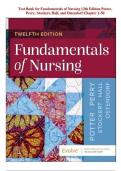
Test Bank for Fundamentals of Nursing, 12th Edition by Potter, Perry, Stockert, Hall, and Ostendorf, covering Chapters 1–50
Test Bank for Fundamentals of Nursing, 12th Edition Authors: Patricia A. Potter, Anne Griffin Perry, Patricia Stockert, Amy Hall, and Wendy Ostendorf Edition: 12th Edition Coverage: Chapters 1–50 Subject: Fundamentals of Nursing, Patient Care, Nursing Practice, and Clinical Foundations Format: Digital Study Resource Audience: Nursing Students, RN Students, BSN Students, ADN Students, and Nursing Learners Product Overview Prepare for your fundamentals of nursing coursework with this comprehensive Test Bank for Fundamentals of Nursing, 12th Edition by Potter, Perry, Stockert, Hall, and Ostendorf, covering Chapters 1–50. This study resource is designed to complement the textbook and help nursing students review foundational concepts, nursing procedures, patient care principles, clinical reasoning, communication, safety, health assessment, and professional nursing practice. Fundamentals of nursing provides the foundation for more advanced nursing subjects. Before progressing into medical-surgical nursing, maternal-child nursing, pediatric nursing, psychiatric nursing, community health nursing, and other specialty areas, students need a strong understanding of basic nursing principles and patient-care skills. A question-based resource can support active learning by allowing students to practice recalling important information, applying concepts to clinical situations, and identifying areas where additional review may be helpful. Chapters 1–50 Study Coverage This resource is intended to support review across the broad range of foundational nursing concepts addressed throughout the 50-chapter course material. Depending on the organization of the accompanying textbook, areas of study may include: Nursing foundations Nursing history and professional development Nursing roles and responsibilities Professional nursing practice Nursing theories and conceptual frameworks Evidence-based nursing practice Clinical judgment Critical thinking Nursing process Assessment Nursing diagnosis Planning Implementation Evaluation Patient-centered care Holistic nursing Cultural considerations Ethics in nursing Legal aspects of nursing Scope of nursing practice Communication Therapeutic communication Interprofessional collaboration Patient education Health promotion Wellness and illness Healthcare environments Patient safety Quality improvement Infection prevention and control Standard precautions Transmission-based precautions Hand hygiene Personal protective equipment Vital signs Health assessment Physical examination Pain assessment Pain management Comfort measures Sleep and rest Nutrition Hydration Fluid and electrolyte balance Elimination Urinary care Bowel care Mobility Positioning Exercise Activity intolerance Skin integrity Pressure injury prevention Wound care Hygiene Personal care Medication administration Medication safety Dosage-related concepts Documentation Reporting Patient rights Safety during transfers and ambulation Oxygenation Respiratory care Perioperative nursing concepts Emergency and acute care concepts Older adult care End-of-life care Loss and grief Spiritual care Discharge planning Continuity of care Designed for Nursing Students The test bank can be incorporated into study routines for learners enrolled in: Bachelor of Science in Nursing programs Associate Degree Nursing programs Diploma nursing programs Registered Nursing programs Practical nursing programs Fundamentals of Nursing courses Nursing foundations courses Clinical nursing courses Nursing laboratory courses Nursing simulation courses It can be useful for students who are beginning their nursing education and need additional practice with fundamental concepts before moving into advanced clinical subjects. Reinforce Fundamental Nursing Concepts Fundamentals of nursing involves much more than memorizing definitions. Students need to understand how nursing knowledge is applied to real patient-care situations. Practice questions can encourage learners to review important concepts such as assessment, planning, implementation, evaluation, communication, patient safety, infection control, documentation, and prioritization. Students can use questions to explore why a particular nursing intervention is appropriate, what information should be assessed first, which patient requires attention first, and what action promotes patient safety. Nursing Process and Clinical Judgment The nursing process is a core component of nursing education and practice. Students must understand how assessment information contributes to nursing decisions and how interventions are selected, implemented, and evaluated. Question-based practice can reinforce the relationship between: Assessment → Nursing Diagnosis → Planning → Implementation → Evaluation Students can also practice distinguishing between assessment findings, nursing interventions, expected outcomes, and evaluation findings. Developing these connections early can help learners build a stronger foundation for later clinical courses. Patient Safety and Quality Care Patient safety is an essential part of nursing practice. Students need to recognize potential hazards, use appropriate safety measures, communicate effectively, and follow established procedures. Study topics may include: Patient identification Fall prevention Safe patient transfers Medication safety Infection prevention Equipment safety Documentation Communication during handoff Prevention of healthcare-associated infections Safe positioning Environmental safety Reviewing these concepts through practice questions can help students become more familiar with common nursing safety principles. Communication and Patient-Centered Care Effective communication is essential for developing therapeutic relationships with patients, families, and healthcare professionals. Students can use practice questions to review therapeutic communication techniques, barriers to communication, active listening, patient education, culturally responsive care, and appropriate professional interactions. Patient-centered nursing requires nurses to consider the individual's physical, emotional, social, cultural, and spiritual needs. Reviewing these principles can help learners understand the broader responsibilities involved in nursing care. Infection Prevention and Control Infection control is another major component of fundamental nursing education. Students can review concepts involving hand hygiene, personal protective equipment, standard precautions, isolation procedures, aseptic techniques, and prevention of infection transmission. Practice questions can help learners distinguish between different precautions and understand when specific infection-control measures are required. Because clinical procedures and institutional policies may vary, students should always compare their study materials with current instructions from their nursing program and clinical facility. Medication Administration and Safety Medication administration requires careful attention to patient identification, medication orders, administration routes, documentation, assessment, and monitoring. This study resource can provide additional opportunities to review medication-related nursing concepts, including safe administration principles and responsibilities before, during, and after medication administration. Students should use their official course materials and current institutional policies when studying medication procedures. Patient Assessment and Vital Signs Assessment is one of the most important responsibilities in nursing practice. Students need to understand how to collect relevant information and recognize findings that may require further attention. Topics may include: Temperature Pulse Respirations Blood pressure Oxygen saturation Pain assessment General observations Physical assessment Patient history Documentation of findings Question practice can help students reinforce the relationship between assessment data and nursing interventions. Nutrition, Elimination, Mobility, and Comfort Fundamental nursing courses cover many activities of daily living and basic patient-care needs. Students may review nutrition, hydration, elimination, mobility, hygiene, sleep, comfort, and positioning. These concepts are important because nurses frequently assess and assist patients with activities that support health, independence, comfort, and recovery. Skin Integrity and Wound Care Maintaining skin integrity is an important aspect of patient care. Students can review factors that contribute to impaired skin integrity, pressure injury prevention, wound assessment, hygiene, repositioning, nutrition, and other nursing interventions. Understanding risk factors and preventive measures can help learners connect basic nursing care with patient outcomes. Preparation for Nursing Assessments Students can use the question bank as part of a structured examination-preparation strategy. A useful study routine may include: Read the assigned textbook chapter. Review lecture notes and instructor materials. Attempt practice questions without referring to notes. Identify questions that were difficult or incorrect. Return to the relevant textbook section. Review the concept again. Practice similar questions. Summarize the topic in your own words. This approach turns practice questions into an active-learning tool rather than simply a method of checking answers. Individual and Group Study The resource can be used for individual study or with classmates. Students studying independently can organize questions according to chapters and topics. Study groups can select questions and discuss the reasoning behind different answers. Explaining concepts to classmates can reinforce understanding and reveal areas where additional review is necessary. Benefits of This Study Resource Using a structured fundamentals of nursing test bank can help students: Review Chapters 1–50 Reinforce nursing fundamentals Practice clinical reasoning Review nursing terminology Identify knowledge gaps Strengthen active recall Review patient-care concepts Prepare for quizzes Prepare for examinations Reinforce textbook learning Review patient safety Practice nursing-process concepts Review communication principles Study infection-control concepts Reinforce medication-safety principles Review assessment concepts Organize nursing study sessions Support classroom and laboratory learning Important Study Note This product is intended as a supplementary educational study resource. It should be used together with the assigned textbook, lecture notes, instructor guidance, laboratory instruction, simulation activities, and current clinical policies. It is not a replacement for supervised clinical education or professional nursing instruction. Nursing students should follow the procedures and guidelines established by their educational institution and clinical placement. Ideal For Nursing students | BSN students | ADN students | RN students | Practical nursing students | Diploma nursing students | Fundamentals of Nursing students | Nursing foundation students | Nursing study groups | Nursing instructors | Clinical nursing learners | Nursing examination preparation | Nursing laboratory students Final Summary The Test Bank for Fundamentals of Nursing, 12th Edition by Potter, Perry, Stockert, Hall, and Ostendorf, Chapters 1–50 provides a structured question-based approach to reviewing essential nursing concepts. It can be incorporated into regular study sessions to reinforce foundational knowledge, practice clinical reasoning, identify areas for further review, and support preparation for nursing coursework and assessments. For the best learning experience, combine practice-question review with comprehensive textbook study, classroom instruction, hands-on skills practice, simulation, and supervised clinical experience.
Document information
- Uploaded on
- September 24, 2026
- Number of pages
- 585
- Written in
- 2026/2027
- Type
- Exam (elaborations)
- Contains
- Questions & answers


