
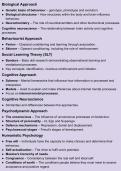
Biological Approach
● Genetic basis of behaviour – genotype, phenotype and evolution.
● Biological structures – How structures within the body and brain influence
behaviour.
● Neurochemistry – The role of neurotransmitters and other biochemical processes.
Cognitive neuroscience – The relationship between brain activity and cognitive
processes.
Behaviourist Approach
● Pavlov – Classical conditioning and learning through association.
● Skinner – Operant conditioning, including the role of reinforcement.
Social Learning Theory (SLT)
● Bandura – Bobo doll research demonstrating observational learning and
mediational processes.
● Key concepts: identification, vicarious reinforcement and imitation.
Cognitive Approach
● Schema – Mental frameworks that influence how information is processed and
interpreted.
● Models – Used to explain and make inferences about internal mental processes.
● Focus on internal mental processes.
Cognitive Neuroscience
● Similarities and differences between the approaches.
Psychodynamic Approach
● The unconscious – The influence of unconscious processes on behaviour.
● Structure of personality – Id, Ego and Superego.
● Defence mechanisms – Repression, denial and displacement.
● Psychosexual stages – Freud's stages of development.
Humanistic Psychology
● Free will – Individuals have the capacity to make choices and determine their
behaviour.
● Self-actualisation – The drive to fulfil one's potential.
● Maslow's hierarchy of needs.
● Congruence – Consistency between the real self and ideal self.
● Conditions of worth – The conditions people believe they must meet to receive
acceptance and positive regard.
, Biological structures → Which structures
Biological Approach influence behaviour?
Neurochemistry → How do biochemical
Nature–nurture interaction: processes influence behaviour?
Behaviour is influenced by both genetic Cognitive neuroscience → How does brain
factors and environmental experiences, which activity relate to cognitive processes?
can interact to produce an individual's
phenotype. Biological Structures
● Different structures of the brain and
Genetic basis of behaviour nervous system have specialised
Genotype functions that influence behaviour and
cognitive processes.
● An individual's genetic makeup - the
● For example, the hippocampus is
genes they inherit from their parents.
● Influences characteristics and
involved in spatial memory and
predispositions, including aspects of navigation.
behaviour. ● Maguire et al. (2000) provide an
example of the relationship between
Examples:
brain structure and behaviour.
- genes influencing eye colour
- genes influencing blood type Neurochemistry
Phenotype ● Behaviour is influenced by biochemical
● An individual's observable processes within the body, including the
characteristics, resulting from the action of neurotransmitters.
interaction between their genotype and ● Neurotransmitters are chemical
environment. messengers that allow communication
● Therefore, genes do not necessarily between neurons.
determine behaviour directly; ● Changes in neurotransmitter activity can
environmental factors can influence how influence behaviour, mood and cognitive
genetic predispositions are expressed. processes.
Examples: ● Examples include dopamine, serotonin
and GABA.
- Height influenced by genes + nutrition
- Skin Pigmentation influenced by genes + Cognitive Neuroscience
sun exposure
● Cognitive neuroscience investigates how
Evolution brain activity and structures are
● Behaviour can be influenced by natural associated with cognitive processes
selection. such as memory, attention and
● Characteristics that improve an organism's perception.
chances of survival and reproduction are ● Techniques such as brain scanning can
more likely to be passed on to future be used to investigate these
generations through natural selection. relationships.
● Over many generations, this can result in ● This allows researchers to make links
behavioural characteristics becoming between observable brain activity and
more common within a population. cognitive processes.
● Genetic basis of behaviour – genotype, phenotype and evolution.
● Biological structures – How structures within the body and brain influence
behaviour.
● Neurochemistry – The role of neurotransmitters and other biochemical processes.
Cognitive neuroscience – The relationship between brain activity and cognitive
processes.
Behaviourist Approach
● Pavlov – Classical conditioning and learning through association.
● Skinner – Operant conditioning, including the role of reinforcement.
Social Learning Theory (SLT)
● Bandura – Bobo doll research demonstrating observational learning and
mediational processes.
● Key concepts: identification, vicarious reinforcement and imitation.
Cognitive Approach
● Schema – Mental frameworks that influence how information is processed and
interpreted.
● Models – Used to explain and make inferences about internal mental processes.
● Focus on internal mental processes.
Cognitive Neuroscience
● Similarities and differences between the approaches.
Psychodynamic Approach
● The unconscious – The influence of unconscious processes on behaviour.
● Structure of personality – Id, Ego and Superego.
● Defence mechanisms – Repression, denial and displacement.
● Psychosexual stages – Freud's stages of development.
Humanistic Psychology
● Free will – Individuals have the capacity to make choices and determine their
behaviour.
● Self-actualisation – The drive to fulfil one's potential.
● Maslow's hierarchy of needs.
● Congruence – Consistency between the real self and ideal self.
● Conditions of worth – The conditions people believe they must meet to receive
acceptance and positive regard.
, Biological structures → Which structures
Biological Approach influence behaviour?
Neurochemistry → How do biochemical
Nature–nurture interaction: processes influence behaviour?
Behaviour is influenced by both genetic Cognitive neuroscience → How does brain
factors and environmental experiences, which activity relate to cognitive processes?
can interact to produce an individual's
phenotype. Biological Structures
● Different structures of the brain and
Genetic basis of behaviour nervous system have specialised
Genotype functions that influence behaviour and
cognitive processes.
● An individual's genetic makeup - the
● For example, the hippocampus is
genes they inherit from their parents.
● Influences characteristics and
involved in spatial memory and
predispositions, including aspects of navigation.
behaviour. ● Maguire et al. (2000) provide an
example of the relationship between
Examples:
brain structure and behaviour.
- genes influencing eye colour
- genes influencing blood type Neurochemistry
Phenotype ● Behaviour is influenced by biochemical
● An individual's observable processes within the body, including the
characteristics, resulting from the action of neurotransmitters.
interaction between their genotype and ● Neurotransmitters are chemical
environment. messengers that allow communication
● Therefore, genes do not necessarily between neurons.
determine behaviour directly; ● Changes in neurotransmitter activity can
environmental factors can influence how influence behaviour, mood and cognitive
genetic predispositions are expressed. processes.
Examples: ● Examples include dopamine, serotonin
and GABA.
- Height influenced by genes + nutrition
- Skin Pigmentation influenced by genes + Cognitive Neuroscience
sun exposure
● Cognitive neuroscience investigates how
Evolution brain activity and structures are
● Behaviour can be influenced by natural associated with cognitive processes
selection. such as memory, attention and
● Characteristics that improve an organism's perception.
chances of survival and reproduction are ● Techniques such as brain scanning can
more likely to be passed on to future be used to investigate these
generations through natural selection. relationships.
● Over many generations, this can result in ● This allows researchers to make links
behavioural characteristics becoming between observable brain activity and
more common within a population. cognitive processes.


