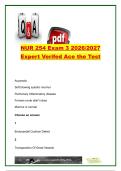
This NUR 254 Exam 3 2026/2027 study resource provides 100+ exam questions, answers, clinical findings, nursing interventions, developmental concepts, medications, and patient-teaching points across 24 pages. The document focuses on pediatric nursing and child health, combining growth and development with family-centered care, pediatric assessment, congenital heart disease, respiratory disorders, renal and urinary conditions, dehydration, and gastrointestinal abnormalities. The cover identifies the resource as “NUR 254 Exam 3 2026/2027 – Expert Verified Ace the Test,” and the opening questions immediately test congenital cardiac defects and emergency pediatric interventions.
The first major section covers the foundations of family-centered and atraumatic pediatric nursing care. Family-centered care is organized around empowerment and enabling families to participate in planning, delivery, and evaluation, while atraumatic care emphasizes preventing or minimizing separation, loss of control, bodily injury, and pain. The pediatric nurse's roles include therapeutic relationships, family advocacy, health promotion, disease and injury prevention, teaching, counseling, collaboration, and ethical decision-making. Growth principles such as cephalocaudal and proximodistal development are also reviewed, alongside expected infant weight changes.
A substantial developmental section reviews Erikson's psychosocial stages from infancy through adolescence. Topics include trust versus mistrust, autonomy versus shame and doubt, initiative versus guilt, industry versus inferiority, and identity versus role confusion. Students also review developmental communication, therapeutic play, and patterns of unoccupied, onlooker, solitary, parallel, associative, and cooperative play. The material links these concepts to age-appropriate nursing communication, privacy, choices, explanations, and activities children can successfully accomplish.
The resource provides practical preparation for pediatric assessment, pain measurement, milestones, immunization, and health screening. Pain tools represented in the notes include NIPS, FLACC, Wong-Baker Faces, and numeric rating scales for different pediatric age groups. Students review red flags involving fontanel closure, weight gain, babbling, and abnormal fontanel appearance, along with infant and toddler milestones such as rolling, sitting unsupported, walking, stair climbing, running, jumping, and toilet training. Lead screening, preschool milestones, vaccine consent, live-vaccine precautions in immunocompromised children, and active versus passive immunity are also covered.
One of the document's largest sections focuses on pediatric cardiovascular nursing and congenital heart defects. Students distinguish acyanotic left-to-right shunts from cyanotic right-to-left shunts and mixed-blood-flow disorders. Conditions include patent ductus arteriosus (PDA), atrial septal defect (ASD), ventricular septal defect (VSD), coarctation of the aorta, Tetralogy of Fallot, tricuspid atresia, and transposition of the great vessels. The material reviews murmurs, altered pulmonary blood flow, extremity blood-pressure and pulse differences, cyanosis, feeding difficulties, and failure to thrive.
Emergency cardiovascular concepts include Tet spells and pediatric heart failure. The notes direct students to recognize knee-to-chest positioning, calming the child, oxygen, prescribed medication, and remaining with the child during a Tet spell. Heart-failure content covers early findings such as increased respiratory rate and poor feeding, along with digoxin, furosemide, electrolyte monitoring, weight changes, and right-sided manifestations such as jugular venous distention, dependent edema, hepatomegaly, ascites, and weight gain. Post-cardiac-catheterization teaching is also included.
The respiratory section covers acute epiglottitis, croup, RSV, cystic fibrosis, asthma, status asthmaticus, postural drainage, otitis media, and tonsil/adenoid care. The study guide identifies epiglottitis as an emergency and warns against throat inspection or culture in the scenario described. Croup is associated with a barking cough, while RSV review emphasizes tachypnea and oxygen-saturation monitoring. Cystic fibrosis content includes abnormally thick secretions, failure to thrive, nutrition, infection prevention, chest physiotherapy/postural drainage, and pancreatic enzymes given with meals.
Asthma material reviews wheezing, allergen avoidance, bronchospasm management, exercise, recognition of deterioration, peak/expiratory flow monitoring, inhaler teaching, and trigger avoidance. The document specifically associates absence of wheezing during status asthmaticus with a need for immediate follow-up. Additional cardiopulmonary material includes Kawasaki disease and rheumatic fever/carditis, with strawberry tongue and peeling skin included under Kawasaki disease and a history of group A streptococcal infection and elevated ASO titer represented in the rheumatic-fever material.
Another important section covers pediatric urinary and renal disorders. Students review UTI risk and prevention, including the course material's identification of E. coli as a common cause, increased fluids, front-to-back wiping, regular voiding, and avoidance of caffeine. Enuresis, acute glomerulonephritis, and nephrotic syndrome are also addressed. The guide associates acute glomerulonephritis with group A streptococcal infection, hypertension, hematuria, proteinuria, and ASO titers, while nephrotic syndrome is characterized by massive proteinuria and hypoalbuminemia. Normal pediatric urinary output is listed as 1–3 mL/kg/hr in the source.
The concluding pages concentrate on dehydration and pediatric gastrointestinal disorders. Dehydration review includes a sunken fontanel and oral rehydration as the initial intervention represented in the notes. GI disorders include Hirschsprung disease, gastroesophageal reflux, cleft lip/palate, tracheoesophageal fistula, pyloric stenosis, and intussusception. Hirschsprung disease is associated with delayed passage of meconium, bilious vomiting, constipation, and ribbon-like stool at later ages. Pyloric stenosis includes projectile vomiting and an olive-like abdominal mass, while tracheoesophageal fistula is associated with coughing, cyanosis, and choking and is treated as NPO in the document.
The final topic, intussusception, is described as telescoping of the intestine that produces inflammation and reduced bowel blood flow. Key exam findings in the document include currant-jelly stools and a sausage-shaped abdominal mass. Together with the earlier cardiac, respiratory, renal, developmental, and family-care material, these topics make the document a broad pediatric nursing review rather than a resource focused on a single body system.
Relevant students: This document is most relevant for NUR 254 students preparing for Exam 3 in the 2026/2027 academic year, particularly nursing students studying pediatric nursing, child health, family-centered care, pediatric growth and development, congenital heart disease, pediatric respiratory nursing, renal disorders, gastrointestinal disorders, and medical-surgical pediatric care. It is especially useful for students reviewing Erikson stages, developmental milestones, pediatric pain scales, congenital cardiac defects, Tetralogy of Fallot, heart failure, cystic fibrosis, asthma, RSV, glomerulonephritis, nephrotic syndrome, dehydration, Hirschsprung disease, tracheoesophageal fistula, pyloric stenosis, and intussusception. The uploaded document does not identify a university or institution, so a specific university name cannot accurately be included at the end of the title.
Keywords: NUR 254 Exam 3, NUR , NUR 254 Exam 3 questions and answers, NUR 254 study guide, pediatric nursing exam, child health nursing, family centered care, atraumatic care, pediatric growth and development, Erikson pediatric stages, pediatric developmental milestones, pediatric pain scales, NIPS pain scale, FLACC scale, Wong Baker Faces, pediatric assessment, pediatric immunizations, congenital heart defects, acyanotic heart defects, cyanotic heart defects, patent ductus arteriosus, PDA, atrial septal defect, ASD, ventricular septal defect, VSD, coarctation of the aorta, Tetralogy of Fallot, tet spells, transposition of great vessels, tricuspid atresia, pediatric heart failure, digoxin pediatric nursing, Kawasaki disease, rheumatic fever, acute epiglottitis, croup, RSV, cystic fibrosis, pancreatic enzymes, pediatric asthma, status asthmaticus, otitis media, pediatric UTI, enuresis, acute glomerulonephritis, nephrotic syndrome, pediatric dehydration, Hirschsprung disease, GERD pediatric nursing, cleft lip and palate, tracheoesophageal fistula, pyloric stenosis, intussusception, pediatric gastrointestinal disorders