
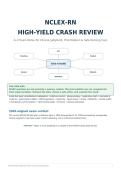
NCLEX-RN
HIGH-YIELD CRASH REVIEW
A–Z Exam Notes for Clinical Judgment, Prioritization & Safe Nursing Care
Act
Prioritize Protect
SAFE NURSING
Assess Educate
Reassess
THE CORE IDEA
NCLEX questions are not primarily a memory contest. They test whether you can recognize the
most urgent problem, interpret the data, choose a safe action, and evaluate the result.
Inside this book: prioritization & delegation • infection control • pharmacology • medication math • restraints &
crutches • electrolytes & ABGs • CBC/coagulation • maternity • heart failure • stroke • DKA/HHS • mental health
• therapeutic communication • rapid-review tables • formulas • decision pathways
2026-aligned exam context
The current NCLEX-RN test plan is effective April 1, 2026 through March 31, 2029 and explicitly incorporates
clinical judgment. Use these notes to build reasoning, not to memorize isolated trivia.
PREVIEW • Pages 1–3 are designed as a sample of the finished study-book format.
NCLEX-RN High-Yield Crash Review • Exam-focused study notes 1
, Preview: The NCLEX Priority Engine
When several patients compete for attention, do not ask “Which diagnosis sounds worst?” Ask “Who has the
greatest immediate risk of deterioration, and what assessment/action prevents harm?”
Immediate threat Airway / Breathing Circulation / Acute change Stable / chronic
Safety
Situation Priority thinking Typical action
Stridor / airway obstruction Airway threat can become fatal quickly Assess airway, call for help, intervene
immediately
SpO₂ 82% with respiratory Severe oxygenation problem Assess breathing and oxygenation; intervene
distress promptly
New chest pain Acute, potentially life-threatening change Immediate focused assessment and
emergency response
Active bleeding + stable Hemorrhage threatens circulation Control bleeding, assess perfusion, escalate
chronic disease
Stable COPD on established Expected/chronic and stable Can generally wait behind unstable clients
home oxygen
IMPORTANT CORRECTION
Do not treat “ABCs” as a magic answer. A patient with an immediate safety threat may take
priority, and the clinical context determines the first action. Also, words such as “always” and
“never” are not automatically wrong. Judge the actual nursing action.
Clinical judgment loop
Prioritize
hypotheses
Recognize cues Take action
CLINICAL JUDGMENT
Analyze cues Evaluate outcomes
Generate solutions
Exam habit: read the final question first, identify what is being asked, then return to the case and separate
unstable/new/acute findings from stable/expected/chronic findings.
NCLEX-RN High-Yield Crash Review • Exam-focused study notes 2
, Preview: The Lab & ABG Fast Map
The goal is not to recite numbers. Link the abnormal value to the body system it threatens and the action it
demands.
Lab Common reference range High-yield association
in this review
Na⁺ 135–145 mEq/L Brain: confusion, seizures, severe neurologic changes
K⁺ 3.5–5.0 mEq/L Heart: dysrhythmias; hyperkalemia may produce peaked T waves
Ca²⁺ 8.5–10.5 mg/dL Muscle/nerve: hypocalcemia → tetany; hypercalcemia → weakness
Mg²⁺ 1.5–2.5 mg/dL Reflexes/cardiac function: low → hyperreflexia; high → depressed reflexes
pH 7.35–7.45 Acid-base status
PaCO₂ 35–45 mmHg Respiratory component
HCO₃⁻ 22–26 mEq/L Metabolic component
pH: acid or alk? Compare CO₂ Compare HCO₃⁻ ROME Name disorder
ROME
Respiratory Opposite, Metabolic Equal. pH and PaCO₂ move in opposite directions in primary
respiratory disorders. pH and HCO₃⁻ move in the same direction in primary metabolic disorders.
Pattern Interpretation Think
↓ pH + ↑ PaCO₂ Respiratory acidosis Hypoventilation, COPD, sedation
↑ pH + ↓ PaCO₂ Respiratory alkalosis Hyperventilation, panic, fever
↓ pH + ↓ HCO₃⁻ Metabolic acidosis DKA, renal failure, diarrhea
↑ pH + ↑ HCO₃⁻ Metabolic alkalosis Vomiting, gastric acid loss
This is the level of compression used throughout the book: understand the mechanism first, then memorize the
small set of numbers and exceptions that repeatedly matter.
NCLEX-RN High-Yield Crash Review • Exam-focused study notes 3
HIGH-YIELD CRASH REVIEW
A–Z Exam Notes for Clinical Judgment, Prioritization & Safe Nursing Care
Act
Prioritize Protect
SAFE NURSING
Assess Educate
Reassess
THE CORE IDEA
NCLEX questions are not primarily a memory contest. They test whether you can recognize the
most urgent problem, interpret the data, choose a safe action, and evaluate the result.
Inside this book: prioritization & delegation • infection control • pharmacology • medication math • restraints &
crutches • electrolytes & ABGs • CBC/coagulation • maternity • heart failure • stroke • DKA/HHS • mental health
• therapeutic communication • rapid-review tables • formulas • decision pathways
2026-aligned exam context
The current NCLEX-RN test plan is effective April 1, 2026 through March 31, 2029 and explicitly incorporates
clinical judgment. Use these notes to build reasoning, not to memorize isolated trivia.
PREVIEW • Pages 1–3 are designed as a sample of the finished study-book format.
NCLEX-RN High-Yield Crash Review • Exam-focused study notes 1
, Preview: The NCLEX Priority Engine
When several patients compete for attention, do not ask “Which diagnosis sounds worst?” Ask “Who has the
greatest immediate risk of deterioration, and what assessment/action prevents harm?”
Immediate threat Airway / Breathing Circulation / Acute change Stable / chronic
Safety
Situation Priority thinking Typical action
Stridor / airway obstruction Airway threat can become fatal quickly Assess airway, call for help, intervene
immediately
SpO₂ 82% with respiratory Severe oxygenation problem Assess breathing and oxygenation; intervene
distress promptly
New chest pain Acute, potentially life-threatening change Immediate focused assessment and
emergency response
Active bleeding + stable Hemorrhage threatens circulation Control bleeding, assess perfusion, escalate
chronic disease
Stable COPD on established Expected/chronic and stable Can generally wait behind unstable clients
home oxygen
IMPORTANT CORRECTION
Do not treat “ABCs” as a magic answer. A patient with an immediate safety threat may take
priority, and the clinical context determines the first action. Also, words such as “always” and
“never” are not automatically wrong. Judge the actual nursing action.
Clinical judgment loop
Prioritize
hypotheses
Recognize cues Take action
CLINICAL JUDGMENT
Analyze cues Evaluate outcomes
Generate solutions
Exam habit: read the final question first, identify what is being asked, then return to the case and separate
unstable/new/acute findings from stable/expected/chronic findings.
NCLEX-RN High-Yield Crash Review • Exam-focused study notes 2
, Preview: The Lab & ABG Fast Map
The goal is not to recite numbers. Link the abnormal value to the body system it threatens and the action it
demands.
Lab Common reference range High-yield association
in this review
Na⁺ 135–145 mEq/L Brain: confusion, seizures, severe neurologic changes
K⁺ 3.5–5.0 mEq/L Heart: dysrhythmias; hyperkalemia may produce peaked T waves
Ca²⁺ 8.5–10.5 mg/dL Muscle/nerve: hypocalcemia → tetany; hypercalcemia → weakness
Mg²⁺ 1.5–2.5 mg/dL Reflexes/cardiac function: low → hyperreflexia; high → depressed reflexes
pH 7.35–7.45 Acid-base status
PaCO₂ 35–45 mmHg Respiratory component
HCO₃⁻ 22–26 mEq/L Metabolic component
pH: acid or alk? Compare CO₂ Compare HCO₃⁻ ROME Name disorder
ROME
Respiratory Opposite, Metabolic Equal. pH and PaCO₂ move in opposite directions in primary
respiratory disorders. pH and HCO₃⁻ move in the same direction in primary metabolic disorders.
Pattern Interpretation Think
↓ pH + ↑ PaCO₂ Respiratory acidosis Hypoventilation, COPD, sedation
↑ pH + ↓ PaCO₂ Respiratory alkalosis Hyperventilation, panic, fever
↓ pH + ↓ HCO₃⁻ Metabolic acidosis DKA, renal failure, diarrhea
↑ pH + ↑ HCO₃⁻ Metabolic alkalosis Vomiting, gastric acid loss
This is the level of compression used throughout the book: understand the mechanism first, then memorize the
small set of numbers and exceptions that repeatedly matter.
NCLEX-RN High-Yield Crash Review • Exam-focused study notes 3


