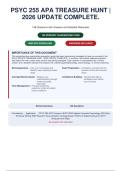
PSYC 255 APA TREASURE HUNT |
2026 UPDATE COMPLETE.
148 Questions with Answers and Detailed Rationales
100 PERCENT GUARANTEED PASS
INSTANT DOWNLOAD ANSWERS INCLUDED
IMPORTANCE OF THIS DOCUMENT
This comprehensive examination preparation guide has been meticulously developed to help you succeed in the
PSYC 255 APA TREASURE HUNT | 2026 UPDATE COMPLETE.. It contains 148 carefully selected questions
that reflect the most current exam content and testing strategies. Each question is accompanied by a correct
answer and a detailed rationale that explains the underlying pathophysiology, pharmacology, or clinical reasoning.
Self-Assessment – Test your knowledge and Exam Preparation – Familiarize yourself with the
identify areas requiring further question format and content
study areas
Concept Reinforcement – Deepen your Confidence Building – Develop test-taking
understanding through strategies and reduce
evidence-based exam anxiety
rationales
Time Management – Practice answering
questions under simulated
exam conditions
Review Summary 148 Questions
Foundations - Application - PSYC 255 APA Treasure HUNT 2026 Update Complete Psychology APA Style
Scholarly Writing AND Research Documentation Undergraduate YEAR 2-3 Sophomore/junior WITH
Graduate-level Rigor
All answers with rationales
,Table of Contents
Content Area Questions Key Topics
APA Style Overview AND 1-25 APA 7th Edition, Researcher, Reference, Article, Citation
Ethical USE OF Sources
Formatting THE Title PAGE 26-50 Student, Researcher, Format, APA 7th Edition, Manuscript
AND Running HEAD
In-text Citations 51-75 APA 7th Edition, Reference, Citation, Authors, Source
Paraphrasing AND Direct
Quotations
Citing Different Source Types 76-100 APA 7th Edition, Researcher, Wants, Student, Article
Books Journal Articles
Websites
Constructing THE Reference 101-125 APA 7th Edition, Researcher, Source, Manuscript, Student
LIST CORE Elements
Reference LIST Formatting 126-148 Reference, Researcher, Student, APA 7th Edition, Wants
AND Alphabetical Order
TOTAL 148 All questions include answers and detailed rationales
,Section A - APA Style Overview AND Ethical USE OF
Sources
Q1.
A researcher paraphrases a key finding from a 2024 article by two authors across three
separate sentences within one paragraph. According to APA 7th edition, what is the
correct citation practice?
A. Cite the authors in every sentence to B. Cite the authors in the first sentence only;
avoid ambiguity. subsequent sentences in the same
paragraph need no citation.
C. Cite the authors in the first sentence and D. Use a single footnote at the paragraph's
again in the final sentence if the material end instead of parenthetical citations.
spans multiple sentences.
Correct: C - Cite the authors in the first sentence and again in the final sentence if the
material spans multiple sentences.
Rationale:APA 7th edition permits citing the source once at the start of a multi-sentence
paraphrase and again at the end if the paraphrase continues across several sentences,
ensuring the reader knows the material's boundaries. Citing every sentence (A) is redundant,
and omitting all but the first (B) risks ambiguity about where the borrowed idea ends.
Why the other answers are wrong:
A. Repeating the citation in every sentence is unnecessary and clutters the prose under APA
7th edition guidance.
B. Omitting a closing citation can leave the reader unsure whether later sentences are the
author's original ideas.
D. APA 7th edition uses author-date citations in text, not footnotes, for source attribution.
Reference: American Psychological Association. (2020). Publication manual of the American
Psychological Association (7th ed.), §8.1-8.2.
Q2.
Which reference-list entry correctly follows APA 7th edition for a journal article with a
DOI?
A. Smith, J. A., & Lee, K. (2023). Title of B. Smith, J. A., & Lee, K. (2023). Title of
article. Journal of Psychology, 45(2), article. Journal of Psychology, 45(2),
123-145. https://doi.org/10.xxxx/yyyy 123-145. Retrieved from
https://doi.org/10.xxxx/yyyy
C. Smith, J. A., & Lee, K. (2023). Title of D. Smith, J. A., & Lee, K. (2023). Title of
article. Journal of Psychology, 45(2), pp. article. Journal of Psychology, 45, 123-145.
123-145. doi:10.xxxx/yyyy DOI: 10.xxxx/yyyy
Page 3
, Section A - APA Style Overview AND Ethical USE OF Sources
Correct: A - Smith, J. A., & Lee, K. (2023). Title of article. Journal of Psychology, 45(2),
123-145. https://doi.org/10.xxxx/yyyy
Rationale:APA 7th edition requires the DOI as a full https://doi.org/ URL, no 'Retrieved from'
preface, no 'pp.' before page numbers, and issue numbers included when available. Option A
satisfies all these requirements.
Why the other answers are wrong:
B. APA 7th edition eliminated the 'Retrieved from' phrase before DOIs.
C. APA reference entries do not include 'pp.' before page ranges, and DOIs must be formatted
as https URLs.
D. Omitting the issue number and using 'DOI:' with a space violates APA 7th edition formatting.
Reference: American Psychological Association. (2020). Publication manual (7th ed.), §9.34, §10.1.
Q3.
Which sentence demonstrates bias-free language consistent with APA 7th edition when
describing participants in a study of older adults with diabetes?
A. The diabetic elderly subjects completed B. The elderly diabetic patients completed
the survey. the survey.
C. The older adults with diabetes completed D. The aged diabetics completed the survey.
the survey.
Correct: C - The older adults with diabetes completed the survey.
Rationale:APA 7th edition endorses person-first language and adjectives rather than labels,
so 'older adults with diabetes' is preferred. Terms like 'the diabetic elderly' or 'the aged
diabetics' reduce participants to a condition or age category.
Why the other answers are wrong:
A. 'Diabetic elderly subjects' uses a condition as a label and 'subjects' is discouraged in favor of
'participants.'
B. Placing 'elderly' before 'diabetic' still labels individuals by condition rather than using
person-first language.
D. 'The aged diabetics' is a categorical label that APA 7th edition specifically advises against.
Reference: American Psychological Association. (2020). Publication manual (7th ed.), §5.1-5.4.
Q4.
A researcher reports a statistically nonsignificant result and writes, 'The intervention did
not work.' Which APA/JARS reporting practice is most appropriate?
A. State that the intervention was ineffective B. Report the test statistic, p value, and
and omit the test statistic. effect size, and describe the result as not
statistically significant rather than
'ineffective.'
Page 4
2026 UPDATE COMPLETE.
148 Questions with Answers and Detailed Rationales
100 PERCENT GUARANTEED PASS
INSTANT DOWNLOAD ANSWERS INCLUDED
IMPORTANCE OF THIS DOCUMENT
This comprehensive examination preparation guide has been meticulously developed to help you succeed in the
PSYC 255 APA TREASURE HUNT | 2026 UPDATE COMPLETE.. It contains 148 carefully selected questions
that reflect the most current exam content and testing strategies. Each question is accompanied by a correct
answer and a detailed rationale that explains the underlying pathophysiology, pharmacology, or clinical reasoning.
Self-Assessment – Test your knowledge and Exam Preparation – Familiarize yourself with the
identify areas requiring further question format and content
study areas
Concept Reinforcement – Deepen your Confidence Building – Develop test-taking
understanding through strategies and reduce
evidence-based exam anxiety
rationales
Time Management – Practice answering
questions under simulated
exam conditions
Review Summary 148 Questions
Foundations - Application - PSYC 255 APA Treasure HUNT 2026 Update Complete Psychology APA Style
Scholarly Writing AND Research Documentation Undergraduate YEAR 2-3 Sophomore/junior WITH
Graduate-level Rigor
All answers with rationales
,Table of Contents
Content Area Questions Key Topics
APA Style Overview AND 1-25 APA 7th Edition, Researcher, Reference, Article, Citation
Ethical USE OF Sources
Formatting THE Title PAGE 26-50 Student, Researcher, Format, APA 7th Edition, Manuscript
AND Running HEAD
In-text Citations 51-75 APA 7th Edition, Reference, Citation, Authors, Source
Paraphrasing AND Direct
Quotations
Citing Different Source Types 76-100 APA 7th Edition, Researcher, Wants, Student, Article
Books Journal Articles
Websites
Constructing THE Reference 101-125 APA 7th Edition, Researcher, Source, Manuscript, Student
LIST CORE Elements
Reference LIST Formatting 126-148 Reference, Researcher, Student, APA 7th Edition, Wants
AND Alphabetical Order
TOTAL 148 All questions include answers and detailed rationales
,Section A - APA Style Overview AND Ethical USE OF
Sources
Q1.
A researcher paraphrases a key finding from a 2024 article by two authors across three
separate sentences within one paragraph. According to APA 7th edition, what is the
correct citation practice?
A. Cite the authors in every sentence to B. Cite the authors in the first sentence only;
avoid ambiguity. subsequent sentences in the same
paragraph need no citation.
C. Cite the authors in the first sentence and D. Use a single footnote at the paragraph's
again in the final sentence if the material end instead of parenthetical citations.
spans multiple sentences.
Correct: C - Cite the authors in the first sentence and again in the final sentence if the
material spans multiple sentences.
Rationale:APA 7th edition permits citing the source once at the start of a multi-sentence
paraphrase and again at the end if the paraphrase continues across several sentences,
ensuring the reader knows the material's boundaries. Citing every sentence (A) is redundant,
and omitting all but the first (B) risks ambiguity about where the borrowed idea ends.
Why the other answers are wrong:
A. Repeating the citation in every sentence is unnecessary and clutters the prose under APA
7th edition guidance.
B. Omitting a closing citation can leave the reader unsure whether later sentences are the
author's original ideas.
D. APA 7th edition uses author-date citations in text, not footnotes, for source attribution.
Reference: American Psychological Association. (2020). Publication manual of the American
Psychological Association (7th ed.), §8.1-8.2.
Q2.
Which reference-list entry correctly follows APA 7th edition for a journal article with a
DOI?
A. Smith, J. A., & Lee, K. (2023). Title of B. Smith, J. A., & Lee, K. (2023). Title of
article. Journal of Psychology, 45(2), article. Journal of Psychology, 45(2),
123-145. https://doi.org/10.xxxx/yyyy 123-145. Retrieved from
https://doi.org/10.xxxx/yyyy
C. Smith, J. A., & Lee, K. (2023). Title of D. Smith, J. A., & Lee, K. (2023). Title of
article. Journal of Psychology, 45(2), pp. article. Journal of Psychology, 45, 123-145.
123-145. doi:10.xxxx/yyyy DOI: 10.xxxx/yyyy
Page 3
, Section A - APA Style Overview AND Ethical USE OF Sources
Correct: A - Smith, J. A., & Lee, K. (2023). Title of article. Journal of Psychology, 45(2),
123-145. https://doi.org/10.xxxx/yyyy
Rationale:APA 7th edition requires the DOI as a full https://doi.org/ URL, no 'Retrieved from'
preface, no 'pp.' before page numbers, and issue numbers included when available. Option A
satisfies all these requirements.
Why the other answers are wrong:
B. APA 7th edition eliminated the 'Retrieved from' phrase before DOIs.
C. APA reference entries do not include 'pp.' before page ranges, and DOIs must be formatted
as https URLs.
D. Omitting the issue number and using 'DOI:' with a space violates APA 7th edition formatting.
Reference: American Psychological Association. (2020). Publication manual (7th ed.), §9.34, §10.1.
Q3.
Which sentence demonstrates bias-free language consistent with APA 7th edition when
describing participants in a study of older adults with diabetes?
A. The diabetic elderly subjects completed B. The elderly diabetic patients completed
the survey. the survey.
C. The older adults with diabetes completed D. The aged diabetics completed the survey.
the survey.
Correct: C - The older adults with diabetes completed the survey.
Rationale:APA 7th edition endorses person-first language and adjectives rather than labels,
so 'older adults with diabetes' is preferred. Terms like 'the diabetic elderly' or 'the aged
diabetics' reduce participants to a condition or age category.
Why the other answers are wrong:
A. 'Diabetic elderly subjects' uses a condition as a label and 'subjects' is discouraged in favor of
'participants.'
B. Placing 'elderly' before 'diabetic' still labels individuals by condition rather than using
person-first language.
D. 'The aged diabetics' is a categorical label that APA 7th edition specifically advises against.
Reference: American Psychological Association. (2020). Publication manual (7th ed.), §5.1-5.4.
Q4.
A researcher reports a statistically nonsignificant result and writes, 'The intervention did
not work.' Which APA/JARS reporting practice is most appropriate?
A. State that the intervention was ineffective B. Report the test statistic, p value, and
and omit the test statistic. effect size, and describe the result as not
statistically significant rather than
'ineffective.'
Page 4