
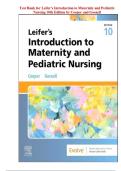
Leifer’s Introduction to Maternity and Pediatric Nursing, 10th Edition – Nursing Study Guide & Practice Questions
Leifer’s Introduction to Maternity and Pediatric Nursing, 10th Edition – Nursing Study Guide & Practice Questions Prepare for maternity and pediatric nursing coursework with a comprehensive study resource designed around the major concepts covered in Leifer’s Introduction to Maternity and Pediatric Nursing, 10th Edition. This resource is suitable for nursing students who want additional practice, review, and reinforcement of essential concepts in maternal-newborn and pediatric nursing. The 10th edition provides an opportunity to strengthen understanding of the nursing care of women, newborns, infants, children, and adolescents. A well-organized practice resource can help students review important concepts, test their knowledge, identify areas requiring additional study, and prepare for classroom examinations and nursing assessments. This study resource is useful for students taking maternity nursing, maternal-child nursing, pediatric nursing, obstetric nursing, or related healthcare courses. It can also serve as a supplementary review tool for students preparing for comprehensive nursing examinations and NCLEX-style practice. Topics commonly associated with maternity and pediatric nursing include reproductive health, pregnancy, prenatal care, labor and delivery, postpartum nursing care, newborn assessment, newborn complications, infant care, growth and development, pediatric health conditions, family-centered care, and nursing interventions. Students can use practice questions to reinforce their understanding of important nursing principles rather than simply memorizing information. Reviewing questions alongside textbook material can help develop clinical reasoning, prioritization, assessment, patient-safety awareness, and appropriate nursing interventions. The maternity section can support review of pregnancy-related concepts, including maternal physiologic changes, prenatal assessment, nutrition during pregnancy, fetal development, complications of pregnancy, labor processes, delivery, postpartum assessment, and patient education. Newborn-related material can help students review newborn assessment, adaptation to extrauterine life, feeding, safety, common newborn problems, and nursing care. The pediatric section provides a foundation for reviewing nursing care across different developmental stages. Students can reinforce concepts involving infants, toddlers, preschoolers, school-age children, and adolescents. Developmental milestones, nutrition, health promotion, communication, injury prevention, family involvement, and common pediatric disorders are important areas for nursing students to understand. A strong maternity and pediatric nursing study resource should also encourage students to connect assessment findings with nursing actions. Practice questions can therefore be used to develop skills such as recognizing abnormal findings, determining appropriate priorities, selecting safe interventions, evaluating outcomes, and identifying situations that require immediate attention. This resource may be particularly useful for students who prefer active learning. Instead of only reading chapters repeatedly, students can answer practice questions, review explanations, identify incorrect responses, and return to the relevant textbook sections for clarification. It can be incorporated into individual study sessions, small-group review, classroom preparation, or examination revision. Students may use the material before lectures to familiarize themselves with major concepts or after completing textbook chapters to evaluate their understanding. For maternity nursing, learners can focus on the continuum of care from preconception through pregnancy, childbirth, postpartum recovery, and newborn care. For pediatric nursing, learners can concentrate on developmental considerations, family-centered care, health promotion, disease prevention, assessment, and nursing management. Another important benefit of practice-based learning is the opportunity to recognize knowledge gaps. If a student repeatedly struggles with a particular subject—such as fetal monitoring, postpartum complications, developmental milestones, pediatric medication safety, or newborn assessment—the student can identify that topic for additional review. The resource is also useful for building familiarity with nursing-question formats. Students can practice analyzing clinical scenarios, identifying relevant assessment information, distinguishing expected from unexpected findings, and selecting appropriate nursing responses. This study material should be used as a supplement to the official textbook, instructor materials, lecture notes, and other authorized learning resources. Students should verify clinical information against current course materials and current evidence-based nursing guidance because nursing education and clinical recommendations can change over time. Whether you are beginning your maternity and pediatric nursing course or reviewing before a major examination, structured practice can make studying more active and focused. Use the questions to assess your current knowledge, review difficult concepts, and strengthen clinical reasoning. Key Study Areas May Include: Maternity and maternal-newborn nursing Reproductive health Prenatal assessment and care Pregnancy and fetal development Maternal nutrition Complications of pregnancy Labor and delivery Intrapartum nursing care Postpartum assessment and care Newborn assessment Newborn adaptation Breastfeeding and infant nutrition High-risk newborn care Pediatric nursing principles Growth and development Developmental milestones Pediatric assessment Family-centered nursing care Pediatric nutrition Pediatric health promotion Childhood illnesses and disorders Pediatric safety and injury prevention Medication safety in children Communication with children and families Clinical judgment and prioritization Nursing interventions and patient education NCLEX-style nursing practice This resource is intended for educational purposes and can be a valuable addition to a student's maternity and pediatric nursing study routine. Combine practice questions with active textbook review, instructor guidance, clinical experience, and evidence-based resources to build a stronger foundation for professional nursing practice.
Document information
- Uploaded on
- September 24, 2026
- Number of pages
- 318
- Written in
- 2026/2027
- Type
- Exam (elaborations)
- Contains
- Questions & answers


