
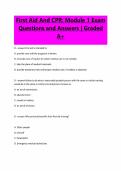
First Aid And CPR: Module 1 Exam Questions and Answers | Graded A+
First Aid And CPR: Module 1 Exam Questions and Answers | Graded A+ D - answer-First aid is intended to: A. provide care until the prognosis is known. B. only take care of injuries for which medical care is not needed. C. take the place of medical treatment. D. provide temporary help until proper medical care, if needed, is obtained. D - answer-Failure to do what a reasonably prudent person with the same or similar training would do in the same or similar circumstances is known as: A. an act of commission. B. abandonment. C. assault or battery. D. an act of omission. B - answer-Who primarily benefits from first aid training? A. Other people B. Oneself C. Paramedics D. Emergency medical techniciansC - answer-If a victim refuses first aid treatment, the first aid responder should: A. perform first aid anyway. B. leave the victim because he or she has refused help. C. call 9-1-1 and stay with the victim until help arrives. D. None of the above. D - answer-Consent to give first aid must be obtained from every victim who is: A. responsive. B. mentally competent. C. of legal age. D. All of the above. D - answer-Someone must call 9-1-1 if you are unsure of the victim's condition, if the victim's condition is life threatening or could become life threatening, or: A. the victim needs the skill and equipment of EMS. B. a spinal injury is suspected. C. distance or traffic could delay getting to the hospital. D. All of the above. D - answer-Which of the following are bloodborne diseases? A. Hepatitis B B. Hepatitis C C. HIV D. All of the above. D - answer-Who is a vital link between emergency medical services (EMS) and the victim?A. Firefighters B. Police officers C. Paramedics D. Bystanders D - answer-Why are laypersons less likely to offer help when an emergency occurs in a public place? A. Lack of knowledge B. Confusion about what an emergency is C. Characteristics of the emergency D. All of the above. D - answer-What should the rescuer look for during the scene size-up? A. Hazards that could be dangerous to the rescuer, the victim(s), or bystanders B. The mechanism or cause of injury C. The number of victims D. All of the above. A - answer-The outer layer of the skin is called the ________. A. epidermis B. dermis C. outerdermis D. None of the above. D - answer-If the oxygen supply of the body is cut off, death will occur in about ________ minutes.A. 8 to 10 B. 1 to 2 C. 2 to 4 D. 4 to 6 B - answer-Inadequate circulation is known as ________. A. hyperperfusion, or shock B. hypoperfusion, or shock C. hemorrhage D. None of the above. A - answer-Which of the following arteries should be used to check the pulse of an infant? A. Brachial B. Radial C. Carotid D. Femoral C - answer-Hemorrhage is the term for: A. fainting. B. severe heat loss. C. profuse bleeding. D. inadequate circulation. D - answer-What protects the central nervous system from injury? A. Skull B. VertebraeC. Meninges and CSF D. All of the above. A - answer-The bone of the upper arm is the: A. humerus. B. radius. C. clavicle. D. ulna. B - answer-Oxygen from air is made available to the blood through the ________ and then to the body cells by the circulatory system. A. central nervous system B. respiratory system C. endocrine system D. gastrointestinal system D - answer-What is the purpose of skin? A. To protect against bacteria invasion B. To help regulate body temperature C. To act as a sensory organ D. All of the above. A - answer-Which three body systems include the most important and sensitive organs? A. Respiratory, circulatory, nervous B. Circulatory, skeletal, respiratory C. Circulatory, gastrointestinal, nervousD. Respiratory, skeletal, nervous C - answer-________ refers to the circulation of blood through an organ or a structure. A. Hemorrhage B. Hypoperfusion C. Perfusion D. Hyperperfusion B - answer-The normal heart rate for toddlers is ________ beats per minute. A. 60 to 100 B. 100 to 190 C. 120 to 140 D. 80 to 100 B - answer-The lowest part of the sternum is called the: A. thorax. B. xiphoid process. C. scapula. D. pelvis. D - answer-Which of the following statements is true concerning infants and children? A. Infants and children have smaller respiratory structures than adults do. B. Infants' and children's respiratory structures are more easily obstructed than are those of adults. C. Cardiac arrest in children usually results from respiratory arrest. D. All of the above.
Document information
- Uploaded on
- September 24, 2026
- Number of pages
- 13
- Written in
- 2026/2027
- Type
- Exam (elaborations)
- Contains
- Questions & answers


