Page 1 of 60
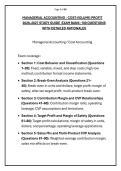
MANAGERIAL ACCOUNTING - COST-VOLUME-PROFIT
2026–2027 STUDY GUIDE EXAM BANK: 100 QUESTIONS
WITH DETAILED RATIONALES
Managerial Accounting / Cost Accounting
Exam coverage :
• Section 1: Cost Behavior and Classification (Questions
1–20): Fixed, variable, mixed, and step costs; high-low
method; contribution format income statements.
• Section 2: Break-Even Analysis (Questions 21–
40): Break-even in units and dollars; target profit; margin of
safety; after-tax target profit; multi-product break-even.
• Section 3: Contribution Margin and CVP Relationships
(Questions 41–60): Contribution margin ratio; operating
leverage; CVP assumptions and limitations.
• Section 4: Target Profit and Margin of Safety (Questions
61–80): Target profit calculations; margin of safety in units,
dollars, and percentage; operating leverage applications.
• Section 5: Sales Mix and Multi-Product CVP Analysis
(Questions 81–90): Weighted-average contribution margin;
sales mix effects on break-even.
, Page 2 of 60
• Section 6: CVP Applications and Decision-Making
(Questions 91–100): Cost structure changes; special
orders; strategic use of CVP analysis.
Section 1: Cost Behavior and Classification (Questions 1–20)
Question 1: A manufacturing company pays $5,000 per month
for factory rent and $12 per unit for direct materials. If
production increases from 1,000 to 1,500 units, which of the
following correctly describes the behavior of these costs?
A. Both costs remain constant in total.
B. Factory rent per unit decreases while direct materials per unit
remains constant.
C. Factory rent per unit remains constant while direct materials
per unit decreases.
D. Both costs increase proportionally with production.
CORRECT ANSWER: B
RATIONALE: Factory rent is a fixed cost, so total rent remains at
$5,000, but rent per unit decreases as production increases
($5,000 ÷ 1,000 = $5.00 vs. $5,000 ÷ 1,500 = $3.33). Direct
materials are variable costs, so the cost per unit remains
constant at $12 regardless of production volume. Option A is
incorrect because variable costs change in total. Option C
reverses the behavior of the two costs. Option D is incorrect
because fixed costs do not increase proportionally.
, Page 3 of 60
Question 2: Which of the following would be classified as a
variable cost for a furniture manufacturer?
A. Straight-line depreciation on factory equipment
B. Factory supervisor's salary
C. Wood used in the production of tables
D. Property taxes on the factory building
CORRECT ANSWER: C
RATIONALE: Wood is a direct material that varies directly with
the number of tables produced, making it a variable cost.
Straight-line depreciation, factory supervisor salaries, and
property taxes are all fixed costs because they do not change
with production volume within the relevant range.
Question 3: A company's total cost is $50,000 when 10,000
units are produced and $65,000 when 15,000 units are
produced. Using the high-low method, what is the variable cost
per unit?
A. $3.00
B. $3.33
C. $5.00
D. $2.00
CORRECT ANSWER: A
RATIONALE: Using the high-low method: Variable cost per unit
= (Cost at high activity − Cost at low activity) ÷ (High activity −
Low activity) = ($65,000 − $50,000) ÷ (15,000 − 10,000) =
, Page 4 of 60
$15,000 ÷ 5,000 = $3.00 per unit. Options B, C, and D are
incorrect calculations.
Question 4: Using the high-low method from Question 3, what
is the total fixed cost?
A. $20,000
B. $15,000
C. $30,000
D. $25,000
CORRECT ANSWER: A
RATIONALE: Total cost = Fixed cost + (Variable cost per unit ×
Units). Using the low point: $50,000 = Fixed cost + ($3.00 ×
10,000). Fixed cost = $50,000 − $30,000 = $20,000. Options B,
C, and D are incorrect.
Question 5: Which of the following best describes a mixed
cost?
A. A cost that remains constant in total regardless of activity
level
B. A cost that changes proportionally with activity level
C. A cost that has both a fixed and a variable component
D. A cost that is incurred only when production occurs
CORRECT ANSWER: C
MANAGERIAL ACCOUNTING - COST-VOLUME-PROFIT
2026–2027 STUDY GUIDE EXAM BANK: 100 QUESTIONS
WITH DETAILED RATIONALES
Managerial Accounting / Cost Accounting
Exam coverage :
• Section 1: Cost Behavior and Classification (Questions
1–20): Fixed, variable, mixed, and step costs; high-low
method; contribution format income statements.
• Section 2: Break-Even Analysis (Questions 21–
40): Break-even in units and dollars; target profit; margin of
safety; after-tax target profit; multi-product break-even.
• Section 3: Contribution Margin and CVP Relationships
(Questions 41–60): Contribution margin ratio; operating
leverage; CVP assumptions and limitations.
• Section 4: Target Profit and Margin of Safety (Questions
61–80): Target profit calculations; margin of safety in units,
dollars, and percentage; operating leverage applications.
• Section 5: Sales Mix and Multi-Product CVP Analysis
(Questions 81–90): Weighted-average contribution margin;
sales mix effects on break-even.
, Page 2 of 60
• Section 6: CVP Applications and Decision-Making
(Questions 91–100): Cost structure changes; special
orders; strategic use of CVP analysis.
Section 1: Cost Behavior and Classification (Questions 1–20)
Question 1: A manufacturing company pays $5,000 per month
for factory rent and $12 per unit for direct materials. If
production increases from 1,000 to 1,500 units, which of the
following correctly describes the behavior of these costs?
A. Both costs remain constant in total.
B. Factory rent per unit decreases while direct materials per unit
remains constant.
C. Factory rent per unit remains constant while direct materials
per unit decreases.
D. Both costs increase proportionally with production.
CORRECT ANSWER: B
RATIONALE: Factory rent is a fixed cost, so total rent remains at
$5,000, but rent per unit decreases as production increases
($5,000 ÷ 1,000 = $5.00 vs. $5,000 ÷ 1,500 = $3.33). Direct
materials are variable costs, so the cost per unit remains
constant at $12 regardless of production volume. Option A is
incorrect because variable costs change in total. Option C
reverses the behavior of the two costs. Option D is incorrect
because fixed costs do not increase proportionally.
, Page 3 of 60
Question 2: Which of the following would be classified as a
variable cost for a furniture manufacturer?
A. Straight-line depreciation on factory equipment
B. Factory supervisor's salary
C. Wood used in the production of tables
D. Property taxes on the factory building
CORRECT ANSWER: C
RATIONALE: Wood is a direct material that varies directly with
the number of tables produced, making it a variable cost.
Straight-line depreciation, factory supervisor salaries, and
property taxes are all fixed costs because they do not change
with production volume within the relevant range.
Question 3: A company's total cost is $50,000 when 10,000
units are produced and $65,000 when 15,000 units are
produced. Using the high-low method, what is the variable cost
per unit?
A. $3.00
B. $3.33
C. $5.00
D. $2.00
CORRECT ANSWER: A
RATIONALE: Using the high-low method: Variable cost per unit
= (Cost at high activity − Cost at low activity) ÷ (High activity −
Low activity) = ($65,000 − $50,000) ÷ (15,000 − 10,000) =
, Page 4 of 60
$15,000 ÷ 5,000 = $3.00 per unit. Options B, C, and D are
incorrect calculations.
Question 4: Using the high-low method from Question 3, what
is the total fixed cost?
A. $20,000
B. $15,000
C. $30,000
D. $25,000
CORRECT ANSWER: A
RATIONALE: Total cost = Fixed cost + (Variable cost per unit ×
Units). Using the low point: $50,000 = Fixed cost + ($3.00 ×
10,000). Fixed cost = $50,000 − $30,000 = $20,000. Options B,
C, and D are incorrect.
Question 5: Which of the following best describes a mixed
cost?
A. A cost that remains constant in total regardless of activity
level
B. A cost that changes proportionally with activity level
C. A cost that has both a fixed and a variable component
D. A cost that is incurred only when production occurs
CORRECT ANSWER: C