
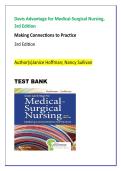
Davis Advantage for Medical-Surgical Nursing,
3rd Edition
Making Connections to Practice
3rd Edition
Author(s)Janice Hoffman; Nancy Sullivan
TEST BANK
,
,Question 1
A nurse begins caring for a postoperative medical-surgical patient.
Which action best demonstrates patient-centered care?
A. Explaining the routine care schedule and asking the patient to follow
it
B. Asking the patient about personal goals and preferences before
planning care
C. Completing all nursing interventions quickly to minimize
interruptions
D. Selecting interventions based solely on the surgeon's preferences
Correct Answer:
B. Asking the patient about personal goals and preferences before
planning care
Rationale:
Patient-centered care incorporates the patient's preferences, values,
needs, and goals into care planning. Option A emphasizes the routine
rather than the individual. Option C prioritizes efficiency over patient
preferences. Option D excludes the patient's perspective from decision-
making.
Question 2
A nurse is using the nursing process for a patient admitted with
weakness and dizziness. Which action represents the assessment
phase?
, A. Identifying fall risk as the priority nursing diagnosis
B. Reviewing the patient's blood pressure, symptoms, and medication
history
C. Instructing the patient to call for assistance before ambulating
D. Determining whether the patient's dizziness has improved
Correct Answer:
B. Reviewing the patient's blood pressure, symptoms, and medication
history
Rationale:
Assessment involves collecting and validating information about the
patient's condition. Option A involves analysis and identification of a
problem. Option C is an intervention. Option D evaluates the patient's
response to care.
Question 3
A nurse receives a handoff about four medical-surgical patients. Which
patient should the nurse assess first?
A. A patient requesting assistance with bathing
B. A patient reporting new difficulty breathing
C. A patient waiting for discharge instructions
D. A patient requesting a different meal selection
Correct Answer:
B. A patient reporting new difficulty breathing
Rationale:
New difficulty breathing may indicate an acute threat to airway or
3rd Edition
Making Connections to Practice
3rd Edition
Author(s)Janice Hoffman; Nancy Sullivan
TEST BANK
,
,Question 1
A nurse begins caring for a postoperative medical-surgical patient.
Which action best demonstrates patient-centered care?
A. Explaining the routine care schedule and asking the patient to follow
it
B. Asking the patient about personal goals and preferences before
planning care
C. Completing all nursing interventions quickly to minimize
interruptions
D. Selecting interventions based solely on the surgeon's preferences
Correct Answer:
B. Asking the patient about personal goals and preferences before
planning care
Rationale:
Patient-centered care incorporates the patient's preferences, values,
needs, and goals into care planning. Option A emphasizes the routine
rather than the individual. Option C prioritizes efficiency over patient
preferences. Option D excludes the patient's perspective from decision-
making.
Question 2
A nurse is using the nursing process for a patient admitted with
weakness and dizziness. Which action represents the assessment
phase?
, A. Identifying fall risk as the priority nursing diagnosis
B. Reviewing the patient's blood pressure, symptoms, and medication
history
C. Instructing the patient to call for assistance before ambulating
D. Determining whether the patient's dizziness has improved
Correct Answer:
B. Reviewing the patient's blood pressure, symptoms, and medication
history
Rationale:
Assessment involves collecting and validating information about the
patient's condition. Option A involves analysis and identification of a
problem. Option C is an intervention. Option D evaluates the patient's
response to care.
Question 3
A nurse receives a handoff about four medical-surgical patients. Which
patient should the nurse assess first?
A. A patient requesting assistance with bathing
B. A patient reporting new difficulty breathing
C. A patient waiting for discharge instructions
D. A patient requesting a different meal selection
Correct Answer:
B. A patient reporting new difficulty breathing
Rationale:
New difficulty breathing may indicate an acute threat to airway or



