
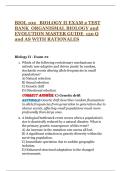
BIOL 102 BIOLOGY II EXAM 2 TEST
BANK ORGANISMAL BIOLOGY and
EVOLUTION MASTER GUIDE 150 Q
and AS WITH RATIONALES
Biology II - Exam #2
1. Which of the following evolutionary mechanisms is
entirely non-adaptive and driven purely by random,
stochastic events altering allele frequencies in small
populations?
A) Natural selection
B) Sexual selection
C) Genetic drift
D) Directional selection
CORRECT ANSWER: C) Genetic drift
Rationale: Genetic drift describes random fluctuations
in allele frequencies from generation to generation due to
chance events, affecting small populations much more
profoundly than large ones.
2. A biological bottleneck event occurs when a population's
size is drastically reduced by a natural disaster. What is
the primary genetic consequence of this event?
A) An increase in the mutation rate across all loci.
B) A significant reduction in genetic diversity within the
surviving population.
C) Immediate speciation due to sudden geographic
isolation.
D) Enhanced structural adaptation to the changed
environment.
, CORRECT ANSWER: B) A significant reduction in
genetic diversity within the surviving population.
Rationale: When a population collapses randomly,
many unique alleles are permanently lost, leaving the
surviving population with less genetic variation to adapt
to future selective pressures.
3. According to the biological species concept, what is the
ultimate criterion that determines whether two distinct
populations belong to the same species?
A) They share more than 99% identical morphological
structures.
B) They occupy the exact same ecological niche and
geographic range.
C) They have the ability to interbreed in nature and
produce viable, fertile offspring.
D) They utilize identical metabolic pathways to process
organic nutrients.
CORRECT ANSWER: C) They have the ability to
interbreed in nature and produce viable, fertile
offspring.
Rationale: The biological species concept focuses on
reproductive isolation; if two groups cannot successfully
interbreed and produce fertile young, they are considered
distinct biological species.
4. Which of the following reproductive isolating mechanisms
is classified as a postzygotic barrier?
A) Hybrid sterility
B) Temporal isolation
C) Behavioral isolation
D) Mechanical isolation
CORRECT ANSWER: A) Hybrid sterility
Rationale: Postzygotic barriers occur after
fertilization. Hybrid sterility allows a zygote to form and
, grow into an adult (like a mule), but the hybrid is
incapable of producing functional gametes.
5. What type of speciation takes place when a physical
geographic barrier, such as a rising mountain range,
divides a single ancestral population into isolated groups?
A) Sympatric speciation
B) Allopatric speciation
C) Parapatric speciation
D) Peripatric speciation
CORRECT ANSWER: B) Allopatric speciation
Rationale: Allopatric speciation occurs when
geographic isolation blocks gene flow between
populations, allowing them to evolve independently
through mutation, drift, and selection.
6. In a population of birds, individuals with intermediate
beak sizes survive less efficiently than individuals with
either very small or very large beaks. What type of natural
selection is operating here?
A) Stabilizing selection
B) Directional selection
C) Disruptive selection
D) Balancing selection
CORRECT ANSWER: C) Disruptive selection
Rationale: Disruptive (or diversifying) selection favors
individuals at both phenotypic extremes while selecting
against intermediate or average phenotypes.
7. Which of the following structural features is uniquely
characteristic of all angiosperms, distinguishing them
cleanly from gymnosperms?
A) The production of seeds
B) The presence of true vascular tissue
C) The formation of flowers and fruits
D) A dominant sporophyte generation
, CORRECT ANSWER: C) The formation of flowers
and fruits
Rationale: Angiosperms are flowering plants that
enclose their seeds inside fruits (matured ovaries),
whereas gymnosperms produce naked seeds exposed on
cones.
8. What is the primary functional purpose of the vascular
tissue component known as xylem?
A) Shuttling manufactured organic sugars from leaves to
roots.
B) Directing the active uptake of atmospheric carbon
dioxide.
C) Transporting water and dissolved mineral ions upward
from the soil.
D) Storing excess starches inside the seed coat.
CORRECT ANSWER: C) Transporting water and
dissolved mineral ions upward from the soil.
Rationale: Xylem consists of dead, hollowed tracheids
and vessel elements that form structural pipes for
unidirectional water transport driven by transpiration.
9. In the plant alternation of generations life cycle, what
ploidy level and structural form describes the gametophyte
stage?
A) Diploid and spore-producing
B) Haploid and gamete-producing
C) Diploid and seed-producing
D) Triploid and fruit-producing
CORRECT ANSWER: B) Haploid and gamete-
producing
Rationale: The gametophyte is the multicellular
haploid (n) phase of the plant life cycle that produces
haploid gametes (sperm and eggs) via mitosis.
BANK ORGANISMAL BIOLOGY and
EVOLUTION MASTER GUIDE 150 Q
and AS WITH RATIONALES
Biology II - Exam #2
1. Which of the following evolutionary mechanisms is
entirely non-adaptive and driven purely by random,
stochastic events altering allele frequencies in small
populations?
A) Natural selection
B) Sexual selection
C) Genetic drift
D) Directional selection
CORRECT ANSWER: C) Genetic drift
Rationale: Genetic drift describes random fluctuations
in allele frequencies from generation to generation due to
chance events, affecting small populations much more
profoundly than large ones.
2. A biological bottleneck event occurs when a population's
size is drastically reduced by a natural disaster. What is
the primary genetic consequence of this event?
A) An increase in the mutation rate across all loci.
B) A significant reduction in genetic diversity within the
surviving population.
C) Immediate speciation due to sudden geographic
isolation.
D) Enhanced structural adaptation to the changed
environment.
, CORRECT ANSWER: B) A significant reduction in
genetic diversity within the surviving population.
Rationale: When a population collapses randomly,
many unique alleles are permanently lost, leaving the
surviving population with less genetic variation to adapt
to future selective pressures.
3. According to the biological species concept, what is the
ultimate criterion that determines whether two distinct
populations belong to the same species?
A) They share more than 99% identical morphological
structures.
B) They occupy the exact same ecological niche and
geographic range.
C) They have the ability to interbreed in nature and
produce viable, fertile offspring.
D) They utilize identical metabolic pathways to process
organic nutrients.
CORRECT ANSWER: C) They have the ability to
interbreed in nature and produce viable, fertile
offspring.
Rationale: The biological species concept focuses on
reproductive isolation; if two groups cannot successfully
interbreed and produce fertile young, they are considered
distinct biological species.
4. Which of the following reproductive isolating mechanisms
is classified as a postzygotic barrier?
A) Hybrid sterility
B) Temporal isolation
C) Behavioral isolation
D) Mechanical isolation
CORRECT ANSWER: A) Hybrid sterility
Rationale: Postzygotic barriers occur after
fertilization. Hybrid sterility allows a zygote to form and
, grow into an adult (like a mule), but the hybrid is
incapable of producing functional gametes.
5. What type of speciation takes place when a physical
geographic barrier, such as a rising mountain range,
divides a single ancestral population into isolated groups?
A) Sympatric speciation
B) Allopatric speciation
C) Parapatric speciation
D) Peripatric speciation
CORRECT ANSWER: B) Allopatric speciation
Rationale: Allopatric speciation occurs when
geographic isolation blocks gene flow between
populations, allowing them to evolve independently
through mutation, drift, and selection.
6. In a population of birds, individuals with intermediate
beak sizes survive less efficiently than individuals with
either very small or very large beaks. What type of natural
selection is operating here?
A) Stabilizing selection
B) Directional selection
C) Disruptive selection
D) Balancing selection
CORRECT ANSWER: C) Disruptive selection
Rationale: Disruptive (or diversifying) selection favors
individuals at both phenotypic extremes while selecting
against intermediate or average phenotypes.
7. Which of the following structural features is uniquely
characteristic of all angiosperms, distinguishing them
cleanly from gymnosperms?
A) The production of seeds
B) The presence of true vascular tissue
C) The formation of flowers and fruits
D) A dominant sporophyte generation
, CORRECT ANSWER: C) The formation of flowers
and fruits
Rationale: Angiosperms are flowering plants that
enclose their seeds inside fruits (matured ovaries),
whereas gymnosperms produce naked seeds exposed on
cones.
8. What is the primary functional purpose of the vascular
tissue component known as xylem?
A) Shuttling manufactured organic sugars from leaves to
roots.
B) Directing the active uptake of atmospheric carbon
dioxide.
C) Transporting water and dissolved mineral ions upward
from the soil.
D) Storing excess starches inside the seed coat.
CORRECT ANSWER: C) Transporting water and
dissolved mineral ions upward from the soil.
Rationale: Xylem consists of dead, hollowed tracheids
and vessel elements that form structural pipes for
unidirectional water transport driven by transpiration.
9. In the plant alternation of generations life cycle, what
ploidy level and structural form describes the gametophyte
stage?
A) Diploid and spore-producing
B) Haploid and gamete-producing
C) Diploid and seed-producing
D) Triploid and fruit-producing
CORRECT ANSWER: B) Haploid and gamete-
producing
Rationale: The gametophyte is the multicellular
haploid (n) phase of the plant life cycle that produces
haploid gametes (sperm and eggs) via mitosis.


