
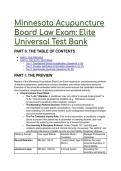
Minnesota Acupuncture
Board Law Exam: Elite
Universal Test Bank
PART 0: THE TABLE OF CONTENTS
● PART I: THE PREVIEW
● PART II: THE ELITE TEST BANK
○ Tier 1: Foundational Syntax & Application (Questions 1–18)
○ Tier 2: Complex Application & Simulation (Questions 19–37)
○ Tier 3: Grandmaster Synthesis (Questions 38–55)
PART I: THE PREVIEW
Mastery of the Minnesota Acupuncture Board Law Exam requires an uncompromising synthesis
of statutory parameters, professional conduct mandates, and clinical compliance protocols.
Execution of the principles embedded within this document ensures that candidates transition
from theoretical competence to absolute jurisdictional and operational authority.
● Critical Axioms Cheat Sheet:
○ The "L.Ac." Mandate: A practitioner may only utilize "Licensed Acupuncturist" or
"L.Ac." Unauthorized geographical modifiers (e.g., "Minnesota Licensed
Acupuncturist") constitute a direct statutory violation.
○ The Mandatory Referral Doctrine: Referral to a licensed physician is
non-negotiable for eight specific presentations, most notably: unexplained weight
loss exceeding 15% within three months, acute undiagnosed neurological changes,
and uncontrolled hypertension.
○ The Pre-Treatment Inquiry Rule: Prior to any intervention, a practitioner is legally
bound to inquire if the patient has a pacemaker or bleeding disorder, and must
document the patient's prior examinations by a licensed physician.
○ The Immunity & Discipline Protocol: Under Chapter 147, reporting peer
violations grants absolute civil and criminal immunity. Conversely, "fee splitting" and
unauthorized disclosure of health records are strict liability disciplinary offenses.
Statutory Domain Core Legal Statute Absolute Metric / Strategic Professional
Constraint Implication
Record Retention MN Stat. 145.32 7 years (Adult); Age 25 Defines the exact
(Minor) temporal boundary of
clinical liability.
Licensure Lapse MN Stat. 147B.02 2 Annual Cycles Exceeding this
boundary permanently
,Statutory Domain Core Legal Statute Absolute Metric / Strategic Professional
Constraint Implication
terminates the
credential.
Informed Consent MN Stat. 147B.06 5 Specific Explicit Side Failure to document
Effects exactly protects against
battery claims.
Sterilization MN Stat. 147B.06 CDC Standards State law explicitly
anchors to federal
epidemiological
mandates.
Data Privacy MN Stat. 144.293 1 Year Consent Prevents unauthorized
Expiration perpetual data mining
by external entities.
PART II: THE ELITE TEST BANK
Tier 1: Foundational Syntax & Application (Questions 1–18)
Q1: An individual has recently fulfilled all requirements for acupuncture licensure in the state.
Based on the principles of Minnesota Statutes 147B, which title format is the MOST
APPROPRIATE for advertising and professional literature? A) Minnesota Licensed
Acupuncturist B) Registered Acupuncturist of Minnesota C) Licensed Acupuncturist or L.Ac. D)
Board Certified Minnesota Acupuncturist
● Answer: C (Licensed Acupuncturist or L.Ac.)
● Distractor Analysis:
○ A is incorrect: The statute explicitly forbids using the modifier "Minnesota" in
conjunction with the licensed title to prevent implied state endorsement.
○ B is incorrect: The state utilizes a licensure model, not a registration model,
rendering the term "Registered" legally inaccurate in this context.
○ D is incorrect: "Board Certified" references NCCAOM certification status, not the
state-issued legal title, and improperly appends the state name.
The Mentor's Analysis: Title protection laws are absolute and unforgiving. When formatting
professional credentials, the immediate priority is strict statutory compliance. By utilizing the
exact approved terminology, you bypass the common trap of assuming geographical modifiers
enhance credibility. Professional Intuition: Never append state names to protected
occupational titles unless explicitly authorized by statute.
Q2: A practitioner from an international jurisdiction relocates to the state. Based on the
principles of licensure exceptions, which individual is permitted to practice acupuncture
WITHOUT holding an active acupuncture license? A) A certified physical therapist applying dry
needling techniques. B) A visiting acupuncturist conducting a 45-day workshop within a single
calendar year. C) A visiting acupuncturist teaching at a registered instructional school for a
period of one year. D) A naturopathic doctor performing electrical stimulation on acupuncture
points.
● Answer: C (A visiting acupuncturist teaching at a registered instructional school for a
period of one year.)
● Distractor Analysis:
○ A is incorrect: Physical therapists operate under a different practice act and are not
, granted blanket acupuncture exemptions under 147B.
○ B is incorrect: The tutorial/workshop exemption is strictly capped at a maximum of
30 days per calendar year.
○ D is incorrect: Naturopathic doctors are not listed under the specific exemptions of
147B.02 Subd. 4, which only explicitly names MDs, DOs, and DCs.
The Mentor's Analysis: Jurisdictional exemptions are narrowly tailored to specific professions
and temporal boundaries. When evaluating unlicensed practice, the immediate priority is
verifying statutory caps. By utilizing the exact timelines for visiting instructors, you bypass the
common trap of generalizing educational exemptions. Professional Intuition: Visiting workshop
exemptions strictly expire at 30 days; formal school instructional exemptions permit up
to one year.
Q3: A patient arrives at a clinic for an initial evaluation. Based on the principles of Professional
Conduct (147B.06), which inquiry is the practitioner REQUIRED to make prior to initiating
treatment? A) Whether the patient has a history of severe psychiatric illness. B) Whether the
patient has a pacemaker or bleeding disorder. C) Whether the patient has experienced
anaphylaxis to herbal remedies. D) Whether the patient is currently engaged in physical therapy.
● Answer: B (Whether the patient has a pacemaker or bleeding disorder.)
● Distractor Analysis:
○ A is incorrect: While clinically relevant for holistic care, psychiatric history is not an
explicitly mandated pre-treatment statutory inquiry.
○ C is incorrect: Herbal allergy inquiries reflect good clinical practice but are not
universally mandated by the specific statutory checklist prior to basic treatment.
○ D is incorrect: Concurrent physical therapy is not a statutory prerequisite inquiry.
The Mentor's Analysis: Statutory intake protocols supersede general clinical interviews. When
initiating an intake, the immediate priority is mitigating life-threatening device or physiological
interactions. By utilizing the mandated pacemaker and bleeding disorder questions, you bypass
the common trap of relying solely on generic holistic health forms. Professional Intuition:
Pacemakers and bleeding disorders represent the two explicit physiological hard-stops
requiring documentation prior to needle insertion.
Q4: An applicant submits documents for initial licensure. Based on the principles of Board
Action on Applications, which element must the applicant provide regarding background
access? A) A signed waiver authorizing the board to access records in any state where the
applicant practiced. B) A federal fingerprint background check directly from the FBI. C) A signed
affidavit of moral character from two licensed physicians. D) A sworn statement renouncing
licenses held in foreign jurisdictions.
● Answer: A (A signed waiver authorizing the board to access records in any state where
the applicant practiced.)
● Distractor Analysis:
○ B is incorrect: While background checks are standard across medicine, the
acupuncture statute specifically dictates the provision of a signed waiver for
interstate record access.
○ C is incorrect: Affidavits of moral character are a legacy requirement no longer
mandated by the current practice act.
○ D is incorrect: Holding multiple licenses is permitted; renouncing foreign licenses is
legally groundless.
The Mentor's Analysis: Application protocols rely on absolute transparency. When submitting
licensure documents, the immediate priority is granting the regulatory body unrestricted access
to historical practice data. By utilizing the mandated waiver, you bypass the common trap of
Board Law Exam: Elite
Universal Test Bank
PART 0: THE TABLE OF CONTENTS
● PART I: THE PREVIEW
● PART II: THE ELITE TEST BANK
○ Tier 1: Foundational Syntax & Application (Questions 1–18)
○ Tier 2: Complex Application & Simulation (Questions 19–37)
○ Tier 3: Grandmaster Synthesis (Questions 38–55)
PART I: THE PREVIEW
Mastery of the Minnesota Acupuncture Board Law Exam requires an uncompromising synthesis
of statutory parameters, professional conduct mandates, and clinical compliance protocols.
Execution of the principles embedded within this document ensures that candidates transition
from theoretical competence to absolute jurisdictional and operational authority.
● Critical Axioms Cheat Sheet:
○ The "L.Ac." Mandate: A practitioner may only utilize "Licensed Acupuncturist" or
"L.Ac." Unauthorized geographical modifiers (e.g., "Minnesota Licensed
Acupuncturist") constitute a direct statutory violation.
○ The Mandatory Referral Doctrine: Referral to a licensed physician is
non-negotiable for eight specific presentations, most notably: unexplained weight
loss exceeding 15% within three months, acute undiagnosed neurological changes,
and uncontrolled hypertension.
○ The Pre-Treatment Inquiry Rule: Prior to any intervention, a practitioner is legally
bound to inquire if the patient has a pacemaker or bleeding disorder, and must
document the patient's prior examinations by a licensed physician.
○ The Immunity & Discipline Protocol: Under Chapter 147, reporting peer
violations grants absolute civil and criminal immunity. Conversely, "fee splitting" and
unauthorized disclosure of health records are strict liability disciplinary offenses.
Statutory Domain Core Legal Statute Absolute Metric / Strategic Professional
Constraint Implication
Record Retention MN Stat. 145.32 7 years (Adult); Age 25 Defines the exact
(Minor) temporal boundary of
clinical liability.
Licensure Lapse MN Stat. 147B.02 2 Annual Cycles Exceeding this
boundary permanently
,Statutory Domain Core Legal Statute Absolute Metric / Strategic Professional
Constraint Implication
terminates the
credential.
Informed Consent MN Stat. 147B.06 5 Specific Explicit Side Failure to document
Effects exactly protects against
battery claims.
Sterilization MN Stat. 147B.06 CDC Standards State law explicitly
anchors to federal
epidemiological
mandates.
Data Privacy MN Stat. 144.293 1 Year Consent Prevents unauthorized
Expiration perpetual data mining
by external entities.
PART II: THE ELITE TEST BANK
Tier 1: Foundational Syntax & Application (Questions 1–18)
Q1: An individual has recently fulfilled all requirements for acupuncture licensure in the state.
Based on the principles of Minnesota Statutes 147B, which title format is the MOST
APPROPRIATE for advertising and professional literature? A) Minnesota Licensed
Acupuncturist B) Registered Acupuncturist of Minnesota C) Licensed Acupuncturist or L.Ac. D)
Board Certified Minnesota Acupuncturist
● Answer: C (Licensed Acupuncturist or L.Ac.)
● Distractor Analysis:
○ A is incorrect: The statute explicitly forbids using the modifier "Minnesota" in
conjunction with the licensed title to prevent implied state endorsement.
○ B is incorrect: The state utilizes a licensure model, not a registration model,
rendering the term "Registered" legally inaccurate in this context.
○ D is incorrect: "Board Certified" references NCCAOM certification status, not the
state-issued legal title, and improperly appends the state name.
The Mentor's Analysis: Title protection laws are absolute and unforgiving. When formatting
professional credentials, the immediate priority is strict statutory compliance. By utilizing the
exact approved terminology, you bypass the common trap of assuming geographical modifiers
enhance credibility. Professional Intuition: Never append state names to protected
occupational titles unless explicitly authorized by statute.
Q2: A practitioner from an international jurisdiction relocates to the state. Based on the
principles of licensure exceptions, which individual is permitted to practice acupuncture
WITHOUT holding an active acupuncture license? A) A certified physical therapist applying dry
needling techniques. B) A visiting acupuncturist conducting a 45-day workshop within a single
calendar year. C) A visiting acupuncturist teaching at a registered instructional school for a
period of one year. D) A naturopathic doctor performing electrical stimulation on acupuncture
points.
● Answer: C (A visiting acupuncturist teaching at a registered instructional school for a
period of one year.)
● Distractor Analysis:
○ A is incorrect: Physical therapists operate under a different practice act and are not
, granted blanket acupuncture exemptions under 147B.
○ B is incorrect: The tutorial/workshop exemption is strictly capped at a maximum of
30 days per calendar year.
○ D is incorrect: Naturopathic doctors are not listed under the specific exemptions of
147B.02 Subd. 4, which only explicitly names MDs, DOs, and DCs.
The Mentor's Analysis: Jurisdictional exemptions are narrowly tailored to specific professions
and temporal boundaries. When evaluating unlicensed practice, the immediate priority is
verifying statutory caps. By utilizing the exact timelines for visiting instructors, you bypass the
common trap of generalizing educational exemptions. Professional Intuition: Visiting workshop
exemptions strictly expire at 30 days; formal school instructional exemptions permit up
to one year.
Q3: A patient arrives at a clinic for an initial evaluation. Based on the principles of Professional
Conduct (147B.06), which inquiry is the practitioner REQUIRED to make prior to initiating
treatment? A) Whether the patient has a history of severe psychiatric illness. B) Whether the
patient has a pacemaker or bleeding disorder. C) Whether the patient has experienced
anaphylaxis to herbal remedies. D) Whether the patient is currently engaged in physical therapy.
● Answer: B (Whether the patient has a pacemaker or bleeding disorder.)
● Distractor Analysis:
○ A is incorrect: While clinically relevant for holistic care, psychiatric history is not an
explicitly mandated pre-treatment statutory inquiry.
○ C is incorrect: Herbal allergy inquiries reflect good clinical practice but are not
universally mandated by the specific statutory checklist prior to basic treatment.
○ D is incorrect: Concurrent physical therapy is not a statutory prerequisite inquiry.
The Mentor's Analysis: Statutory intake protocols supersede general clinical interviews. When
initiating an intake, the immediate priority is mitigating life-threatening device or physiological
interactions. By utilizing the mandated pacemaker and bleeding disorder questions, you bypass
the common trap of relying solely on generic holistic health forms. Professional Intuition:
Pacemakers and bleeding disorders represent the two explicit physiological hard-stops
requiring documentation prior to needle insertion.
Q4: An applicant submits documents for initial licensure. Based on the principles of Board
Action on Applications, which element must the applicant provide regarding background
access? A) A signed waiver authorizing the board to access records in any state where the
applicant practiced. B) A federal fingerprint background check directly from the FBI. C) A signed
affidavit of moral character from two licensed physicians. D) A sworn statement renouncing
licenses held in foreign jurisdictions.
● Answer: A (A signed waiver authorizing the board to access records in any state where
the applicant practiced.)
● Distractor Analysis:
○ B is incorrect: While background checks are standard across medicine, the
acupuncture statute specifically dictates the provision of a signed waiver for
interstate record access.
○ C is incorrect: Affidavits of moral character are a legacy requirement no longer
mandated by the current practice act.
○ D is incorrect: Holding multiple licenses is permitted; renouncing foreign licenses is
legally groundless.
The Mentor's Analysis: Application protocols rely on absolute transparency. When submitting
licensure documents, the immediate priority is granting the regulatory body unrestricted access
to historical practice data. By utilizing the mandated waiver, you bypass the common trap of


