
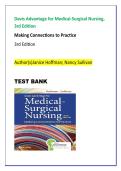
Davis Advantage for Medical-Surgical Nursing,
3rd Edition
Making Connections to Practice
3rd Edition
Author(s)Janice Hoffman; Nancy Sullivan
TEST BANK
,
,Question 1
A medical-surgical nurse begins a shift by reviewing the electronic
health record, identifying patients at greatest risk for deterioration, and
organizing assessments accordingly. Which competency is the nurse
demonstrating?
A. Delegation of all assessment activities to assistive personnel
B. Clinical judgment to prioritize patient needs
C. Independent prescribing of treatment
D. Replacement of the nursing process with standardized protocols
Correct Answer:
B. Clinical judgment to prioritize patient needs
Rationale:
Clinical judgment involves recognizing relevant information, interpreting
findings, determining priorities, taking appropriate action, and
evaluating outcomes. Reviewing patient information and prioritizing
assessments based on risk demonstrates clinical judgment. Assessment
and prioritization remain nursing responsibilities; assistive personnel
cannot independently replace the nurse's clinical decision-making.
Question 2
A nurse caring for a patient on a medical-surgical unit consistently
verifies the patient's identity before medication administration,
procedure preparation, and specimen collection. Which patient safety
principle is the nurse applying?
A. Maintaining continuity of care
B. Using two patient identifiers
, C. Promoting independent decision-making
D. Delegating safety checks to assistive personnel
Correct Answer:
B. Using two patient identifiers
Rationale:
Using at least two approved patient identifiers before care activities
helps prevent wrong-patient errors. Continuity of care and patient
autonomy are important but do not specifically address patient
identification. The registered nurse remains accountable for verifying
patient identity before providing care.
Question 3
A nurse is planning care for a patient with newly diagnosed heart
failure. Which action best reflects patient-centered care?
A. Selecting interventions based only on the medical diagnosis
B. Providing the same discharge instructions used for all patients with
heart failure
C. Incorporating the patient's goals, preferences, values, and ability to
manage the treatment plan
D. Asking the family to make all decisions for the patient
Correct Answer:
C. Incorporating the patient's goals, preferences, values, and ability to
manage the treatment plan
Rationale:
Patient-centered care respects the patient's preferences, values, needs,
and participation in decision-making. A standardized plan may require
individualization. Family involvement can be valuable when
3rd Edition
Making Connections to Practice
3rd Edition
Author(s)Janice Hoffman; Nancy Sullivan
TEST BANK
,
,Question 1
A medical-surgical nurse begins a shift by reviewing the electronic
health record, identifying patients at greatest risk for deterioration, and
organizing assessments accordingly. Which competency is the nurse
demonstrating?
A. Delegation of all assessment activities to assistive personnel
B. Clinical judgment to prioritize patient needs
C. Independent prescribing of treatment
D. Replacement of the nursing process with standardized protocols
Correct Answer:
B. Clinical judgment to prioritize patient needs
Rationale:
Clinical judgment involves recognizing relevant information, interpreting
findings, determining priorities, taking appropriate action, and
evaluating outcomes. Reviewing patient information and prioritizing
assessments based on risk demonstrates clinical judgment. Assessment
and prioritization remain nursing responsibilities; assistive personnel
cannot independently replace the nurse's clinical decision-making.
Question 2
A nurse caring for a patient on a medical-surgical unit consistently
verifies the patient's identity before medication administration,
procedure preparation, and specimen collection. Which patient safety
principle is the nurse applying?
A. Maintaining continuity of care
B. Using two patient identifiers
, C. Promoting independent decision-making
D. Delegating safety checks to assistive personnel
Correct Answer:
B. Using two patient identifiers
Rationale:
Using at least two approved patient identifiers before care activities
helps prevent wrong-patient errors. Continuity of care and patient
autonomy are important but do not specifically address patient
identification. The registered nurse remains accountable for verifying
patient identity before providing care.
Question 3
A nurse is planning care for a patient with newly diagnosed heart
failure. Which action best reflects patient-centered care?
A. Selecting interventions based only on the medical diagnosis
B. Providing the same discharge instructions used for all patients with
heart failure
C. Incorporating the patient's goals, preferences, values, and ability to
manage the treatment plan
D. Asking the family to make all decisions for the patient
Correct Answer:
C. Incorporating the patient's goals, preferences, values, and ability to
manage the treatment plan
Rationale:
Patient-centered care respects the patient's preferences, values, needs,
and participation in decision-making. A standardized plan may require
individualization. Family involvement can be valuable when



