
Relias Dysrhythmia Basic Test 35 Questions and Answers
2026/2027 (Basic A Dysrhythmia)
250 ORIGINAL exam-style practice questions. Correct choices are marked with a large green tick inside an empty box. This is not a leaked or reproduced
Relias examination.
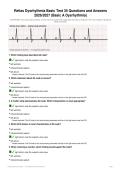
Normal sinus rhythm — original study schematic
Original educational schematic — not a diagnostic patient tracing.
1. Which finding best describes SA node?
■ ✓ right atrium near the superior vena cava
• left ventricle
• interventricular septum
• left atrium
Answer rationale: The SA node is the usual primary pacemaker and lies in the right atrium near the SVC.
2. Which statement about SA node is correct?
• left ventricle
• interventricular septum
■ ✓ right atrium near the superior vena cava
• left atrium
Answer rationale: The SA node is the usual primary pacemaker and lies in the right atrium near the SVC.
3. A rhythm strip demonstrates SA node. Which interpretation is most appropriate?
■ ✓ right atrium near the superior vena cava
• left ventricle
• interventricular septum
• left atrium
Answer rationale: The SA node is the usual primary pacemaker and lies in the right atrium near the SVC.
4. Which ECG feature is most characteristic of SA node?
• left ventricle
• interventricular septum
■ ✓ right atrium near the superior vena cava
• left atrium
Answer rationale: The SA node is the usual primary pacemaker and lies in the right atrium near the SVC.
5. When reviewing a monitor, which finding would support SA node?
■ ✓ right atrium near the superior vena cava
• left ventricle
• interventricular septum
Relias Dysrhythmia Basic — 250 Original Practice Questions Page 1
, • left atrium
Answer rationale: The SA node is the usual primary pacemaker and lies in the right atrium near the SVC.
6. Which option correctly identifies SA node?
• left ventricle
• interventricular septum
■ ✓ right atrium near the superior vena cava
• left atrium
Answer rationale: The SA node is the usual primary pacemaker and lies in the right atrium near the SVC.
7. A learner asks how to recognize SA node. What is the best answer?
■ ✓ right atrium near the superior vena cava
• left ventricle
• interventricular septum
• left atrium
Answer rationale: The SA node is the usual primary pacemaker and lies in the right atrium near the SVC.
8. Which description should be matched with SA node?
• left ventricle
• interventricular septum
■ ✓ right atrium near the superior vena cava
• left atrium
Answer rationale: The SA node is the usual primary pacemaker and lies in the right atrium near the SVC.
9. Which rhythm-interpretation statement is accurate for SA node?
■ ✓ right atrium near the superior vena cava
• left ventricle
• interventricular septum
• left atrium
Answer rationale: The SA node is the usual primary pacemaker and lies in the right atrium near the SVC.
10. In a basic dysrhythmia review, SA node is best identified by:
• left ventricle
• interventricular septum
■ ✓ right atrium near the superior vena cava
• left atrium
Answer rationale: The SA node is the usual primary pacemaker and lies in the right atrium near the SVC.
11. Which finding best describes P wave?
■ ✓ atrial depolarization
• ventricular depolarization
• ventricular repolarization
• AV-valve closure
Answer rationale: The P wave represents atrial depolarization.
12. Which statement about P wave is correct?
• ventricular depolarization
Relias Dysrhythmia Basic — 250 Original Practice Questions Page 2
, • ventricular repolarization
■ ✓ atrial depolarization
• AV-valve closure
Answer rationale: The P wave represents atrial depolarization.
13. A rhythm strip demonstrates P wave. Which interpretation is most appropriate?
■ ✓ atrial depolarization
• ventricular depolarization
• ventricular repolarization
• AV-valve closure
Answer rationale: The P wave represents atrial depolarization.
14. Which ECG feature is most characteristic of P wave?
• ventricular depolarization
• ventricular repolarization
■ ✓ atrial depolarization
• AV-valve closure
Answer rationale: The P wave represents atrial depolarization.
15. When reviewing a monitor, which finding would support P wave?
■ ✓ atrial depolarization
• ventricular depolarization
• ventricular repolarization
• AV-valve closure
Answer rationale: The P wave represents atrial depolarization.
16. Which option correctly identifies P wave?
• ventricular depolarization
• ventricular repolarization
■ ✓ atrial depolarization
• AV-valve closure
Answer rationale: The P wave represents atrial depolarization.
17. A learner asks how to recognize P wave. What is the best answer?
■ ✓ atrial depolarization
• ventricular depolarization
• ventricular repolarization
• AV-valve closure
Answer rationale: The P wave represents atrial depolarization.
18. Which description should be matched with P wave?
• ventricular depolarization
• ventricular repolarization
■ ✓ atrial depolarization
• AV-valve closure
Answer rationale: The P wave represents atrial depolarization.
Relias Dysrhythmia Basic — 250 Original Practice Questions Page 3
, 19. Which rhythm-interpretation statement is accurate for P wave?
■ ✓ atrial depolarization
• ventricular depolarization
• ventricular repolarization
• AV-valve closure
Answer rationale: The P wave represents atrial depolarization.
20. In a basic dysrhythmia review, P wave is best identified by:
• ventricular depolarization
• ventricular repolarization
■ ✓ atrial depolarization
• AV-valve closure
Answer rationale: The P wave represents atrial depolarization.
21. A regular rhythm has an R-R interval of 1.0 second. What is the approximate rate?
• 40 bpm
■ ✓ 60 bpm
• 80 bpm
• 100 bpm
Answer rationale: 60 ÷ 1.0 = 60 bpm.
22. An R-R interval of 0.5 second corresponds to approximately:
• 60 bpm
• 90 bpm
■ ✓ 120 bpm
• 150 bpm
Answer rationale: 60 ÷ 0.5 = 120 bpm.
23. Using the 300 method, four large boxes between R waves equals:
• 50 bpm
■ ✓ 75 bpm
• 100 bpm
• 150 bpm
Answer rationale: 300 ÷ 4 = 75 bpm.
24. Using the 300 method, six large boxes between R waves equals:
• 40 bpm
■ ✓ 50 bpm
• 60 bpm
• 90 bpm
Answer rationale: 300 ÷ 6 = 50 bpm.
25. Using the 300 method, two large boxes between R waves equals:
• 50 bpm
• 75 bpm
• 100 bpm
Relias Dysrhythmia Basic — 250 Original Practice Questions Page 4
2026/2027 (Basic A Dysrhythmia)
250 ORIGINAL exam-style practice questions. Correct choices are marked with a large green tick inside an empty box. This is not a leaked or reproduced
Relias examination.
Normal sinus rhythm — original study schematic
Original educational schematic — not a diagnostic patient tracing.
1. Which finding best describes SA node?
■ ✓ right atrium near the superior vena cava
• left ventricle
• interventricular septum
• left atrium
Answer rationale: The SA node is the usual primary pacemaker and lies in the right atrium near the SVC.
2. Which statement about SA node is correct?
• left ventricle
• interventricular septum
■ ✓ right atrium near the superior vena cava
• left atrium
Answer rationale: The SA node is the usual primary pacemaker and lies in the right atrium near the SVC.
3. A rhythm strip demonstrates SA node. Which interpretation is most appropriate?
■ ✓ right atrium near the superior vena cava
• left ventricle
• interventricular septum
• left atrium
Answer rationale: The SA node is the usual primary pacemaker and lies in the right atrium near the SVC.
4. Which ECG feature is most characteristic of SA node?
• left ventricle
• interventricular septum
■ ✓ right atrium near the superior vena cava
• left atrium
Answer rationale: The SA node is the usual primary pacemaker and lies in the right atrium near the SVC.
5. When reviewing a monitor, which finding would support SA node?
■ ✓ right atrium near the superior vena cava
• left ventricle
• interventricular septum
Relias Dysrhythmia Basic — 250 Original Practice Questions Page 1
, • left atrium
Answer rationale: The SA node is the usual primary pacemaker and lies in the right atrium near the SVC.
6. Which option correctly identifies SA node?
• left ventricle
• interventricular septum
■ ✓ right atrium near the superior vena cava
• left atrium
Answer rationale: The SA node is the usual primary pacemaker and lies in the right atrium near the SVC.
7. A learner asks how to recognize SA node. What is the best answer?
■ ✓ right atrium near the superior vena cava
• left ventricle
• interventricular septum
• left atrium
Answer rationale: The SA node is the usual primary pacemaker and lies in the right atrium near the SVC.
8. Which description should be matched with SA node?
• left ventricle
• interventricular septum
■ ✓ right atrium near the superior vena cava
• left atrium
Answer rationale: The SA node is the usual primary pacemaker and lies in the right atrium near the SVC.
9. Which rhythm-interpretation statement is accurate for SA node?
■ ✓ right atrium near the superior vena cava
• left ventricle
• interventricular septum
• left atrium
Answer rationale: The SA node is the usual primary pacemaker and lies in the right atrium near the SVC.
10. In a basic dysrhythmia review, SA node is best identified by:
• left ventricle
• interventricular septum
■ ✓ right atrium near the superior vena cava
• left atrium
Answer rationale: The SA node is the usual primary pacemaker and lies in the right atrium near the SVC.
11. Which finding best describes P wave?
■ ✓ atrial depolarization
• ventricular depolarization
• ventricular repolarization
• AV-valve closure
Answer rationale: The P wave represents atrial depolarization.
12. Which statement about P wave is correct?
• ventricular depolarization
Relias Dysrhythmia Basic — 250 Original Practice Questions Page 2
, • ventricular repolarization
■ ✓ atrial depolarization
• AV-valve closure
Answer rationale: The P wave represents atrial depolarization.
13. A rhythm strip demonstrates P wave. Which interpretation is most appropriate?
■ ✓ atrial depolarization
• ventricular depolarization
• ventricular repolarization
• AV-valve closure
Answer rationale: The P wave represents atrial depolarization.
14. Which ECG feature is most characteristic of P wave?
• ventricular depolarization
• ventricular repolarization
■ ✓ atrial depolarization
• AV-valve closure
Answer rationale: The P wave represents atrial depolarization.
15. When reviewing a monitor, which finding would support P wave?
■ ✓ atrial depolarization
• ventricular depolarization
• ventricular repolarization
• AV-valve closure
Answer rationale: The P wave represents atrial depolarization.
16. Which option correctly identifies P wave?
• ventricular depolarization
• ventricular repolarization
■ ✓ atrial depolarization
• AV-valve closure
Answer rationale: The P wave represents atrial depolarization.
17. A learner asks how to recognize P wave. What is the best answer?
■ ✓ atrial depolarization
• ventricular depolarization
• ventricular repolarization
• AV-valve closure
Answer rationale: The P wave represents atrial depolarization.
18. Which description should be matched with P wave?
• ventricular depolarization
• ventricular repolarization
■ ✓ atrial depolarization
• AV-valve closure
Answer rationale: The P wave represents atrial depolarization.
Relias Dysrhythmia Basic — 250 Original Practice Questions Page 3
, 19. Which rhythm-interpretation statement is accurate for P wave?
■ ✓ atrial depolarization
• ventricular depolarization
• ventricular repolarization
• AV-valve closure
Answer rationale: The P wave represents atrial depolarization.
20. In a basic dysrhythmia review, P wave is best identified by:
• ventricular depolarization
• ventricular repolarization
■ ✓ atrial depolarization
• AV-valve closure
Answer rationale: The P wave represents atrial depolarization.
21. A regular rhythm has an R-R interval of 1.0 second. What is the approximate rate?
• 40 bpm
■ ✓ 60 bpm
• 80 bpm
• 100 bpm
Answer rationale: 60 ÷ 1.0 = 60 bpm.
22. An R-R interval of 0.5 second corresponds to approximately:
• 60 bpm
• 90 bpm
■ ✓ 120 bpm
• 150 bpm
Answer rationale: 60 ÷ 0.5 = 120 bpm.
23. Using the 300 method, four large boxes between R waves equals:
• 50 bpm
■ ✓ 75 bpm
• 100 bpm
• 150 bpm
Answer rationale: 300 ÷ 4 = 75 bpm.
24. Using the 300 method, six large boxes between R waves equals:
• 40 bpm
■ ✓ 50 bpm
• 60 bpm
• 90 bpm
Answer rationale: 300 ÷ 6 = 50 bpm.
25. Using the 300 method, two large boxes between R waves equals:
• 50 bpm
• 75 bpm
• 100 bpm
Relias Dysrhythmia Basic — 250 Original Practice Questions Page 4


