
Medication Aide Test (Latest ): Most
Comprehensive Qs & Ans - to Pass the Exam, 100%
Verified - UPDATED
250 high-yield original exam-style questions • Correct answer marked with a large green ✓ inside a box • No A/B/C/D labels
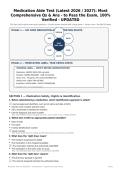
VISUAL 1 — SIX CORE MEDICATION-ADMINISTRATION RIGHTS
PERSON
DOC DRUG
SAFE
MED PASS
TIME DOSE
ROUTE
VISUAL 2 — MEDICATION LABEL / MAR CROSS-CHECK
TRAINING LABEL — VERIFY BEFORE ADMINISTRATION
Medication: SAMPLE DRUG 500 mg tablet
Resident: SAMPLE RESIDENT DOB: 01/01/1940
Route: Oral Frequency: Per authorized MAR/order
Allergy alert: CHECK THE RECORD
Expiration: CHECK LABEL / FACILITY PROCEDURE
Illustration only — not a real prescription.
SECTION 1 — Medication Safety, Rights & Identification
1. Before administering a medication, which identification approach is safest?
☑ Use two approved identifiers, such as full name and date of birth.
• Use the room number and first name.
• Ask a roommate to identify the resident.
• Use the diagnosis and room number.
Why: Two identifiers reduce wrong-person errors; room number is not a reliable identifier.
2. Which item is NOT an appropriate patient identifier?
• Date of birth
• Full name
• Facility identification number
☑ Room number
Why: Room assignments can change and therefore should not be used as an identifier.
3. What does the 'right drug' mean?
• The resident recognizes the tablet.
• The medication is the cheapest available.
☑ The medication matches the authorized order/MAR.
• The medication is the same color as usual.
Why: The medication label must match the authorized order/MAR.
4. What does the 'right dose' require?
• The pharmacy package is ignored.
☑ The amount prepared matches the authorized dose.
Medication Aide Test 2026/2027 • 250 Questions • Original exam-style practice Page 1
, • The amount looks approximately correct.
• The resident chooses the dose.
Why: Dose accuracy is a core medication-safety check.
5. What does the 'right route' mean?
☑ The medication is given by the prescribed route.
• Any route that is convenient.
• The route the resident prefers regardless of the order.
• Only the oral route.
Why: The route must match the authorized order and facility policy.
6. What is the purpose of checking the MAR/eMAR before administration?
• To replace patient identification.
• To determine the resident's diagnosis only.
• To avoid checking the label.
☑ To compare the medication, dose, route, time, and resident with the authorized record.
Why: The MAR/eMAR is a key source for medication administration verification.
7. A resident says, 'This pill looks different from my usual pill.' What is the best action?
• Tell the resident appearance never matters.
• Crush it to hide the difference.
☑ Stop and verify the medication before giving it.
• Give it because the package is on the cart.
Why: Unexpected appearance should trigger a verification step, not a guess.
8. Which action best prevents a look-alike/sound-alike medication error?
• Ask another resident.
☑ Read the complete medication name and strength against the order.
• Rely on the first few letters.
• Use the pill color only.
Why: Similar names and packaging are known contributors to medication errors.
9. A medication label is smudged and the strength cannot be read. What should the aide do?
☑ Do not administer it until the medication can be safely verified.
• Guess the strength.
• Use the resident's memory.
• Give half the tablet.
Why: An unreadable label creates an unsafe uncertainty.
10. Which is a medication error?
• Documenting an administration correctly.
• Checking an allergy before administration.
• Using two identifiers.
☑ Giving a medication to the wrong resident.
Why: Wrong-person administration is a preventable medication error.
11. If a medication error occurs, the medication aide should first follow the facility's
emergency/error protocol and:
• Change the MAR to make it look correct.
• Wait until the next shift.
☑ Notify the nurse/supervisor promptly.
• Hide the error if the resident feels fine.
Why: Prompt reporting allows assessment, treatment, documentation, and prevention of further harm.
12. Why should an aide avoid distractions while preparing medications?
• Distractions replace verification.
☑ Distractions increase the chance of selection and administration errors.
• Distractions improve speed.
• Distractions make calculations easier.
Medication Aide Test 2026/2027 • 250 Questions • Original exam-style practice Page 2
, Why: Medication preparation requires focused attention.
13. When should the medication label be compared with the MAR/eMAR?
☑ According to the facility's required medication-check procedure, including before administration.
• Only after the resident swallows it.
• Only once per week.
• Never if the cart is locked.
Why: Repeated comparison points are a common safety practice.
14. What is the safest response to an unclear medication order?
• Interpret it yourself.
• Ask another resident.
• Choose the closest available dose.
☑ Clarify it through the authorized nurse/prescriber/pharmacy process before administration.
Why: Unclear orders should be clarified rather than guessed.
15. Which is an example of a trailing-zero safety problem?
• 5 mg is unsafe because it has no decimal.
• 10 mg must be written as 10.0 mg.
☑ 5.0 mg can be misread as 50 mg.
• 0.5 mg is always read as 50 mg.
Why: Trailing zeros can contribute to tenfold dosing errors.
16. Which notation is generally safer?
• 00.5 mg
☑ 0.5 mg
• .5 mg
• 0.50 mg
Why: A leading zero helps prevent a decimal point from being missed.
17. Why should a medication aide check for documented allergies before administration?
☑ To reduce the risk of an allergic reaction.
• To determine the medication's color.
• To calculate room assignment.
• To decide whether documentation is needed.
Why: Allergy verification is a basic medication-safety step.
18. A resident refuses a medication. What is the best initial response?
• Force the medication.
• Hide it in food without authorization.
• Threaten the resident.
☑ Respect the refusal, avoid coercion, and follow the facility's refusal/reporting procedure.
Why: Residents generally have the right to refuse; follow policy and notify the nurse as required.
19. What should be documented after a medication is administered?
• A personal opinion about the resident.
• Nothing if the medication was routine.
☑ The administration according to the MAR/eMAR and facility policy.
• Only the resident's room number.
Why: Accurate documentation establishes what was given and supports continuity of care.
20. Why is documenting a medication before giving it unsafe?
• It prevents all adverse reactions.
☑ It can falsely indicate that the medication was administered.
• It makes the medication work faster.
• It improves identification.
Why: Documentation should accurately reflect care actually provided.
21. What does PRN mean?
☑ As needed.
Medication Aide Test 2026/2027 • 250 Questions • Original exam-style practice Page 3
, • Every morning.
• Before meals only.
• At bedtime every night.
Why: PRN medications are given only when indicated and within the authorized order/policy.
22. Who should assess whether a PRN medication is needed when assessment is outside the aide's
scope?
• The resident's roommate.
• The aide's friend.
• The housekeeping staff.
☑ The licensed nurse or other authorized clinician.
Why: Assessment and scope of practice are governed by state law, delegation, and facility policy.
23. A resident asks what a medication is for. What should the aide do?
• Say all medicines do the same thing.
• Ignore the question.
☑ Provide only information within the aide's training and refer clinical questions to the nurse/pharmacist as
required.
• Invent an explanation.
Why: Medication education must remain within the person's role and verified information.
24. Which practice best supports medication security?
• Carry loose tablets in a pocket.
☑ Keep medications secured and accessible only to authorized personnel.
• Leave the cart unlocked in a hallway.
• Store medications in a resident's roommate's drawer.
Why: Secure storage reduces diversion, contamination, and administration errors.
25. The oral route means a medication is given:
☑ By mouth.
• Into the ear.
• Onto the skin only.
• Into a muscle.
Why: Oral medications are administered through the mouth.
SECTION 2 — Routes, Dosage Forms & Administration
VISUAL — BLOOD PRESSURE MEASUREMENT REFERENCE
Correct cuff size
BLOOD PRESSURE
120/80
Arm supported; resident still
26. A sublingual medication is placed:
• Inside the ear.
• Between the toes.
• On the scalp.
☑ Under the tongue.
Why: Sublingual means under the tongue for absorption through oral mucosa.
27. A buccal medication is placed:
• Into the eye.
• Into the rectum.
Medication Aide Test 2026/2027 • 250 Questions • Original exam-style practice Page 4
Comprehensive Qs & Ans - to Pass the Exam, 100%
Verified - UPDATED
250 high-yield original exam-style questions • Correct answer marked with a large green ✓ inside a box • No A/B/C/D labels
VISUAL 1 — SIX CORE MEDICATION-ADMINISTRATION RIGHTS
PERSON
DOC DRUG
SAFE
MED PASS
TIME DOSE
ROUTE
VISUAL 2 — MEDICATION LABEL / MAR CROSS-CHECK
TRAINING LABEL — VERIFY BEFORE ADMINISTRATION
Medication: SAMPLE DRUG 500 mg tablet
Resident: SAMPLE RESIDENT DOB: 01/01/1940
Route: Oral Frequency: Per authorized MAR/order
Allergy alert: CHECK THE RECORD
Expiration: CHECK LABEL / FACILITY PROCEDURE
Illustration only — not a real prescription.
SECTION 1 — Medication Safety, Rights & Identification
1. Before administering a medication, which identification approach is safest?
☑ Use two approved identifiers, such as full name and date of birth.
• Use the room number and first name.
• Ask a roommate to identify the resident.
• Use the diagnosis and room number.
Why: Two identifiers reduce wrong-person errors; room number is not a reliable identifier.
2. Which item is NOT an appropriate patient identifier?
• Date of birth
• Full name
• Facility identification number
☑ Room number
Why: Room assignments can change and therefore should not be used as an identifier.
3. What does the 'right drug' mean?
• The resident recognizes the tablet.
• The medication is the cheapest available.
☑ The medication matches the authorized order/MAR.
• The medication is the same color as usual.
Why: The medication label must match the authorized order/MAR.
4. What does the 'right dose' require?
• The pharmacy package is ignored.
☑ The amount prepared matches the authorized dose.
Medication Aide Test 2026/2027 • 250 Questions • Original exam-style practice Page 1
, • The amount looks approximately correct.
• The resident chooses the dose.
Why: Dose accuracy is a core medication-safety check.
5. What does the 'right route' mean?
☑ The medication is given by the prescribed route.
• Any route that is convenient.
• The route the resident prefers regardless of the order.
• Only the oral route.
Why: The route must match the authorized order and facility policy.
6. What is the purpose of checking the MAR/eMAR before administration?
• To replace patient identification.
• To determine the resident's diagnosis only.
• To avoid checking the label.
☑ To compare the medication, dose, route, time, and resident with the authorized record.
Why: The MAR/eMAR is a key source for medication administration verification.
7. A resident says, 'This pill looks different from my usual pill.' What is the best action?
• Tell the resident appearance never matters.
• Crush it to hide the difference.
☑ Stop and verify the medication before giving it.
• Give it because the package is on the cart.
Why: Unexpected appearance should trigger a verification step, not a guess.
8. Which action best prevents a look-alike/sound-alike medication error?
• Ask another resident.
☑ Read the complete medication name and strength against the order.
• Rely on the first few letters.
• Use the pill color only.
Why: Similar names and packaging are known contributors to medication errors.
9. A medication label is smudged and the strength cannot be read. What should the aide do?
☑ Do not administer it until the medication can be safely verified.
• Guess the strength.
• Use the resident's memory.
• Give half the tablet.
Why: An unreadable label creates an unsafe uncertainty.
10. Which is a medication error?
• Documenting an administration correctly.
• Checking an allergy before administration.
• Using two identifiers.
☑ Giving a medication to the wrong resident.
Why: Wrong-person administration is a preventable medication error.
11. If a medication error occurs, the medication aide should first follow the facility's
emergency/error protocol and:
• Change the MAR to make it look correct.
• Wait until the next shift.
☑ Notify the nurse/supervisor promptly.
• Hide the error if the resident feels fine.
Why: Prompt reporting allows assessment, treatment, documentation, and prevention of further harm.
12. Why should an aide avoid distractions while preparing medications?
• Distractions replace verification.
☑ Distractions increase the chance of selection and administration errors.
• Distractions improve speed.
• Distractions make calculations easier.
Medication Aide Test 2026/2027 • 250 Questions • Original exam-style practice Page 2
, Why: Medication preparation requires focused attention.
13. When should the medication label be compared with the MAR/eMAR?
☑ According to the facility's required medication-check procedure, including before administration.
• Only after the resident swallows it.
• Only once per week.
• Never if the cart is locked.
Why: Repeated comparison points are a common safety practice.
14. What is the safest response to an unclear medication order?
• Interpret it yourself.
• Ask another resident.
• Choose the closest available dose.
☑ Clarify it through the authorized nurse/prescriber/pharmacy process before administration.
Why: Unclear orders should be clarified rather than guessed.
15. Which is an example of a trailing-zero safety problem?
• 5 mg is unsafe because it has no decimal.
• 10 mg must be written as 10.0 mg.
☑ 5.0 mg can be misread as 50 mg.
• 0.5 mg is always read as 50 mg.
Why: Trailing zeros can contribute to tenfold dosing errors.
16. Which notation is generally safer?
• 00.5 mg
☑ 0.5 mg
• .5 mg
• 0.50 mg
Why: A leading zero helps prevent a decimal point from being missed.
17. Why should a medication aide check for documented allergies before administration?
☑ To reduce the risk of an allergic reaction.
• To determine the medication's color.
• To calculate room assignment.
• To decide whether documentation is needed.
Why: Allergy verification is a basic medication-safety step.
18. A resident refuses a medication. What is the best initial response?
• Force the medication.
• Hide it in food without authorization.
• Threaten the resident.
☑ Respect the refusal, avoid coercion, and follow the facility's refusal/reporting procedure.
Why: Residents generally have the right to refuse; follow policy and notify the nurse as required.
19. What should be documented after a medication is administered?
• A personal opinion about the resident.
• Nothing if the medication was routine.
☑ The administration according to the MAR/eMAR and facility policy.
• Only the resident's room number.
Why: Accurate documentation establishes what was given and supports continuity of care.
20. Why is documenting a medication before giving it unsafe?
• It prevents all adverse reactions.
☑ It can falsely indicate that the medication was administered.
• It makes the medication work faster.
• It improves identification.
Why: Documentation should accurately reflect care actually provided.
21. What does PRN mean?
☑ As needed.
Medication Aide Test 2026/2027 • 250 Questions • Original exam-style practice Page 3
, • Every morning.
• Before meals only.
• At bedtime every night.
Why: PRN medications are given only when indicated and within the authorized order/policy.
22. Who should assess whether a PRN medication is needed when assessment is outside the aide's
scope?
• The resident's roommate.
• The aide's friend.
• The housekeeping staff.
☑ The licensed nurse or other authorized clinician.
Why: Assessment and scope of practice are governed by state law, delegation, and facility policy.
23. A resident asks what a medication is for. What should the aide do?
• Say all medicines do the same thing.
• Ignore the question.
☑ Provide only information within the aide's training and refer clinical questions to the nurse/pharmacist as
required.
• Invent an explanation.
Why: Medication education must remain within the person's role and verified information.
24. Which practice best supports medication security?
• Carry loose tablets in a pocket.
☑ Keep medications secured and accessible only to authorized personnel.
• Leave the cart unlocked in a hallway.
• Store medications in a resident's roommate's drawer.
Why: Secure storage reduces diversion, contamination, and administration errors.
25. The oral route means a medication is given:
☑ By mouth.
• Into the ear.
• Onto the skin only.
• Into a muscle.
Why: Oral medications are administered through the mouth.
SECTION 2 — Routes, Dosage Forms & Administration
VISUAL — BLOOD PRESSURE MEASUREMENT REFERENCE
Correct cuff size
BLOOD PRESSURE
120/80
Arm supported; resident still
26. A sublingual medication is placed:
• Inside the ear.
• Between the toes.
• On the scalp.
☑ Under the tongue.
Why: Sublingual means under the tongue for absorption through oral mucosa.
27. A buccal medication is placed:
• Into the eye.
• Into the rectum.
Medication Aide Test 2026/2027 • 250 Questions • Original exam-style practice Page 4


