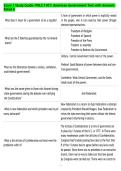
Exam 1 Study Guide- POLS 1101: American Government Test with Answers
Rated A
A form of government in which power is explicitly vested
What does it mean for a government to be a republic? in the people, who in turn exercise their power through
elected representatives.
Freedom of Religion
Freedom of Speech
What are the 5 liberties guaranteed by the 1st Amend-
Freedom of the Press
ment?
Freedom to Assemble
Freedom to Redress the Government
Unitary- Central Government holds most of the power.
Federal- Good Balance of power between state and cen-
What are the ditterences between a unitary, confederal,
tral government.
and federal government?
Confederal- Weak Central Government, and the States
holds must of the power.
-What was the name given to those who favored strong
state governments during the debate over ratifying Anti-Federalist
the Constitution?
New federalism is a return to dual federalism a attempt
-What is new federalism and which president was its pri- created by President Ronald Reagan. Dual Federalism in-
mary advocate? volves the state exercising their power without the federal
government interfering in attairs.
The Articles of Confederation is a form of government set
in place by 13 states of the U.S. in 1777. in There were
many weaknesses under the Articles of Confederation.
-What is the Articles of Confederation and what were the Congress had trouble passing laws due to the fact that
problems with it? 9 of the 13 states had to agree before any laws could
be passed. Since there was no president or an executive
branch, there was no way to make sure that laws passed
by Congress were carried out. There were no courts to
, interpret laws or to judge those that broke them because a
national court system did not exist. To make matters worse,
changing the Articles of Confederation was nearly impos-
sible. A unanimous vote of all 13 states were required
before any changes could be made.
-What is limited government and how do federalism, re-
(Republicanism) is one possible ideology of governing a
publicanism, the separation of powers, and the
society or state as a republic. The key point is that the
system of checks and balances limit government activity
people hold popular sovereignty, rather than the people
(that is, how does the American political system
being subjects of a king.
seek to limit a "tyranny of the majority")?
( 13, 14, 15th ) The Reconstruction Amendments are the
Thirteenth, Fourteenth, and Fifteenth amendments to the
United States Constitution, adopted between 1865 and
1870, the five years immediately following the Civil War
The 13th Amendment banned slavery and all involuntary
servitude, except in the case of punishment for a crime.
Which were the Civil War (aka the Reconstruction) Amend-
ments and what did they do? The 14th Amendment defined a citizen as any person born
in or naturalized in the U.S., overturning the Dredd Scott V.
Sandford (1857) Supreme Court ruling stating that Black
people were not eligible for citizenship.
The 15th Amendment prohibited governments from deny-
ing U.S. citizens the right to vote based on race, color, or
past servitude.
First, the statute (law) must have a secular legislative pur-
pose;
What is the Lemon Test? What are the three prongs of the
Lemon Test? second, its principal or primary ettect must be one that
neither advances nor inhibits religion;
Rated A
A form of government in which power is explicitly vested
What does it mean for a government to be a republic? in the people, who in turn exercise their power through
elected representatives.
Freedom of Religion
Freedom of Speech
What are the 5 liberties guaranteed by the 1st Amend-
Freedom of the Press
ment?
Freedom to Assemble
Freedom to Redress the Government
Unitary- Central Government holds most of the power.
Federal- Good Balance of power between state and cen-
What are the ditterences between a unitary, confederal,
tral government.
and federal government?
Confederal- Weak Central Government, and the States
holds must of the power.
-What was the name given to those who favored strong
state governments during the debate over ratifying Anti-Federalist
the Constitution?
New federalism is a return to dual federalism a attempt
-What is new federalism and which president was its pri- created by President Ronald Reagan. Dual Federalism in-
mary advocate? volves the state exercising their power without the federal
government interfering in attairs.
The Articles of Confederation is a form of government set
in place by 13 states of the U.S. in 1777. in There were
many weaknesses under the Articles of Confederation.
-What is the Articles of Confederation and what were the Congress had trouble passing laws due to the fact that
problems with it? 9 of the 13 states had to agree before any laws could
be passed. Since there was no president or an executive
branch, there was no way to make sure that laws passed
by Congress were carried out. There were no courts to
, interpret laws or to judge those that broke them because a
national court system did not exist. To make matters worse,
changing the Articles of Confederation was nearly impos-
sible. A unanimous vote of all 13 states were required
before any changes could be made.
-What is limited government and how do federalism, re-
(Republicanism) is one possible ideology of governing a
publicanism, the separation of powers, and the
society or state as a republic. The key point is that the
system of checks and balances limit government activity
people hold popular sovereignty, rather than the people
(that is, how does the American political system
being subjects of a king.
seek to limit a "tyranny of the majority")?
( 13, 14, 15th ) The Reconstruction Amendments are the
Thirteenth, Fourteenth, and Fifteenth amendments to the
United States Constitution, adopted between 1865 and
1870, the five years immediately following the Civil War
The 13th Amendment banned slavery and all involuntary
servitude, except in the case of punishment for a crime.
Which were the Civil War (aka the Reconstruction) Amend-
ments and what did they do? The 14th Amendment defined a citizen as any person born
in or naturalized in the U.S., overturning the Dredd Scott V.
Sandford (1857) Supreme Court ruling stating that Black
people were not eligible for citizenship.
The 15th Amendment prohibited governments from deny-
ing U.S. citizens the right to vote based on race, color, or
past servitude.
First, the statute (law) must have a secular legislative pur-
pose;
What is the Lemon Test? What are the three prongs of the
Lemon Test? second, its principal or primary ettect must be one that
neither advances nor inhibits religion;