
WGU D337 – Internet of Things and Infrastructure
Objective Assessment–Style Practice Exam | 250 Original
Questions
Original practice material. This PDF is not an official WGU examination and does not reproduce proprietary or leaked exam items. Questions are
designed around legitimate D337-relevant concepts and course coverage.
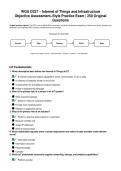
Illustrative IoT Data Path
Sensors Edge Gateway Cloud Apps
Original study diagram: device → local processing → transport → platform → user application
IoT Fundamentals
1. Which description best defines the Internet of Things (IoT)?
■✓ A network of physical objects equipped to sense, communicate, or act on data
● A collection of websites stored on one server
● A replacement for all traditional computer networks
● A type of programming language
2. What is the primary role of a sensor in an IoT system?
● Store long-term backups
■✓ Detect or measure a physical condition
● Encrypt every network packet
● Replace an application server
3. What is the primary role of an actuator?
■✓ Perform a physical action based on a command
● Measure humidity only
● Assign IP addresses
● Archive historical data
4. Which stakeholder typically owns a sensor deployment and makes its data available under defined
terms?
■✓ Information provider
● Information consumer
● Packet forwarder
● Compiler
5. Which IoT stakeholder commonly supplies computing, storage, and analytics capabilities?
■✓ Platform provider
, ● End user
● Sensor manufacturer only
● Cable installer
6. Which best describes interoperability?
■✓ Systems exchanging and using information meaningfully
● Increasing only wireless range
● Using one vendor exclusively
● Compressing every dataset
Connectivity and Protocols
7. Which technology is generally suitable for low-power, long-range IoT telemetry?
■✓ LoRaWAN
● HDMI
● SATA
● VGA
8. Which protocol uses a lightweight publish/subscribe messaging model?
■✓ MQTT
● FTP
● POP3
● NTP
9. In MQTT, which component routes messages between publishers and subscribers?
■✓ Broker
● Hypervisor
● Compiler
● Firewall rule
10. Which wireless technology is commonly used for short-range, low-power personal-area IoT
connections?
■✓ Bluetooth Low Energy
● Fiber Channel
● DSL
● DOCSIS
11. Which factor is LEAST relevant when selecting IoT connectivity?
● Data rate
● Power availability
● Range
■✓ Keyboard layout
12. A rural environmental sensor needs years of battery life and small periodic messages. What is a strong
candidate?
■✓ LPWAN
, ● 10 Gigabit Ethernet to every sensor
● HDMI
● SCSI
Edge Fog Cloud
13. What is a major benefit of edge computing?
■✓ Lower latency by processing near data generation
● Eliminating all security requirements
● Guaranteeing unlimited storage
● Removing all networks
14. Which situation most strongly favors edge processing?
■✓ A safety system requiring immediate local response
● A yearly printed report
● Archiving paper records
● Formatting a presentation
15. What is fog computing generally associated with?
■✓ Intermediate distributed computing between edge devices and centralized cloud resources
● A type of Wi-Fi antenna only
● A database table
● A physical backup medium
16. Why might an IoT gateway aggregate data before sending it upstream?
■✓ To reduce bandwidth and normalize data
● To remove all authentication
● To disable local processing
● To make sensors consume more power
Security and Privacy
17. Which control most directly prevents unauthorized devices from joining an IoT service?
■✓ Strong authentication and device identity
● Increasing screen brightness
● Adding more sensors
● Disabling logs
18. What security problem is created by unchanged default credentials?
■✓ Attackers may gain unauthorized access
● Data automatically becomes encrypted
● Latency becomes zero
● Radio range increases
19. What is a botnet?
■✓ A network of compromised devices controlled remotely
, ● A faster database index
● A physical sensor type
● A cable standard
20. Which principle limits a user or process to only the permissions needed?
■✓ Least privilege
● Open access
● Maximum exposure
● Implicit trust
21. Why are signed firmware updates valuable?
■✓ They help verify software authenticity and integrity
● They eliminate the need for testing
● They increase sensor temperature
● They replace encryption keys
22. What does encryption primarily protect?
■✓ Confidentiality of data
● Physical durability of devices
● Wireless range
● Battery chemistry
Data and Architecture
23. Which architecture combines batch processing with a speed layer for recent data?
■✓ Lambda architecture
● Star topology
● Ring topology
● Client-only architecture
24. Which architecture emphasizes a single stream-processing path with replayable data?
■✓ Kappa architecture
● Token ring
● Bus topology
● RAID 0
25. What is metadata?
■✓ Data that describes other data
● A duplicate sensor battery
● A network cable
● A hardware interrupt
Objective Assessment–Style Practice Exam | 250 Original
Questions
Original practice material. This PDF is not an official WGU examination and does not reproduce proprietary or leaked exam items. Questions are
designed around legitimate D337-relevant concepts and course coverage.
Illustrative IoT Data Path
Sensors Edge Gateway Cloud Apps
Original study diagram: device → local processing → transport → platform → user application
IoT Fundamentals
1. Which description best defines the Internet of Things (IoT)?
■✓ A network of physical objects equipped to sense, communicate, or act on data
● A collection of websites stored on one server
● A replacement for all traditional computer networks
● A type of programming language
2. What is the primary role of a sensor in an IoT system?
● Store long-term backups
■✓ Detect or measure a physical condition
● Encrypt every network packet
● Replace an application server
3. What is the primary role of an actuator?
■✓ Perform a physical action based on a command
● Measure humidity only
● Assign IP addresses
● Archive historical data
4. Which stakeholder typically owns a sensor deployment and makes its data available under defined
terms?
■✓ Information provider
● Information consumer
● Packet forwarder
● Compiler
5. Which IoT stakeholder commonly supplies computing, storage, and analytics capabilities?
■✓ Platform provider
, ● End user
● Sensor manufacturer only
● Cable installer
6. Which best describes interoperability?
■✓ Systems exchanging and using information meaningfully
● Increasing only wireless range
● Using one vendor exclusively
● Compressing every dataset
Connectivity and Protocols
7. Which technology is generally suitable for low-power, long-range IoT telemetry?
■✓ LoRaWAN
● HDMI
● SATA
● VGA
8. Which protocol uses a lightweight publish/subscribe messaging model?
■✓ MQTT
● FTP
● POP3
● NTP
9. In MQTT, which component routes messages between publishers and subscribers?
■✓ Broker
● Hypervisor
● Compiler
● Firewall rule
10. Which wireless technology is commonly used for short-range, low-power personal-area IoT
connections?
■✓ Bluetooth Low Energy
● Fiber Channel
● DSL
● DOCSIS
11. Which factor is LEAST relevant when selecting IoT connectivity?
● Data rate
● Power availability
● Range
■✓ Keyboard layout
12. A rural environmental sensor needs years of battery life and small periodic messages. What is a strong
candidate?
■✓ LPWAN
, ● 10 Gigabit Ethernet to every sensor
● HDMI
● SCSI
Edge Fog Cloud
13. What is a major benefit of edge computing?
■✓ Lower latency by processing near data generation
● Eliminating all security requirements
● Guaranteeing unlimited storage
● Removing all networks
14. Which situation most strongly favors edge processing?
■✓ A safety system requiring immediate local response
● A yearly printed report
● Archiving paper records
● Formatting a presentation
15. What is fog computing generally associated with?
■✓ Intermediate distributed computing between edge devices and centralized cloud resources
● A type of Wi-Fi antenna only
● A database table
● A physical backup medium
16. Why might an IoT gateway aggregate data before sending it upstream?
■✓ To reduce bandwidth and normalize data
● To remove all authentication
● To disable local processing
● To make sensors consume more power
Security and Privacy
17. Which control most directly prevents unauthorized devices from joining an IoT service?
■✓ Strong authentication and device identity
● Increasing screen brightness
● Adding more sensors
● Disabling logs
18. What security problem is created by unchanged default credentials?
■✓ Attackers may gain unauthorized access
● Data automatically becomes encrypted
● Latency becomes zero
● Radio range increases
19. What is a botnet?
■✓ A network of compromised devices controlled remotely
, ● A faster database index
● A physical sensor type
● A cable standard
20. Which principle limits a user or process to only the permissions needed?
■✓ Least privilege
● Open access
● Maximum exposure
● Implicit trust
21. Why are signed firmware updates valuable?
■✓ They help verify software authenticity and integrity
● They eliminate the need for testing
● They increase sensor temperature
● They replace encryption keys
22. What does encryption primarily protect?
■✓ Confidentiality of data
● Physical durability of devices
● Wireless range
● Battery chemistry
Data and Architecture
23. Which architecture combines batch processing with a speed layer for recent data?
■✓ Lambda architecture
● Star topology
● Ring topology
● Client-only architecture
24. Which architecture emphasizes a single stream-processing path with replayable data?
■✓ Kappa architecture
● Token ring
● Bus topology
● RAID 0
25. What is metadata?
■✓ Data that describes other data
● A duplicate sensor battery
● A network cable
● A hardware interrupt


