
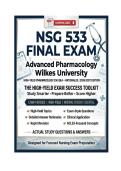
,NSG 533 Advanced Pharmacology Final Exam
Study Guide Wilkes University High-Yield
Pharmacology 150 Q&A + Rationales
2026/2027
1. A 70 kg patient receives a 350 mg IV bolus of a drug. The plasma concentration is measured
at 5 mg/L. What is the volume of distribution (Vd)?
A. 7 L
B. 35 L
C. 70 L
D. 350 L
Correct Answer: C. 70 L
Rationale: Vd = Dose / Plasma Concentration. Vd = 350 mg ÷ 5 mg/L = 70 L. The volume of
distribution reflects the extent of drug distribution into body tissues relative to plasma.
2. A patient with cirrhosis and ascites is prescribed a hydrophilic drug. Which change in drug
distribution is most likely?
A. Decreased Vd for water-soluble drugs
B. Increased Vd for hydrophilic drugs
C. Increased protein binding
,D. Decreased Vd for lipophilic drugs
Correct Answer: B. Increased Vd for hydrophilic drugs
Rationale: Cirrhosis and ascites increase total body water, expanding the volume into which
hydrophilic drugs distribute. This increases the Vd of water-soluble drugs, potentially requiring
higher loading doses.
3. A patient with heart failure has reduced hepatic blood flow. This will most significantly affect
clearance of which drug?
A. Gentamicin
B. Lidocaine
C. Lithium
D. Digoxin
Correct Answer: B. Lidocaine
Rationale: Lidocaine is a high-extraction-ratio drug, meaning its hepatic clearance is highly
dependent on liver blood flow. Reduced hepatic perfusion in heart failure significantly
decreases lidocaine clearance, increasing toxicity risk.
4. A drug follows zero-order kinetics. Which statement is correct?
, A. Half-life is constant
B. Doubling the dose doubles the time to eliminate
C. Elimination rate is proportional to concentration
D. Dose-dependent toxicity is a concern
Correct Answer: D. Dose-dependent toxicity is a concern
Rationale: Zero-order kinetics occurs when metabolic enzymes are saturated. A constant
amount of drug is eliminated per unit time regardless of concentration. Small dose increases
can cause disproportionately large increases in plasma concentration, leading to toxicity.
Examples include phenytoin, ethanol, and high-dose aspirin.
5. A patient with hypoalbuminemia is prescribed a highly protein-bound drug. What is the most
likely clinical consequence?
A. Decreased free drug concentration and reduced efficacy
B. Increased free drug concentration and toxicity risk
C. No change in free drug concentration
D. Increased renal excretion of the drug
Correct Answer: B. Increased free drug concentration and toxicity risk
Rationale: Low albumin reduces protein binding sites, increasing the free (active) fraction of
highly protein-bound drugs. This can cause toxicity even at standard doses. Dose reduction and
monitoring are often necessary.
Study Guide Wilkes University High-Yield
Pharmacology 150 Q&A + Rationales
2026/2027
1. A 70 kg patient receives a 350 mg IV bolus of a drug. The plasma concentration is measured
at 5 mg/L. What is the volume of distribution (Vd)?
A. 7 L
B. 35 L
C. 70 L
D. 350 L
Correct Answer: C. 70 L
Rationale: Vd = Dose / Plasma Concentration. Vd = 350 mg ÷ 5 mg/L = 70 L. The volume of
distribution reflects the extent of drug distribution into body tissues relative to plasma.
2. A patient with cirrhosis and ascites is prescribed a hydrophilic drug. Which change in drug
distribution is most likely?
A. Decreased Vd for water-soluble drugs
B. Increased Vd for hydrophilic drugs
C. Increased protein binding
,D. Decreased Vd for lipophilic drugs
Correct Answer: B. Increased Vd for hydrophilic drugs
Rationale: Cirrhosis and ascites increase total body water, expanding the volume into which
hydrophilic drugs distribute. This increases the Vd of water-soluble drugs, potentially requiring
higher loading doses.
3. A patient with heart failure has reduced hepatic blood flow. This will most significantly affect
clearance of which drug?
A. Gentamicin
B. Lidocaine
C. Lithium
D. Digoxin
Correct Answer: B. Lidocaine
Rationale: Lidocaine is a high-extraction-ratio drug, meaning its hepatic clearance is highly
dependent on liver blood flow. Reduced hepatic perfusion in heart failure significantly
decreases lidocaine clearance, increasing toxicity risk.
4. A drug follows zero-order kinetics. Which statement is correct?
, A. Half-life is constant
B. Doubling the dose doubles the time to eliminate
C. Elimination rate is proportional to concentration
D. Dose-dependent toxicity is a concern
Correct Answer: D. Dose-dependent toxicity is a concern
Rationale: Zero-order kinetics occurs when metabolic enzymes are saturated. A constant
amount of drug is eliminated per unit time regardless of concentration. Small dose increases
can cause disproportionately large increases in plasma concentration, leading to toxicity.
Examples include phenytoin, ethanol, and high-dose aspirin.
5. A patient with hypoalbuminemia is prescribed a highly protein-bound drug. What is the most
likely clinical consequence?
A. Decreased free drug concentration and reduced efficacy
B. Increased free drug concentration and toxicity risk
C. No change in free drug concentration
D. Increased renal excretion of the drug
Correct Answer: B. Increased free drug concentration and toxicity risk
Rationale: Low albumin reduces protein binding sites, increasing the free (active) fraction of
highly protein-bound drugs. This can cause toxicity even at standard doses. Dose reduction and
monitoring are often necessary.


