
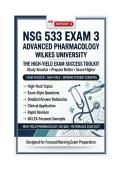
,NSG 533 Advanced Pharmacology Exam 3
Study Guide Wilkes University High-Yield
Pharmacology 150 Q&A + Rationales
2026/2027
1. A 28-year-old patient with moderate persistent asthma is prescribed an inhaled corticosteroid
(ICS). Which of the following best describes the mechanism of action of this drug class?
A. Bronchodilation by relaxing airway smooth muscle
B. Reduction of airway inflammation by inhibiting multiple inflammatory cells and mediators
C. Blockade of leukotriene receptors
D. Antagonism of muscarinic receptors
Correct Answer: B. Reduction of airway inflammation by inhibiting multiple inflammatory cells
and mediators
Rationale: Inhaled corticosteroids (e.g., fluticasone, budesonide) reduce airway inflammation by
suppressing the transcription of pro-inflammatory genes and inhibiting multiple inflammatory
cells (eosinophils, macrophages, lymphocytes) and mediators (cytokines, chemokines). They are
the cornerstone of persistent asthma management. Bronchodilation is the mechanism of beta-2
agonists; LTRA mechanism is receptor blockade; LAMA mechanism is muscarinic antagonism.
2. A patient with asthma is prescribed a short-acting beta-2 agonist (SABA). Which of the
following is the most appropriate counseling point?
A. Use daily for maintenance therapy
,B. Use as a rescue inhaler for acute symptoms
C. Use only at bedtime
D. Use in combination with a LABA for acute relief
Correct Answer: B. Use as a rescue inhaler for acute symptoms
Rationale: SABAs (e.g., albuterol, levalbuterol) are used as rescue inhalers for acute
bronchospasm. They provide rapid bronchodilation within minutes and last 4–6 hours. They are
not for maintenance therapy. LABAs are never used for acute relief.
3. A 62-year-old male with COPD is prescribed tiotropium. Which of the following best describes
the mechanism of action?
A. Short-acting beta-2 agonist
B. Long-acting muscarinic antagonist
C. Inhaled corticosteroid
D. Leukotriene receptor antagonist
Correct Answer: B. Long-acting muscarinic antagonist
Rationale: Tiotropium is a long-acting muscarinic antagonist (LAMA) that blocks muscarinic
receptors in the airways, leading to bronchodilation. It is used for maintenance therapy in COPD
and asthma. SABAs are used for acute relief.
, 4. A patient with asthma is prescribed montelukast. Which of the following is TRUE regarding
this medication?
A. It is a bronchodilator used for acute asthma attacks
B. It is a leukotriene receptor antagonist used for prophylaxis
C. It is a corticosteroid
D. It is a long-acting beta-2 agonist
Correct Answer: B. It is a leukotriene receptor antagonist used for prophylaxis
Rationale: Montelukast is a leukotriene receptor antagonist (LTRA) used for prophylaxis of
asthma and allergic rhinitis. It is not effective for acute asthma attacks. It works by blocking
leukotriene-mediated inflammation and bronchoconstriction. It carries a boxed warning for
neuropsychiatric events.
5. A patient is prescribed fluticasone/salmeterol (Advair) for asthma. Which of the following is
the most important counseling point?
A. Use as a rescue inhaler for acute symptoms
B. Rinse mouth after each use to prevent oral candidiasis
C. Take only when symptomatic
D. Double the dose if symptoms worsen
Correct Answer: B. Rinse mouth after each use to prevent oral candidiasis
Study Guide Wilkes University High-Yield
Pharmacology 150 Q&A + Rationales
2026/2027
1. A 28-year-old patient with moderate persistent asthma is prescribed an inhaled corticosteroid
(ICS). Which of the following best describes the mechanism of action of this drug class?
A. Bronchodilation by relaxing airway smooth muscle
B. Reduction of airway inflammation by inhibiting multiple inflammatory cells and mediators
C. Blockade of leukotriene receptors
D. Antagonism of muscarinic receptors
Correct Answer: B. Reduction of airway inflammation by inhibiting multiple inflammatory cells
and mediators
Rationale: Inhaled corticosteroids (e.g., fluticasone, budesonide) reduce airway inflammation by
suppressing the transcription of pro-inflammatory genes and inhibiting multiple inflammatory
cells (eosinophils, macrophages, lymphocytes) and mediators (cytokines, chemokines). They are
the cornerstone of persistent asthma management. Bronchodilation is the mechanism of beta-2
agonists; LTRA mechanism is receptor blockade; LAMA mechanism is muscarinic antagonism.
2. A patient with asthma is prescribed a short-acting beta-2 agonist (SABA). Which of the
following is the most appropriate counseling point?
A. Use daily for maintenance therapy
,B. Use as a rescue inhaler for acute symptoms
C. Use only at bedtime
D. Use in combination with a LABA for acute relief
Correct Answer: B. Use as a rescue inhaler for acute symptoms
Rationale: SABAs (e.g., albuterol, levalbuterol) are used as rescue inhalers for acute
bronchospasm. They provide rapid bronchodilation within minutes and last 4–6 hours. They are
not for maintenance therapy. LABAs are never used for acute relief.
3. A 62-year-old male with COPD is prescribed tiotropium. Which of the following best describes
the mechanism of action?
A. Short-acting beta-2 agonist
B. Long-acting muscarinic antagonist
C. Inhaled corticosteroid
D. Leukotriene receptor antagonist
Correct Answer: B. Long-acting muscarinic antagonist
Rationale: Tiotropium is a long-acting muscarinic antagonist (LAMA) that blocks muscarinic
receptors in the airways, leading to bronchodilation. It is used for maintenance therapy in COPD
and asthma. SABAs are used for acute relief.
, 4. A patient with asthma is prescribed montelukast. Which of the following is TRUE regarding
this medication?
A. It is a bronchodilator used for acute asthma attacks
B. It is a leukotriene receptor antagonist used for prophylaxis
C. It is a corticosteroid
D. It is a long-acting beta-2 agonist
Correct Answer: B. It is a leukotriene receptor antagonist used for prophylaxis
Rationale: Montelukast is a leukotriene receptor antagonist (LTRA) used for prophylaxis of
asthma and allergic rhinitis. It is not effective for acute asthma attacks. It works by blocking
leukotriene-mediated inflammation and bronchoconstriction. It carries a boxed warning for
neuropsychiatric events.
5. A patient is prescribed fluticasone/salmeterol (Advair) for asthma. Which of the following is
the most important counseling point?
A. Use as a rescue inhaler for acute symptoms
B. Rinse mouth after each use to prevent oral candidiasis
C. Take only when symptomatic
D. Double the dose if symptoms worsen
Correct Answer: B. Rinse mouth after each use to prevent oral candidiasis


