[STUDY GUIDE] • HIGH-YIELD PRACTICE & REVIEW EDITION
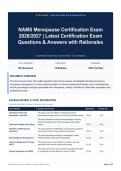
NAMS Menopause Certification Exam
2026/2027 | Latest Certification Exam
Questions & Answers with Rationales
Comprehensive Examination Question Bank • Concept Mapping
TOTAL QUESTIONS EXAM TOPICS RATIONALES
120 Questions 12 Modules 100% Verified
DOCUMENT OVERVIEW
This document provides 120 verified questions with correct answers and detailed rationales focusing on
menopause management. It covers critical concepts in hormone replacement therapy, bone mineral density,
and the physiological changes associated with menopause, making it suitable for certification preparation and
professional review.
EXAM BLUEPRINT & TOPIC DISTRIBUTION
Systematic breakdown of subject domains and exam coverage.
Topic Module Scope & Core Focus Questions Share (%)
Climacteric Phase and This topic covers the stages of menopause and the
Menopause Transition physiological changes that occur during the climacteric phase. 10 Qs 8.3%
This topic addresses various hormonal changes, including
FSH and estradiol levels, during menopause and related
Hormonal Changes and Testing testing. 10 Qs 8.3%
Ethnicity and Menopausal This topic explores the differences in menopausal symptoms
Symptoms and hormone levels among various ethnic groups. 10 Qs 8.3%
This topic discusses the impact of menopause on bone
Bone Health and Osteoporosis mineral density and the risk of osteoporosis. 10 Qs 8.3%
Hormone Replacement Therapy This topic focuses on the indications, benefits, and risks
(HRT) associated with hormone replacement therapy. 10 Qs 8.3%
This topic examines the role of adrenal androgens like DHEA
Adrenal androgens and DHEA in menopause and their effects on women's health. 10 Qs 8.3%
Confidential • Student Study Edition • Practice & Review Guide Page 1 of 37
,STUDENT STUDY & MASTERY EDITION PRACTICE & REVIEW GUIDE
Menopausal Symptoms and This topic covers various symptoms experienced during
Management menopause and their management strategies. 10 Qs 8.3%
Cognitive Function and This topic investigates the effects of menopause on cognitive
Menopause abilities and brain health. 10 Qs 8.3%
This topic addresses the changes in menstrual cycles and
Menstrual Changes and Cycles associated hormonal levels during the menopause transition. 10 Qs 8.3%
This topic discusses conditions affecting vulvar and vaginal
Vulvar and Vaginal Health health during menopause. 10 Qs 8.3%
This topic focuses on the risk of fractures and the need for
Fractures and Long-term Care long-term care in postmenopausal women. 10 Qs 8.3%
Miscellaneous This topic includes various menopause-related issues such as
Menopause-Related Issues thyroid function and other hormonal interactions. 10 Qs 8.3%
Total Exam Coverage 12 Integrated Topic Modules 120 Qs 100.0%
Confidential • Student Study Edition • Practice & Review Guide Page 2 of 37
,STUDENT STUDY & MASTERY EDITION PRACTICE & REVIEW GUIDE
TOPIC 1: CLIMACTERIC PHASE AND MENOPAUSE TRANSITION
10 Questions • 8.3% of Exam • This topic covers the stages of menopause and the physiological changes that occur during the
climacteric phase.
QUESTION 1
Climacteric phase
Answer: The period of endrocrinologic, somatic, and transitory psychologic changes that occur around the
time of menopause.
Rationale: The climacteric phase encompasses the hormonal shifts, physical manifestations, and emotional fluctuations
associated with the menopausal transition. This period is defined by the progressive decline in ovarian function leading to
the cessation of menstruation.
QUESTION 2
Early menopause
Answer: LMP before age 45.
Rationale: Early menopause is defined by the cessation of menstruation before age 45, indicating a premature decline in
ovarian function. This age cutoff distinguishes it from natural menopause, which typically occurs between ages 45 and 55.
QUESTION 3
Primary ovarian insufficiency
Answer: Menopause that occurs before age 40.
Rationale: Primary ovarian insufficiency is defined by the cessation of normal ovarian function, leading to menopause,
which is diagnosed when it occurs before the age of 40. This condition signifies premature ovarian failure, distinct from
natural menopause.
Confidential • Student Study Edition • Practice & Review Guide Page 3 of 37
, STUDENT STUDY & MASTERY EDITION PRACTICE & REVIEW GUIDE
QUESTION 4
Early menopause transition (stage -2)
Answer: Persistent difference of 7 days or more in the length of consecutive cycles.
Rationale: The early menopausal transition is characterized by increasing cycle variability, defined by a persistent
difference of at least 7 days between consecutive menstrual cycles. This variability reflects the initial hormonal fluctuations
of perimenopause.
QUESTION 5
What stage are VMS more likely?
Answer: +1B (generally last 2 years)
Rationale: VMS, or volcanic material supply, is generally considered to be at its peak during the +1b stage, which typically
lasts for the final two years of a volcanic eruption cycle. This heightened supply is driven by the increased pressure and
destabilization within the magma chamber as the eruption nears its end.
QUESTION 6
In the first year after the FMP, there is no production of what hormone?
Answer: Progesterone.
Rationale: Following a female-to-male sex reassignment surgery (FMP), exogenous testosterone therapy suppresses the
hypothalamic-pituitary-gonadal axis, leading to anovulation and cessation of ovarian progesterone production. This
suppression is the primary mechanism by which progesterone is not produced in the first year post-FMP.
QUESTION 7
Systemic and vaginal estrogen will not help with this type of urinary incontinence?
Answer: Will NOT help with stress incontinence.
Rationale: Estrogen therapy primarily addresses stress incontinence by improving urethral and bladder neck support
through tissue hypertrophy and increased vascularity. However, it is ineffective for urge incontinence, which stems from
detrusor muscle overactivity.
Confidential • Student Study Edition • Practice & Review Guide Page 4 of 37
NAMS Menopause Certification Exam
2026/2027 | Latest Certification Exam
Questions & Answers with Rationales
Comprehensive Examination Question Bank • Concept Mapping
TOTAL QUESTIONS EXAM TOPICS RATIONALES
120 Questions 12 Modules 100% Verified
DOCUMENT OVERVIEW
This document provides 120 verified questions with correct answers and detailed rationales focusing on
menopause management. It covers critical concepts in hormone replacement therapy, bone mineral density,
and the physiological changes associated with menopause, making it suitable for certification preparation and
professional review.
EXAM BLUEPRINT & TOPIC DISTRIBUTION
Systematic breakdown of subject domains and exam coverage.
Topic Module Scope & Core Focus Questions Share (%)
Climacteric Phase and This topic covers the stages of menopause and the
Menopause Transition physiological changes that occur during the climacteric phase. 10 Qs 8.3%
This topic addresses various hormonal changes, including
FSH and estradiol levels, during menopause and related
Hormonal Changes and Testing testing. 10 Qs 8.3%
Ethnicity and Menopausal This topic explores the differences in menopausal symptoms
Symptoms and hormone levels among various ethnic groups. 10 Qs 8.3%
This topic discusses the impact of menopause on bone
Bone Health and Osteoporosis mineral density and the risk of osteoporosis. 10 Qs 8.3%
Hormone Replacement Therapy This topic focuses on the indications, benefits, and risks
(HRT) associated with hormone replacement therapy. 10 Qs 8.3%
This topic examines the role of adrenal androgens like DHEA
Adrenal androgens and DHEA in menopause and their effects on women's health. 10 Qs 8.3%
Confidential • Student Study Edition • Practice & Review Guide Page 1 of 37
,STUDENT STUDY & MASTERY EDITION PRACTICE & REVIEW GUIDE
Menopausal Symptoms and This topic covers various symptoms experienced during
Management menopause and their management strategies. 10 Qs 8.3%
Cognitive Function and This topic investigates the effects of menopause on cognitive
Menopause abilities and brain health. 10 Qs 8.3%
This topic addresses the changes in menstrual cycles and
Menstrual Changes and Cycles associated hormonal levels during the menopause transition. 10 Qs 8.3%
This topic discusses conditions affecting vulvar and vaginal
Vulvar and Vaginal Health health during menopause. 10 Qs 8.3%
This topic focuses on the risk of fractures and the need for
Fractures and Long-term Care long-term care in postmenopausal women. 10 Qs 8.3%
Miscellaneous This topic includes various menopause-related issues such as
Menopause-Related Issues thyroid function and other hormonal interactions. 10 Qs 8.3%
Total Exam Coverage 12 Integrated Topic Modules 120 Qs 100.0%
Confidential • Student Study Edition • Practice & Review Guide Page 2 of 37
,STUDENT STUDY & MASTERY EDITION PRACTICE & REVIEW GUIDE
TOPIC 1: CLIMACTERIC PHASE AND MENOPAUSE TRANSITION
10 Questions • 8.3% of Exam • This topic covers the stages of menopause and the physiological changes that occur during the
climacteric phase.
QUESTION 1
Climacteric phase
Answer: The period of endrocrinologic, somatic, and transitory psychologic changes that occur around the
time of menopause.
Rationale: The climacteric phase encompasses the hormonal shifts, physical manifestations, and emotional fluctuations
associated with the menopausal transition. This period is defined by the progressive decline in ovarian function leading to
the cessation of menstruation.
QUESTION 2
Early menopause
Answer: LMP before age 45.
Rationale: Early menopause is defined by the cessation of menstruation before age 45, indicating a premature decline in
ovarian function. This age cutoff distinguishes it from natural menopause, which typically occurs between ages 45 and 55.
QUESTION 3
Primary ovarian insufficiency
Answer: Menopause that occurs before age 40.
Rationale: Primary ovarian insufficiency is defined by the cessation of normal ovarian function, leading to menopause,
which is diagnosed when it occurs before the age of 40. This condition signifies premature ovarian failure, distinct from
natural menopause.
Confidential • Student Study Edition • Practice & Review Guide Page 3 of 37
, STUDENT STUDY & MASTERY EDITION PRACTICE & REVIEW GUIDE
QUESTION 4
Early menopause transition (stage -2)
Answer: Persistent difference of 7 days or more in the length of consecutive cycles.
Rationale: The early menopausal transition is characterized by increasing cycle variability, defined by a persistent
difference of at least 7 days between consecutive menstrual cycles. This variability reflects the initial hormonal fluctuations
of perimenopause.
QUESTION 5
What stage are VMS more likely?
Answer: +1B (generally last 2 years)
Rationale: VMS, or volcanic material supply, is generally considered to be at its peak during the +1b stage, which typically
lasts for the final two years of a volcanic eruption cycle. This heightened supply is driven by the increased pressure and
destabilization within the magma chamber as the eruption nears its end.
QUESTION 6
In the first year after the FMP, there is no production of what hormone?
Answer: Progesterone.
Rationale: Following a female-to-male sex reassignment surgery (FMP), exogenous testosterone therapy suppresses the
hypothalamic-pituitary-gonadal axis, leading to anovulation and cessation of ovarian progesterone production. This
suppression is the primary mechanism by which progesterone is not produced in the first year post-FMP.
QUESTION 7
Systemic and vaginal estrogen will not help with this type of urinary incontinence?
Answer: Will NOT help with stress incontinence.
Rationale: Estrogen therapy primarily addresses stress incontinence by improving urethral and bladder neck support
through tissue hypertrophy and increased vascularity. However, it is ineffective for urge incontinence, which stems from
detrusor muscle overactivity.
Confidential • Student Study Edition • Practice & Review Guide Page 4 of 37