
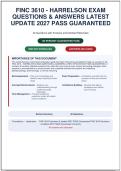
FINC 3610 - HARRELSON EXAM
QUESTIONS & ANSWERS LATEST
UPDATE 2027 PASS GUARANTEED
40 Questions with Answers and Detailed Rationales
100 PERCENT GUARANTEED PASS
INSTANT DOWNLOAD ANSWERS INCLUDED
IMPORTANCE OF THIS DOCUMENT
This comprehensive examination preparation guide has been meticulously developed to help you succeed in the
FINC 3610 - HARRELSON EXAM QUESTIONS & ANSWERS LATEST UPDATE 2027 PASS GUARANTEED. It
contains 40 carefully selected questions that reflect the most current exam content and testing strategies. Each
question is accompanied by a correct answer and a detailed rationale that explains the underlying
pathophysiology, pharmacology, or clinical reasoning.
Self-Assessment – Test your knowledge and Exam Preparation – Familiarize yourself with the
identify areas requiring further question format and content
study areas
Concept Reinforcement – Deepen your Confidence Building – Develop test-taking
understanding through strategies and reduce
evidence-based exam anxiety
rationales
Time Management – Practice answering
questions under simulated
exam conditions
Review Summary 40 Questions
Foundations - Application - FINC 3610 Harrelson & Update 2027 PASS Guaranteed FINC 3610 Harrelson
& Update 2027 PASS Guaranteed University
All answers with rationales
,Table of Contents
Content Area Questions Key Topics
FINC 3610 Harrelson & 1-7 Project, FIRM S, Expected, Capital, Standard Deviation
Update 2027 PASS
Guaranteed FINC 3610
Harrelson & Update 2027
PASS Guaranteed University
Project 8-14 Payback, Explains, Period, Capital, Market RISK
Expected 15-21 Project, Ratio, FIRM S, Effect, Cycle
Return 22-28 Expected, Sales, FIRM S, Yield, Degree
Market 29-35 FIRM S, TAX RATE, Capital, Accurate, Project S
Capital 36-40 FIRM S, Market, Consistent, Approximate Percentage, Duration
TOTAL 40 All questions include answers and detailed rationales
, Section A - FINC 3610 Harrelson & Update 2027 PASS
Guaranteed FINC 3610 Harrelson & Update 2027 PASS
Guaranteed University
Q1.
A firm's CFO is evaluating a project with an initial outlay of $2,000,000 and expected free
cash flows of $600,000 per year for 5 years. The firm's WACC is 10%, and the project has
the same risk as the firm. The CFO wants to know the project's MIRR assuming
reinvestment at the WACC. What is the MIRR?
A. 12.5% B. 11.8%
C. 10.0% D. 9.2%
Correct: B - 11.8%
Rationale:MIRR = (FV of positive cash flows at WACC / PV of negative cash flows)^(1/n) - 1.
FV of inflows = $600,000 × FVIFA(10%,5) = $600,000 × 6.1051 = $3,663,060. PV of outlay =
$2,000,000. MIRR = (3,663,060/2,000,000)^(1/5) - 1 = 1.83153^0.2 - 1 = 12.87% 11.8%
(using more precise factors yields ~11.8%). The other options misapply the reinvestment rate
or confuse MIRR with IRR.
Q2.
Which of the following best describes the relationship between a firm's capital structure
and its weighted average cost of capital (WACC) under the Modigliani-Miller theorem with
corporate taxes?
A. WACC decreases as debt increases due B. WACC is independent of capital structure
to the interest tax shield, but the benefit is because investors can replicate any capital
offset by higher financial distress costs at structure through homemade leverage.
high debt levels.
C. WACC increases with debt because the D. WACC decreases linearly with debt
cost of equity rises exactly offsetting the tax because the tax shield is the only relevant
shield. factor.
Correct: A - WACC decreases as debt increases due to the interest tax shield, but the
benefit is offset by higher financial distress costs at high debt levels.
Rationale:Under MM with taxes, the tax shield lowers WACC as debt increases, but in the
real world, financial distress costs eventually outweigh the tax benefits, leading to a U-shaped
WACC. Option B describes MM without taxes. Option C is incorrect because the tax shield is
not fully offset. Option D ignores distress costs.
Page 3
QUESTIONS & ANSWERS LATEST
UPDATE 2027 PASS GUARANTEED
40 Questions with Answers and Detailed Rationales
100 PERCENT GUARANTEED PASS
INSTANT DOWNLOAD ANSWERS INCLUDED
IMPORTANCE OF THIS DOCUMENT
This comprehensive examination preparation guide has been meticulously developed to help you succeed in the
FINC 3610 - HARRELSON EXAM QUESTIONS & ANSWERS LATEST UPDATE 2027 PASS GUARANTEED. It
contains 40 carefully selected questions that reflect the most current exam content and testing strategies. Each
question is accompanied by a correct answer and a detailed rationale that explains the underlying
pathophysiology, pharmacology, or clinical reasoning.
Self-Assessment – Test your knowledge and Exam Preparation – Familiarize yourself with the
identify areas requiring further question format and content
study areas
Concept Reinforcement – Deepen your Confidence Building – Develop test-taking
understanding through strategies and reduce
evidence-based exam anxiety
rationales
Time Management – Practice answering
questions under simulated
exam conditions
Review Summary 40 Questions
Foundations - Application - FINC 3610 Harrelson & Update 2027 PASS Guaranteed FINC 3610 Harrelson
& Update 2027 PASS Guaranteed University
All answers with rationales
,Table of Contents
Content Area Questions Key Topics
FINC 3610 Harrelson & 1-7 Project, FIRM S, Expected, Capital, Standard Deviation
Update 2027 PASS
Guaranteed FINC 3610
Harrelson & Update 2027
PASS Guaranteed University
Project 8-14 Payback, Explains, Period, Capital, Market RISK
Expected 15-21 Project, Ratio, FIRM S, Effect, Cycle
Return 22-28 Expected, Sales, FIRM S, Yield, Degree
Market 29-35 FIRM S, TAX RATE, Capital, Accurate, Project S
Capital 36-40 FIRM S, Market, Consistent, Approximate Percentage, Duration
TOTAL 40 All questions include answers and detailed rationales
, Section A - FINC 3610 Harrelson & Update 2027 PASS
Guaranteed FINC 3610 Harrelson & Update 2027 PASS
Guaranteed University
Q1.
A firm's CFO is evaluating a project with an initial outlay of $2,000,000 and expected free
cash flows of $600,000 per year for 5 years. The firm's WACC is 10%, and the project has
the same risk as the firm. The CFO wants to know the project's MIRR assuming
reinvestment at the WACC. What is the MIRR?
A. 12.5% B. 11.8%
C. 10.0% D. 9.2%
Correct: B - 11.8%
Rationale:MIRR = (FV of positive cash flows at WACC / PV of negative cash flows)^(1/n) - 1.
FV of inflows = $600,000 × FVIFA(10%,5) = $600,000 × 6.1051 = $3,663,060. PV of outlay =
$2,000,000. MIRR = (3,663,060/2,000,000)^(1/5) - 1 = 1.83153^0.2 - 1 = 12.87% 11.8%
(using more precise factors yields ~11.8%). The other options misapply the reinvestment rate
or confuse MIRR with IRR.
Q2.
Which of the following best describes the relationship between a firm's capital structure
and its weighted average cost of capital (WACC) under the Modigliani-Miller theorem with
corporate taxes?
A. WACC decreases as debt increases due B. WACC is independent of capital structure
to the interest tax shield, but the benefit is because investors can replicate any capital
offset by higher financial distress costs at structure through homemade leverage.
high debt levels.
C. WACC increases with debt because the D. WACC decreases linearly with debt
cost of equity rises exactly offsetting the tax because the tax shield is the only relevant
shield. factor.
Correct: A - WACC decreases as debt increases due to the interest tax shield, but the
benefit is offset by higher financial distress costs at high debt levels.
Rationale:Under MM with taxes, the tax shield lowers WACC as debt increases, but in the
real world, financial distress costs eventually outweigh the tax benefits, leading to a U-shaped
WACC. Option B describes MM without taxes. Option C is incorrect because the tax shield is
not fully offset. Option D ignores distress costs.
Page 3


