
EXCELSIOR COLLEGE / UNIVERSITY
NUR 211 — HEALTH DIFFERENCES ACROSS THE
LIFE SPAN 1
FINAL EXAM PRACTICE QUESTION BANK
250 Original Exam-Style Questions • Answer Key Built Into Each Item
This practice bank is aligned to the official NUR211 course description/content areas: cardiovascular and respiratory disorders,
impaired blood-cell formation, abnormal cell growth, nursing judgment, patient-centered care, and lifespan considerations. It is an
original study resource—not leaked or purportedly secure/live Excelsior examination content.
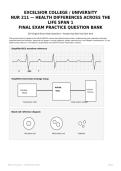
Simplified ECG waveform reference
P QRS T
Simplified chest-tube drainage setup
WATER
SUCTION
PLEURAL SEAL
CONTROL
SPACE
Tube below chest Keep system upright
Blood-cell reference diagram
Red blood cell White blood cell Platelets
NUR 211 Life Span 1 — Original Practice Bank Page 1
, CARDIOVASCULAR DISORDERS
1. A client reports pressure-like chest pain radiating to the left arm with diaphoresis.
Which action is the priority?
☑ Obtain a 12-lead ECG promptly
• Offer a high-fat snack
• Encourage ambulation
• Schedule a routine clinic visit
Rationale: Acute coronary syndrome requires rapid cardiac assessment.
2. Which finding is most consistent with stable angina?
☑ Pain occurs predictably with exertion and improves with rest
• Pain is new and occurs at rest
• Pain persists for several hours despite rest
• Pain occurs only after meals
Rationale: Stable angina is predictable and typically relieved by rest or prescribed nitroglycerin.
3. Which cardiac biomarker is most specific for myocardial injury?
☑ Troponin
• Serum sodium
• Hemoglobin
• Amylase
Rationale: Cardiac troponins are highly specific markers of myocardial injury.
4. A client with suspected myocardial infarction asks why aspirin was prescribed. What is
the best response?
☑ It decreases platelet aggregation
• It increases heart rate
• It dissolves all clots immediately
• It lowers potassium
Rationale: Aspirin inhibits platelet aggregation and reduces further thrombus formation.
5. Which symptom in an older adult may be an atypical presentation of myocardial
infarction?
☑ New confusion or unusual fatigue
• Increased appetite
• Improved exercise tolerance
• Chronic dandruff
Rationale: Older adults may present atypically, including confusion, weakness, dyspnea, or fatigue.
NUR 211 Life Span 1 — Original Practice Bank Page 2
, 6. Which assessment finding is most associated with left-sided heart failure?
☑ Crackles and dyspnea
• Dependent edema only
• Ascites only
• Jugular venous distention without respiratory symptoms
Rationale: Left-sided failure causes pulmonary congestion.
7. Which finding is most associated with right-sided heart failure?
☑ Peripheral edema and jugular venous distention
• Pink frothy sputum only
• Fine crackles only
• Hemoptysis after exercise
Rationale: Right-sided failure causes systemic venous congestion.
8. A client with heart failure has orthopnea. Which intervention is most appropriate?
☑ Elevate the head of the bed
• Place the client flat
• Encourage large meals
• Restrict all activity permanently
Rationale: Upright positioning reduces venous return and improves ventilation.
9. Which medication class commonly reduces afterload in heart failure?
☑ ACE inhibitors
• Antacids
• Antihistamines
• Antidiarrheals
Rationale: ACE inhibitors reduce vasoconstriction and afterload.
10. A client taking digoxin reports nausea and seeing yellow-green halos. What should
the nurse do first?
☑ Hold the dose and notify the provider
• Give an extra dose
• Encourage a potassium-free diet
• Tell the client this is expected
Rationale: These findings suggest digoxin toxicity.
NUR 211 Life Span 1 — Original Practice Bank Page 3
, 11. Which laboratory value is especially important when monitoring a client taking
digoxin?
☑ Serum potassium
• Serum amylase
• Serum bilirubin only
• Platelet count only
Rationale: Hypokalemia increases the risk of digoxin toxicity.
12. Which finding is expected with atrial fibrillation?
☑ Irregularly irregular rhythm
• Regular rhythm at exactly 60/min
• Wide pulse pressure only
• Absent P waves with a perfectly regular rhythm
Rationale: Atrial fibrillation produces an irregularly irregular ventricular response.
13. Why may anticoagulation be prescribed for atrial fibrillation?
☑ To reduce embolic stroke risk
• To increase red blood cell production
• To treat bacterial infection
• To prevent hypoglycemia
Rationale: Atrial fibrillation can promote atrial thrombus formation and embolic stroke.
14. A client becomes unresponsive and has no normal breathing. What is the priority?
☑ Activate emergency response and begin CPR
• Offer oral fluids
• Obtain a diet history
• Place the client in Trendelenburg
Rationale: Immediate CPR and emergency response are required for cardiac arrest.
15. Which rhythm is characterized by chaotic electrical activity with no effective cardiac
output?
☑ Ventricular fibrillation
• Sinus bradycardia
• Sinus rhythm
• First-degree AV block
Rationale: Ventricular fibrillation produces ineffective ventricular activity and requires immediate defibrillation.
NUR 211 Life Span 1 — Original Practice Bank Page 4
NUR 211 — HEALTH DIFFERENCES ACROSS THE
LIFE SPAN 1
FINAL EXAM PRACTICE QUESTION BANK
250 Original Exam-Style Questions • Answer Key Built Into Each Item
This practice bank is aligned to the official NUR211 course description/content areas: cardiovascular and respiratory disorders,
impaired blood-cell formation, abnormal cell growth, nursing judgment, patient-centered care, and lifespan considerations. It is an
original study resource—not leaked or purportedly secure/live Excelsior examination content.
Simplified ECG waveform reference
P QRS T
Simplified chest-tube drainage setup
WATER
SUCTION
PLEURAL SEAL
CONTROL
SPACE
Tube below chest Keep system upright
Blood-cell reference diagram
Red blood cell White blood cell Platelets
NUR 211 Life Span 1 — Original Practice Bank Page 1
, CARDIOVASCULAR DISORDERS
1. A client reports pressure-like chest pain radiating to the left arm with diaphoresis.
Which action is the priority?
☑ Obtain a 12-lead ECG promptly
• Offer a high-fat snack
• Encourage ambulation
• Schedule a routine clinic visit
Rationale: Acute coronary syndrome requires rapid cardiac assessment.
2. Which finding is most consistent with stable angina?
☑ Pain occurs predictably with exertion and improves with rest
• Pain is new and occurs at rest
• Pain persists for several hours despite rest
• Pain occurs only after meals
Rationale: Stable angina is predictable and typically relieved by rest or prescribed nitroglycerin.
3. Which cardiac biomarker is most specific for myocardial injury?
☑ Troponin
• Serum sodium
• Hemoglobin
• Amylase
Rationale: Cardiac troponins are highly specific markers of myocardial injury.
4. A client with suspected myocardial infarction asks why aspirin was prescribed. What is
the best response?
☑ It decreases platelet aggregation
• It increases heart rate
• It dissolves all clots immediately
• It lowers potassium
Rationale: Aspirin inhibits platelet aggregation and reduces further thrombus formation.
5. Which symptom in an older adult may be an atypical presentation of myocardial
infarction?
☑ New confusion or unusual fatigue
• Increased appetite
• Improved exercise tolerance
• Chronic dandruff
Rationale: Older adults may present atypically, including confusion, weakness, dyspnea, or fatigue.
NUR 211 Life Span 1 — Original Practice Bank Page 2
, 6. Which assessment finding is most associated with left-sided heart failure?
☑ Crackles and dyspnea
• Dependent edema only
• Ascites only
• Jugular venous distention without respiratory symptoms
Rationale: Left-sided failure causes pulmonary congestion.
7. Which finding is most associated with right-sided heart failure?
☑ Peripheral edema and jugular venous distention
• Pink frothy sputum only
• Fine crackles only
• Hemoptysis after exercise
Rationale: Right-sided failure causes systemic venous congestion.
8. A client with heart failure has orthopnea. Which intervention is most appropriate?
☑ Elevate the head of the bed
• Place the client flat
• Encourage large meals
• Restrict all activity permanently
Rationale: Upright positioning reduces venous return and improves ventilation.
9. Which medication class commonly reduces afterload in heart failure?
☑ ACE inhibitors
• Antacids
• Antihistamines
• Antidiarrheals
Rationale: ACE inhibitors reduce vasoconstriction and afterload.
10. A client taking digoxin reports nausea and seeing yellow-green halos. What should
the nurse do first?
☑ Hold the dose and notify the provider
• Give an extra dose
• Encourage a potassium-free diet
• Tell the client this is expected
Rationale: These findings suggest digoxin toxicity.
NUR 211 Life Span 1 — Original Practice Bank Page 3
, 11. Which laboratory value is especially important when monitoring a client taking
digoxin?
☑ Serum potassium
• Serum amylase
• Serum bilirubin only
• Platelet count only
Rationale: Hypokalemia increases the risk of digoxin toxicity.
12. Which finding is expected with atrial fibrillation?
☑ Irregularly irregular rhythm
• Regular rhythm at exactly 60/min
• Wide pulse pressure only
• Absent P waves with a perfectly regular rhythm
Rationale: Atrial fibrillation produces an irregularly irregular ventricular response.
13. Why may anticoagulation be prescribed for atrial fibrillation?
☑ To reduce embolic stroke risk
• To increase red blood cell production
• To treat bacterial infection
• To prevent hypoglycemia
Rationale: Atrial fibrillation can promote atrial thrombus formation and embolic stroke.
14. A client becomes unresponsive and has no normal breathing. What is the priority?
☑ Activate emergency response and begin CPR
• Offer oral fluids
• Obtain a diet history
• Place the client in Trendelenburg
Rationale: Immediate CPR and emergency response are required for cardiac arrest.
15. Which rhythm is characterized by chaotic electrical activity with no effective cardiac
output?
☑ Ventricular fibrillation
• Sinus bradycardia
• Sinus rhythm
• First-degree AV block
Rationale: Ventricular fibrillation produces ineffective ventricular activity and requires immediate defibrillation.
NUR 211 Life Span 1 — Original Practice Bank Page 4


