
NRNP 6635 Week 6 Midterm Exam Questions and Revised
Correct Answers & Rationales ()
250 high-fidelity practice questions • Correct answers marked with a large green tick in an empty box • Rationales included
Important: No source can legitimately guarantee a pass or prove access to a future/current university exam. This is a newly written study
set based on publicly surfaced NRNP 6635 Week 6 question themes and current clinical guidance; it is not a leaked exam.
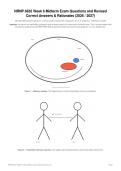
Visual 1 — Memory anatomy. The hippocampus is central to declarative memory consolidation.
Visual 2 — Psychiatric interview structure. Use rapport, open-ended questions, and focused safety assessment.
NRNP 6635 • Week 6 • 250-question source-informed practice set Page 1
, Visual 3 — Limbic network. The amygdala contributes to threat/fear processing; the hippocampus contributes to memory.
Visual 4 — Sleep study pattern. In obstructive apnea, airflow falls while respiratory effort continues.
NRNP 6635 • Week 6 • 250-question source-informed practice set Page 2
, Assessment & MSE
Question 1. The primary purpose of the mental status examination is to assess a patient's current:
mental functioning and behavior
childhood developmental history
family pedigree only
long-term medical prognosis
Rationale: The MSE is a structured description of current appearance, behavior, speech, mood/affect, thought, perception, cognition,
insight, and judgment.
Question 2. Which MSE domain is best assessed by asking a patient to spell a word backward?
perception
attention/concentration
remote memory
abstract reasoning
Rationale: Tasks such as spelling backward or serial subtraction primarily probe attention and concentration.
Question 3. A patient says, 'I feel empty and hopeless,' while appearing tearful. The statement describes the
patient's:
thought process
psychomotor activity
mood
affect
Rationale: Mood is the patient's sustained subjective emotional state; affect is the clinician-observed emotional expression.
Question 4. During an interview, a patient repeatedly gives excessive detail but eventually answers the question.
This speech pattern is:
tangential
clang association
neologism
circumstantial
Rationale: Circumstantiality includes excessive but ultimately relevant detail; tangentiality never returns to the point.
Question 5. A patient rapidly shifts from one topic to another with only weak connections between ideas. This is
most consistent with:
flight of ideas
thought blocking
poverty of speech
NRNP 6635 • Week 6 • 250-question source-informed practice set Page 3
, circumstantiality
Rationale: Flight of ideas is rapid shifting among topics with understandable but often superficial associations, classically seen in mania.
Question 6. Which finding is most suggestive of a hallucination?
a repetitive checking ritual
perceiving a voice when no external stimulus is present
a fixed false belief
a fear of public speaking
Rationale: A hallucination is a perception without an external stimulus.
Question 7. Which finding best represents a delusion?
a recurrent intrusive thought recognized as unreasonable
a sensory perception without a stimulus
a fixed false belief not supported by evidence
a transient feeling of sadness
Rationale: A delusion is a fixed, false belief that is not consistent with reality and is held despite contrary evidence.
Question 8. A patient's speech suddenly stops mid-sentence and remains silent for several seconds. This is:
echolalia
loose association
pressured speech
thought blocking
Rationale: Thought blocking is an abrupt interruption in the flow of thought or speech.
Question 9. Which MSE finding most directly assesses executive functioning?
ability to interpret a proverb
pupil size
gait speed
skin temperature
Rationale: Abstract interpretation and similar tasks can provide information about executive and higher cortical functioning.
Question 10. A patient correctly states the date, location, and reason for the visit. This primarily demonstrates intact:
affect
orientation
insight
judgment
Rationale: Orientation commonly includes person, place, time, and situation.
Question 11. Which question best assesses insight?
What is your full name?
Can you subtract seven from 100?
What do you think is causing these experiences?
What did you eat for breakfast?
Rationale: Insight concerns the patient's understanding of their illness, symptoms, and need for treatment.
Question 12. Which question best assesses judgment?
Who is the president?
What month is it?
What is your mood today?
NRNP 6635 • Week 6 • 250-question source-informed practice set Page 4
Correct Answers & Rationales ()
250 high-fidelity practice questions • Correct answers marked with a large green tick in an empty box • Rationales included
Important: No source can legitimately guarantee a pass or prove access to a future/current university exam. This is a newly written study
set based on publicly surfaced NRNP 6635 Week 6 question themes and current clinical guidance; it is not a leaked exam.
Visual 1 — Memory anatomy. The hippocampus is central to declarative memory consolidation.
Visual 2 — Psychiatric interview structure. Use rapport, open-ended questions, and focused safety assessment.
NRNP 6635 • Week 6 • 250-question source-informed practice set Page 1
, Visual 3 — Limbic network. The amygdala contributes to threat/fear processing; the hippocampus contributes to memory.
Visual 4 — Sleep study pattern. In obstructive apnea, airflow falls while respiratory effort continues.
NRNP 6635 • Week 6 • 250-question source-informed practice set Page 2
, Assessment & MSE
Question 1. The primary purpose of the mental status examination is to assess a patient's current:
mental functioning and behavior
childhood developmental history
family pedigree only
long-term medical prognosis
Rationale: The MSE is a structured description of current appearance, behavior, speech, mood/affect, thought, perception, cognition,
insight, and judgment.
Question 2. Which MSE domain is best assessed by asking a patient to spell a word backward?
perception
attention/concentration
remote memory
abstract reasoning
Rationale: Tasks such as spelling backward or serial subtraction primarily probe attention and concentration.
Question 3. A patient says, 'I feel empty and hopeless,' while appearing tearful. The statement describes the
patient's:
thought process
psychomotor activity
mood
affect
Rationale: Mood is the patient's sustained subjective emotional state; affect is the clinician-observed emotional expression.
Question 4. During an interview, a patient repeatedly gives excessive detail but eventually answers the question.
This speech pattern is:
tangential
clang association
neologism
circumstantial
Rationale: Circumstantiality includes excessive but ultimately relevant detail; tangentiality never returns to the point.
Question 5. A patient rapidly shifts from one topic to another with only weak connections between ideas. This is
most consistent with:
flight of ideas
thought blocking
poverty of speech
NRNP 6635 • Week 6 • 250-question source-informed practice set Page 3
, circumstantiality
Rationale: Flight of ideas is rapid shifting among topics with understandable but often superficial associations, classically seen in mania.
Question 6. Which finding is most suggestive of a hallucination?
a repetitive checking ritual
perceiving a voice when no external stimulus is present
a fixed false belief
a fear of public speaking
Rationale: A hallucination is a perception without an external stimulus.
Question 7. Which finding best represents a delusion?
a recurrent intrusive thought recognized as unreasonable
a sensory perception without a stimulus
a fixed false belief not supported by evidence
a transient feeling of sadness
Rationale: A delusion is a fixed, false belief that is not consistent with reality and is held despite contrary evidence.
Question 8. A patient's speech suddenly stops mid-sentence and remains silent for several seconds. This is:
echolalia
loose association
pressured speech
thought blocking
Rationale: Thought blocking is an abrupt interruption in the flow of thought or speech.
Question 9. Which MSE finding most directly assesses executive functioning?
ability to interpret a proverb
pupil size
gait speed
skin temperature
Rationale: Abstract interpretation and similar tasks can provide information about executive and higher cortical functioning.
Question 10. A patient correctly states the date, location, and reason for the visit. This primarily demonstrates intact:
affect
orientation
insight
judgment
Rationale: Orientation commonly includes person, place, time, and situation.
Question 11. Which question best assesses insight?
What is your full name?
Can you subtract seven from 100?
What do you think is causing these experiences?
What did you eat for breakfast?
Rationale: Insight concerns the patient's understanding of their illness, symptoms, and need for treatment.
Question 12. Which question best assesses judgment?
Who is the president?
What month is it?
What is your mood today?
NRNP 6635 • Week 6 • 250-question source-informed practice set Page 4


