
NCC Electronic Fetal Monitoring Certification Exam
Questions and Answers (2026/2027) (Verified Answers)
1. Which statement best describes external fetal heart-rate monitoring?
Fetal scalp electrode attached to the presenting part
Maternal pulse oximeter placed on a finger
Intrauterine pressure catheter placed inside the uterus
Doppler ultrasound transducer placed on the maternal abdomen
Answer rationale: External FHR monitoring uses Doppler ultrasound from an abdominal transducer.
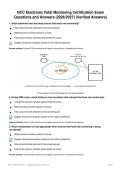
Clinical diagram: external EFM equipment and signal pathways.
2. During EFM review, which finding is most consistent with external fetal heart-rate monitoring?
Intrauterine pressure catheter placed inside the uterus
Maternal pulse oximeter placed on a finger
Fetal scalp electrode attached to the presenting part
Doppler ultrasound transducer placed on the maternal abdomen
Answer rationale: External FHR monitoring uses Doppler ultrasound from an abdominal transducer.
3. Which interpretation is most appropriate when external fetal heart-rate monitoring is being
considered?
Maternal pulse oximeter placed on a finger
Doppler ultrasound transducer placed on the maternal abdomen
Fetal scalp electrode attached to the presenting part
Intrauterine pressure catheter placed inside the uterus
Answer rationale: External FHR monitoring uses Doppler ultrasound from an abdominal transducer.
NCC C-EFM 2026/2027 — Original exam-style practice set Page 1
, 4. A clinician is teaching a colleague about external fetal heart-rate monitoring. Which statement is
correct?
Maternal pulse oximeter placed on a finger
Fetal scalp electrode attached to the presenting part
Doppler ultrasound transducer placed on the maternal abdomen
Intrauterine pressure catheter placed inside the uterus
Answer rationale: External FHR monitoring uses Doppler ultrasound from an abdominal transducer.
5. Which statement best describes external uterine activity monitoring?
Maternal ECG electrode
Tocodynamometer positioned over the uterine fundus
Fetal scalp electrode
Handheld Doppler
Answer rationale: The external TOCO estimates contraction frequency and duration.
6. During EFM review, which finding is most consistent with external uterine activity monitoring?
Tocodynamometer positioned over the uterine fundus
Handheld Doppler
Fetal scalp electrode
Maternal ECG electrode
Answer rationale: The external TOCO estimates contraction frequency and duration.
7. Which interpretation is most appropriate when external uterine activity monitoring is being
considered?
Maternal ECG electrode
Fetal scalp electrode
Handheld Doppler
Tocodynamometer positioned over the uterine fundus
Answer rationale: The external TOCO estimates contraction frequency and duration.
8. A clinician is teaching a colleague about external uterine activity monitoring. Which statement is
correct?
Fetal scalp electrode
Maternal ECG electrode
Handheld Doppler
Tocodynamometer positioned over the uterine fundus
NCC C-EFM 2026/2027 — Original exam-style practice set Page 2
, Answer rationale: The external TOCO estimates contraction frequency and duration.
9. Which statement best describes direct fetal heart-rate monitoring?
External Doppler transducer
External tocodynamometer
Maternal pulse oximeter
Fetal scalp electrode detecting the fetal ECG
Answer rationale: An FSE detects the fetal ECG directly.
10. During EFM review, which finding is most consistent with direct fetal heart-rate monitoring?
External tocodynamometer
Maternal pulse oximeter
External Doppler transducer
Fetal scalp electrode detecting the fetal ECG
Answer rationale: An FSE detects the fetal ECG directly.
11. Which interpretation is most appropriate when direct fetal heart-rate monitoring is being
considered?
External Doppler transducer
External tocodynamometer
Maternal pulse oximeter
Fetal scalp electrode detecting the fetal ECG
Answer rationale: An FSE detects the fetal ECG directly.
12. A clinician is teaching a colleague about direct fetal heart-rate monitoring. Which statement is
correct?
External tocodynamometer
External Doppler transducer
Maternal pulse oximeter
Fetal scalp electrode detecting the fetal ECG
Answer rationale: An FSE detects the fetal ECG directly.
NCC C-EFM 2026/2027 — Original exam-style practice set Page 3
, Schematic CTG: baseline, variability and accelerations.
13. Which finding or action should be recognized as appropriate for direct fetal heart-rate monitoring?
Fetal scalp electrode detecting the fetal ECG
External tocodynamometer
Maternal pulse oximeter
External Doppler transducer
Answer rationale: An FSE detects the fetal ECG directly.
14. Which statement best describes normal fetal baseline heart rate?
110–160 beats/min
170–210 beats/min
220–240 beats/min
60–100 beats/min
Answer rationale: The standard NICHD baseline range is 110–160 bpm.
15. During EFM review, which finding is most consistent with normal fetal baseline heart rate?
110–160 beats/min
220–240 beats/min
60–100 beats/min
170–210 beats/min
Answer rationale: The standard NICHD baseline range is 110–160 bpm.
16. Which interpretation is most appropriate when normal fetal baseline heart rate is being considered?
170–210 beats/min
220–240 beats/min
NCC C-EFM 2026/2027 — Original exam-style practice set Page 4
Questions and Answers (2026/2027) (Verified Answers)
1. Which statement best describes external fetal heart-rate monitoring?
Fetal scalp electrode attached to the presenting part
Maternal pulse oximeter placed on a finger
Intrauterine pressure catheter placed inside the uterus
Doppler ultrasound transducer placed on the maternal abdomen
Answer rationale: External FHR monitoring uses Doppler ultrasound from an abdominal transducer.
Clinical diagram: external EFM equipment and signal pathways.
2. During EFM review, which finding is most consistent with external fetal heart-rate monitoring?
Intrauterine pressure catheter placed inside the uterus
Maternal pulse oximeter placed on a finger
Fetal scalp electrode attached to the presenting part
Doppler ultrasound transducer placed on the maternal abdomen
Answer rationale: External FHR monitoring uses Doppler ultrasound from an abdominal transducer.
3. Which interpretation is most appropriate when external fetal heart-rate monitoring is being
considered?
Maternal pulse oximeter placed on a finger
Doppler ultrasound transducer placed on the maternal abdomen
Fetal scalp electrode attached to the presenting part
Intrauterine pressure catheter placed inside the uterus
Answer rationale: External FHR monitoring uses Doppler ultrasound from an abdominal transducer.
NCC C-EFM 2026/2027 — Original exam-style practice set Page 1
, 4. A clinician is teaching a colleague about external fetal heart-rate monitoring. Which statement is
correct?
Maternal pulse oximeter placed on a finger
Fetal scalp electrode attached to the presenting part
Doppler ultrasound transducer placed on the maternal abdomen
Intrauterine pressure catheter placed inside the uterus
Answer rationale: External FHR monitoring uses Doppler ultrasound from an abdominal transducer.
5. Which statement best describes external uterine activity monitoring?
Maternal ECG electrode
Tocodynamometer positioned over the uterine fundus
Fetal scalp electrode
Handheld Doppler
Answer rationale: The external TOCO estimates contraction frequency and duration.
6. During EFM review, which finding is most consistent with external uterine activity monitoring?
Tocodynamometer positioned over the uterine fundus
Handheld Doppler
Fetal scalp electrode
Maternal ECG electrode
Answer rationale: The external TOCO estimates contraction frequency and duration.
7. Which interpretation is most appropriate when external uterine activity monitoring is being
considered?
Maternal ECG electrode
Fetal scalp electrode
Handheld Doppler
Tocodynamometer positioned over the uterine fundus
Answer rationale: The external TOCO estimates contraction frequency and duration.
8. A clinician is teaching a colleague about external uterine activity monitoring. Which statement is
correct?
Fetal scalp electrode
Maternal ECG electrode
Handheld Doppler
Tocodynamometer positioned over the uterine fundus
NCC C-EFM 2026/2027 — Original exam-style practice set Page 2
, Answer rationale: The external TOCO estimates contraction frequency and duration.
9. Which statement best describes direct fetal heart-rate monitoring?
External Doppler transducer
External tocodynamometer
Maternal pulse oximeter
Fetal scalp electrode detecting the fetal ECG
Answer rationale: An FSE detects the fetal ECG directly.
10. During EFM review, which finding is most consistent with direct fetal heart-rate monitoring?
External tocodynamometer
Maternal pulse oximeter
External Doppler transducer
Fetal scalp electrode detecting the fetal ECG
Answer rationale: An FSE detects the fetal ECG directly.
11. Which interpretation is most appropriate when direct fetal heart-rate monitoring is being
considered?
External Doppler transducer
External tocodynamometer
Maternal pulse oximeter
Fetal scalp electrode detecting the fetal ECG
Answer rationale: An FSE detects the fetal ECG directly.
12. A clinician is teaching a colleague about direct fetal heart-rate monitoring. Which statement is
correct?
External tocodynamometer
External Doppler transducer
Maternal pulse oximeter
Fetal scalp electrode detecting the fetal ECG
Answer rationale: An FSE detects the fetal ECG directly.
NCC C-EFM 2026/2027 — Original exam-style practice set Page 3
, Schematic CTG: baseline, variability and accelerations.
13. Which finding or action should be recognized as appropriate for direct fetal heart-rate monitoring?
Fetal scalp electrode detecting the fetal ECG
External tocodynamometer
Maternal pulse oximeter
External Doppler transducer
Answer rationale: An FSE detects the fetal ECG directly.
14. Which statement best describes normal fetal baseline heart rate?
110–160 beats/min
170–210 beats/min
220–240 beats/min
60–100 beats/min
Answer rationale: The standard NICHD baseline range is 110–160 bpm.
15. During EFM review, which finding is most consistent with normal fetal baseline heart rate?
110–160 beats/min
220–240 beats/min
60–100 beats/min
170–210 beats/min
Answer rationale: The standard NICHD baseline range is 110–160 bpm.
16. Which interpretation is most appropriate when normal fetal baseline heart rate is being considered?
170–210 beats/min
220–240 beats/min
NCC C-EFM 2026/2027 — Original exam-style practice set Page 4


