
Professional
ales - converted.pdf@@@@@@@@@@@@!!!!!!!!!!!!!!!!!!!!!!!!!!!!!!!!!!!!!!!!!!!!!!!))))))))))))(((((((((((((((((((((())))))))))))))))))))))))))!!!!!!!!!!!!!!!
ATI Nursing
PracticeLeadership
Review Guide
and with
Management
Key Concepts
Chapter
and3Rationales
Professional
- converted.pdf@@@@@@@@@@@@!!!!!!!!!!!!!!!!!!!!!!!ATI
Practice Review Guide with Key Concepts and Rationales Nursing - conve
ATI Nursing Leadership and Management - Chapter 3: Professional Practic
ATI Nursing Leadership and Management Chapter 3 Professional Practice Review Guide with Key Concepts and Rationale
Study online at https://quizlet.com/_fg4859
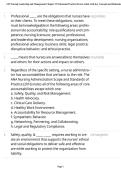
1. Professional _____ are the obligations that nurses have responsibilities
to their clients. To meet these obligations, nurses
must be knowledgeable in the following areas: profes-
sional role accountability; role qualifications and com-
petence; nursing licensure; personal, professional,
and leadership development; nursing organizations;
professional advocacy; business skills; legal practice;
disruptive behavior; and ethical practice.
2. _____ means that nurses are answerable to themselves Accountability
and others for their actions and impact on others.
3. Regardless of the specific setting, a nurse administra- f
tor has accountabilities that are basic to the role. The
ANA Nursing Administration Scope and Standards of
Practice (2016) notes all of the following areas of core
accountabilities except which one:
a. Safety, Quality, and Risk Management.
b. Health Advocacy.
c. Clinical Care Delivery.
d. Healthy Work Environment.
e. Accountability for Resource Management.
f. Sympathetic Behavior.
g. Networking, Partnering, and Collaborating.
h. Legal and Regulatory Compliance.
4. Safety, quality, & _____ _____ requires working to cre- risk management
ate an environment that supports the nurses' ethical
and social obligations to deliver safe and effective
are while working to protect the organization from
liability.
Page 1
ales - converted.pdf@@@@@@@@@@@@!!!!!!!!!!!!!!!!!!!!!!!!!!!!!!!!!!!!!!!!!!!!!!!))))))))))))(((((((((((((((((((((())))))))))))))))))))))))))!!!!!!!!!!!!!!!
ATI Nursing Leadership and Management Chapter 3 Professional Practice Review Guide with Key Concepts and Rationales - conve
,Professional
ales - converted.pdf@@@@@@@@@@@@!!!!!!!!!!!!!!!!!!!!!!!!!!!!!!!!!!!!!!!!!!!!!!!))))))))))))(((((((((((((((((((((())))))))))))))))))))))))))!!!!!!!!!!!!!!!
ATI Nursing
PracticeLeadership
Review Guide
and with
Management
Key Concepts
Chapter
and3Rationales
Professional
- converted.pdf@@@@@@@@@@@@!!!!!!!!!!!!!!!!!!!!!!!ATI
Practice Review Guide with Key Concepts and Rationales Nursing - conve
ATI Nursing Leadership and Management - Chapter 3: Professional Practic
ATI Nursing Leadership and Management Chapter 3 Professional Practice Review Guide with Key Concepts and Rationale
Study online at https://quizlet.com/_fg4859
5. _____ _____ is supporting self-determination of care Health advocacy
and advocating for protection and rights of all
involved in healthcare, including clients, nurses,
providers, populations, and systems.
6. _____ _____ delivery requires a knowledge of the health- Clinical care
care environment, supports and role models a safe
and effective model of care.
7. Establishing a _____ _____ environment is establishing healthy work
and maintaining a place of optimal well-being where
the staff feel supported, safe, and respected.
8. Having accountability for _____ _____ means having resource management
and employing knowledge and strategic manage-
ment of fiscal and human resources.
9. _____ and ______ compliance requires implementing Legal;
and maintaining a compliance program that meets regulatory
the legal and regulatory requirements of the many
different approval and accreditation processes of the
local, state, and federal entities.
10. Networking, partnering, and ______ helps meet the collaborating
expectation of collaborating and building alliances
across a wide span of influence.
11. ______ ______ ______ (LPNs) obtain nursing education in Licensed practical nurses
either certificate, diploma, or associate degree pro-
grams.
12. Registered nurses (RNs) obtain nursing education in c
either associate degree, diploma, or baccalaureate
Page 2
ales - converted.pdf@@@@@@@@@@@@!!!!!!!!!!!!!!!!!!!!!!!!!!!!!!!!!!!!!!!!!!!!!!!))))))))))))(((((((((((((((((((((())))))))))))))))))))))))))!!!!!!!!!!!!!!!
ATI Nursing Leadership and Management Chapter 3 Professional Practice Review Guide with Key Concepts and Rationales - conve
,Professional
ales - converted.pdf@@@@@@@@@@@@!!!!!!!!!!!!!!!!!!!!!!!!!!!!!!!!!!!!!!!!!!!!!!!))))))))))))(((((((((((((((((((((())))))))))))))))))))))))))!!!!!!!!!!!!!!!
ATI Nursing
PracticeLeadership
Review Guide
and with
Management
Key Concepts
Chapter
and3Rationales
Professional
- converted.pdf@@@@@@@@@@@@!!!!!!!!!!!!!!!!!!!!!!!ATI
Practice Review Guide with Key Concepts and Rationales Nursing - conve
ATI Nursing Leadership and Management - Chapter 3: Professional Practic
ATI Nursing Leadership and Management Chapter 3 Professional Practice Review Guide with Key Concepts and Rationale
Study online at https://quizlet.com/_fg4859
degree programs. All of the following are correct re-
garding registered nursing except which one?
a. Baccalaureate education for nurses continues to be
seen as important as nursing practice has become
more complex.
b. Associate degree programs are essential for bring-
ing many students who are place or time bound or
prefer to access community college programs to gain
a nursing education. c. The decrease in RN-BSN pro-
grams, requirements for in person classes, and trav-
eling difficulties has shown a decline in promoting
academic progression.
d. The Institute of Medicine (IOM) noted in their 2010
report that there needs to be a nursing education sys-
tem that supports seamless academic progression.
13. T/F: When the associate degree or diploma nurse is a True.
licensed RN, they are frequently encouraged by their
employer to obtain a BSN.
14. T/F: In 2010, the IOM recommended at least 30 per- False.
cent of RNs have a BSN by 2020.
15. T/F: In 2016, the IOM reported that the goal of 80% of True.
nurses obtaining their BSN was ambitious. The per-
centage of employed nurses with a BSN or higher has
increased from 49% to 51%.
16. The IOM reported all of the following findings related c
to baccalaureate-prepared nurses except which one?
a. Hospitals are increasingly hiring baccalaureate-pre-
pared nurses.
b. ADNs may not have the same earning potential and
Page 3
ales - converted.pdf@@@@@@@@@@@@!!!!!!!!!!!!!!!!!!!!!!!!!!!!!!!!!!!!!!!!!!!!!!!))))))))))))(((((((((((((((((((((())))))))))))))))))))))))))!!!!!!!!!!!!!!!
ATI Nursing Leadership and Management Chapter 3 Professional Practice Review Guide with Key Concepts and Rationales - conve
,Professional
ales - converted.pdf@@@@@@@@@@@@!!!!!!!!!!!!!!!!!!!!!!!!!!!!!!!!!!!!!!!!!!!!!!!))))))))))))(((((((((((((((((((((())))))))))))))))))))))))))!!!!!!!!!!!!!!!
ATI Nursing
PracticeLeadership
Review Guide
and with
Management
Key Concepts
Chapter
and3Rationales
Professional
- converted.pdf@@@@@@@@@@@@!!!!!!!!!!!!!!!!!!!!!!!ATI
Practice Review Guide with Key Concepts and Rationales Nursing - conve
ATI Nursing Leadership and Management - Chapter 3: Professional Practic
ATI Nursing Leadership and Management Chapter 3 Professional Practice Review Guide with Key Concepts and Rationale
Study online at https://quizlet.com/_fg4859
responsibilities as nurses with higher degrees.
c. ADNs may be less hirable in nonhospital locations.
d. New partnerships between community colleges
and universities using a model of education that
streamlines articulation to BSN education are occur-
ring.
17. The National Council of State Boards of Nursing's 2020 b
National Nursing Workforce Survey showed that more
than 60 percent of RNs had a baccalaureate degree
or higher. All of the following are correct except which
one?
a. For first-time licensure applicants, the most com-
mon educational preparation was a baccalaureate de-
gree, the second most common was an associate de-
gree, followed by a diploma as the third most com-
mon.
b. All baccalaureate degree nursing programs first
require obtaining an associates degree in nursing.
c. Nurse administrators who are responsible for large
system and organization-wide leadership are recom-
mended to have a master's degree or doctoral degree
in management, nursing leadership, policy, or admin-
istration.
d. The ANA Scope and Standards of Practice states
that nurse administrators must at minimum have a
baccalaureate degree, hold an active RN license, and
meet all state requirements.
18. T/F: The core of nursing practice is regulated by state True.
law.
Page 4
ales - converted.pdf@@@@@@@@@@@@!!!!!!!!!!!!!!!!!!!!!!!!!!!!!!!!!!!!!!!!!!!!!!!))))))))))))(((((((((((((((((((((())))))))))))))))))))))))))!!!!!!!!!!!!!!!
ATI Nursing Leadership and Management Chapter 3 Professional Practice Review Guide with Key Concepts and Rationales - conve
ales - converted.pdf@@@@@@@@@@@@!!!!!!!!!!!!!!!!!!!!!!!!!!!!!!!!!!!!!!!!!!!!!!!))))))))))))(((((((((((((((((((((())))))))))))))))))))))))))!!!!!!!!!!!!!!!
ATI Nursing
PracticeLeadership
Review Guide
and with
Management
Key Concepts
Chapter
and3Rationales
Professional
- converted.pdf@@@@@@@@@@@@!!!!!!!!!!!!!!!!!!!!!!!ATI
Practice Review Guide with Key Concepts and Rationales Nursing - conve
ATI Nursing Leadership and Management - Chapter 3: Professional Practic
ATI Nursing Leadership and Management Chapter 3 Professional Practice Review Guide with Key Concepts and Rationale
Study online at https://quizlet.com/_fg4859
1. Professional _____ are the obligations that nurses have responsibilities
to their clients. To meet these obligations, nurses
must be knowledgeable in the following areas: profes-
sional role accountability; role qualifications and com-
petence; nursing licensure; personal, professional,
and leadership development; nursing organizations;
professional advocacy; business skills; legal practice;
disruptive behavior; and ethical practice.
2. _____ means that nurses are answerable to themselves Accountability
and others for their actions and impact on others.
3. Regardless of the specific setting, a nurse administra- f
tor has accountabilities that are basic to the role. The
ANA Nursing Administration Scope and Standards of
Practice (2016) notes all of the following areas of core
accountabilities except which one:
a. Safety, Quality, and Risk Management.
b. Health Advocacy.
c. Clinical Care Delivery.
d. Healthy Work Environment.
e. Accountability for Resource Management.
f. Sympathetic Behavior.
g. Networking, Partnering, and Collaborating.
h. Legal and Regulatory Compliance.
4. Safety, quality, & _____ _____ requires working to cre- risk management
ate an environment that supports the nurses' ethical
and social obligations to deliver safe and effective
are while working to protect the organization from
liability.
Page 1
ales - converted.pdf@@@@@@@@@@@@!!!!!!!!!!!!!!!!!!!!!!!!!!!!!!!!!!!!!!!!!!!!!!!))))))))))))(((((((((((((((((((((())))))))))))))))))))))))))!!!!!!!!!!!!!!!
ATI Nursing Leadership and Management Chapter 3 Professional Practice Review Guide with Key Concepts and Rationales - conve
,Professional
ales - converted.pdf@@@@@@@@@@@@!!!!!!!!!!!!!!!!!!!!!!!!!!!!!!!!!!!!!!!!!!!!!!!))))))))))))(((((((((((((((((((((())))))))))))))))))))))))))!!!!!!!!!!!!!!!
ATI Nursing
PracticeLeadership
Review Guide
and with
Management
Key Concepts
Chapter
and3Rationales
Professional
- converted.pdf@@@@@@@@@@@@!!!!!!!!!!!!!!!!!!!!!!!ATI
Practice Review Guide with Key Concepts and Rationales Nursing - conve
ATI Nursing Leadership and Management - Chapter 3: Professional Practic
ATI Nursing Leadership and Management Chapter 3 Professional Practice Review Guide with Key Concepts and Rationale
Study online at https://quizlet.com/_fg4859
5. _____ _____ is supporting self-determination of care Health advocacy
and advocating for protection and rights of all
involved in healthcare, including clients, nurses,
providers, populations, and systems.
6. _____ _____ delivery requires a knowledge of the health- Clinical care
care environment, supports and role models a safe
and effective model of care.
7. Establishing a _____ _____ environment is establishing healthy work
and maintaining a place of optimal well-being where
the staff feel supported, safe, and respected.
8. Having accountability for _____ _____ means having resource management
and employing knowledge and strategic manage-
ment of fiscal and human resources.
9. _____ and ______ compliance requires implementing Legal;
and maintaining a compliance program that meets regulatory
the legal and regulatory requirements of the many
different approval and accreditation processes of the
local, state, and federal entities.
10. Networking, partnering, and ______ helps meet the collaborating
expectation of collaborating and building alliances
across a wide span of influence.
11. ______ ______ ______ (LPNs) obtain nursing education in Licensed practical nurses
either certificate, diploma, or associate degree pro-
grams.
12. Registered nurses (RNs) obtain nursing education in c
either associate degree, diploma, or baccalaureate
Page 2
ales - converted.pdf@@@@@@@@@@@@!!!!!!!!!!!!!!!!!!!!!!!!!!!!!!!!!!!!!!!!!!!!!!!))))))))))))(((((((((((((((((((((())))))))))))))))))))))))))!!!!!!!!!!!!!!!
ATI Nursing Leadership and Management Chapter 3 Professional Practice Review Guide with Key Concepts and Rationales - conve
,Professional
ales - converted.pdf@@@@@@@@@@@@!!!!!!!!!!!!!!!!!!!!!!!!!!!!!!!!!!!!!!!!!!!!!!!))))))))))))(((((((((((((((((((((())))))))))))))))))))))))))!!!!!!!!!!!!!!!
ATI Nursing
PracticeLeadership
Review Guide
and with
Management
Key Concepts
Chapter
and3Rationales
Professional
- converted.pdf@@@@@@@@@@@@!!!!!!!!!!!!!!!!!!!!!!!ATI
Practice Review Guide with Key Concepts and Rationales Nursing - conve
ATI Nursing Leadership and Management - Chapter 3: Professional Practic
ATI Nursing Leadership and Management Chapter 3 Professional Practice Review Guide with Key Concepts and Rationale
Study online at https://quizlet.com/_fg4859
degree programs. All of the following are correct re-
garding registered nursing except which one?
a. Baccalaureate education for nurses continues to be
seen as important as nursing practice has become
more complex.
b. Associate degree programs are essential for bring-
ing many students who are place or time bound or
prefer to access community college programs to gain
a nursing education. c. The decrease in RN-BSN pro-
grams, requirements for in person classes, and trav-
eling difficulties has shown a decline in promoting
academic progression.
d. The Institute of Medicine (IOM) noted in their 2010
report that there needs to be a nursing education sys-
tem that supports seamless academic progression.
13. T/F: When the associate degree or diploma nurse is a True.
licensed RN, they are frequently encouraged by their
employer to obtain a BSN.
14. T/F: In 2010, the IOM recommended at least 30 per- False.
cent of RNs have a BSN by 2020.
15. T/F: In 2016, the IOM reported that the goal of 80% of True.
nurses obtaining their BSN was ambitious. The per-
centage of employed nurses with a BSN or higher has
increased from 49% to 51%.
16. The IOM reported all of the following findings related c
to baccalaureate-prepared nurses except which one?
a. Hospitals are increasingly hiring baccalaureate-pre-
pared nurses.
b. ADNs may not have the same earning potential and
Page 3
ales - converted.pdf@@@@@@@@@@@@!!!!!!!!!!!!!!!!!!!!!!!!!!!!!!!!!!!!!!!!!!!!!!!))))))))))))(((((((((((((((((((((())))))))))))))))))))))))))!!!!!!!!!!!!!!!
ATI Nursing Leadership and Management Chapter 3 Professional Practice Review Guide with Key Concepts and Rationales - conve
,Professional
ales - converted.pdf@@@@@@@@@@@@!!!!!!!!!!!!!!!!!!!!!!!!!!!!!!!!!!!!!!!!!!!!!!!))))))))))))(((((((((((((((((((((())))))))))))))))))))))))))!!!!!!!!!!!!!!!
ATI Nursing
PracticeLeadership
Review Guide
and with
Management
Key Concepts
Chapter
and3Rationales
Professional
- converted.pdf@@@@@@@@@@@@!!!!!!!!!!!!!!!!!!!!!!!ATI
Practice Review Guide with Key Concepts and Rationales Nursing - conve
ATI Nursing Leadership and Management - Chapter 3: Professional Practic
ATI Nursing Leadership and Management Chapter 3 Professional Practice Review Guide with Key Concepts and Rationale
Study online at https://quizlet.com/_fg4859
responsibilities as nurses with higher degrees.
c. ADNs may be less hirable in nonhospital locations.
d. New partnerships between community colleges
and universities using a model of education that
streamlines articulation to BSN education are occur-
ring.
17. The National Council of State Boards of Nursing's 2020 b
National Nursing Workforce Survey showed that more
than 60 percent of RNs had a baccalaureate degree
or higher. All of the following are correct except which
one?
a. For first-time licensure applicants, the most com-
mon educational preparation was a baccalaureate de-
gree, the second most common was an associate de-
gree, followed by a diploma as the third most com-
mon.
b. All baccalaureate degree nursing programs first
require obtaining an associates degree in nursing.
c. Nurse administrators who are responsible for large
system and organization-wide leadership are recom-
mended to have a master's degree or doctoral degree
in management, nursing leadership, policy, or admin-
istration.
d. The ANA Scope and Standards of Practice states
that nurse administrators must at minimum have a
baccalaureate degree, hold an active RN license, and
meet all state requirements.
18. T/F: The core of nursing practice is regulated by state True.
law.
Page 4
ales - converted.pdf@@@@@@@@@@@@!!!!!!!!!!!!!!!!!!!!!!!!!!!!!!!!!!!!!!!!!!!!!!!))))))))))))(((((((((((((((((((((())))))))))))))))))))))))))!!!!!!!!!!!!!!!
ATI Nursing Leadership and Management Chapter 3 Professional Practice Review Guide with Key Concepts and Rationales - conve


