
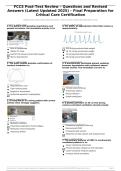
FCCS Post-Test Review – Questions and Revised
Answers (Latest Updated 2025) – Final Preparation for
Critical Care Certification
Original exam-relevant FCCS-style review items • Correct choices marked with large green checks
AIRWAY & VENTILATION AIRWAY & VENTILATION
1. In a patient with gurgling respirations and 4. For ARDS, an appropriate initial tidal volume is
pooled secretions, the immediate priority is to: approximately:
Clinical photo illustration ECG diagram
Give IV furosemide 4–6 mL/kg predicted body weight
Obtain CT chest 10–12 mL/kg actual body weight
Suction the airway and provide oxygen 15 mL/kg predicted body weight
Start a beta blocker 20 mL/kg actual body weight
AIRWAY & VENTILATION AIRWAY & VENTILATION
2. The most reliable bedside confirmation of 5. A mechanically ventilated patient suddenly
tracheal intubation is: becomes hypotensive with unilateral absent
breath sounds. The immediate concern is:
Ventilation diagram
Improved skin color
Monitoring photo illustration
Tube misting alone Tension pneumothorax
Epigastric auscultation Pulmonary edema
Sustained waveform capnography Pleural effusion
Simple atelectasis
AIRWAY & VENTILATION
3. A rising PaCO₂ in a tiring patient with severe
AIRWAY & VENTILATION
asthma most strongly suggests: 6. A plateau pressure of 38 cm H₂O during
volume-controlled ventilation should prompt:
Medication photo illustration
Metabolic alkalosis
Ventilated-patient photo illustration
Impending respiratory muscle fatigue Increasing inspiratory flow only
Resolution of bronchospasm Removing all PEEP
Improving airflow Increasing tidal volume
Reduction of tidal volume and reassessment
AIRWAY & VENTILATION
7. The primary purpose of PEEP in mechanically
ventilated patients is to:
Cause intentional atelectasis
Prevent alveolar collapse at end expiration
Lower functional residual capacity
Increase airway secretions
Study aid only. These are original questions, not reproduced or represented as secure/official SCCM FCCS examination items. Page 1
,FCCS Post-Test Review • 250 Original FCCS-aligned Questions
AIRWAY & VENTILATION SHOCK & HEMODYNAMICS
8. In acute severe asthma, an important 14. A rising serum lactate in shock is best
ventilator strategy is to: interpreted as:
Proof of liver failure
Proof of myocardial infarction
A marker of impaired perfusion/stress that should be
interpreted in clinical context
A specific test for bacterial infection
Positioning photo illustration SHOCK & HEMODYNAMICS
Eliminate all expiratory time 15. Cold clammy skin, elevated JVP, pulmonary
edema, and hypotension most strongly suggest:
Allow prolonged expiratory time
Hypovolemic shock
Target zero auto-PEEP
Cardiogenic shock
Use very high respiratory rates
Neurogenic shock
Distributive shock
AIRWAY & VENTILATION
9. If a ventilated patient has a high peak pressure
but a normal plateau pressure, suspect: SHOCK & HEMODYNAMICS
Pulmonary fibrosis 16. Warm extremities, bounding pulses, and low
SVR are classically associated with:
Chest wall rigidity
Obstructive shock
Increased airway resistance
Hemorrhagic shock
Decreased lung compliance
Cardiogenic shock
Distributive shock
AIRWAY & VENTILATION
10. A patient with acute upper-airway obstruction
and stridor should first receive: SHOCK & HEMODYNAMICS
A diuretic 17. A patient with suspected massive pulmonary
embolism, hypotension, and RV strain has:
A routine outpatient chest x-ray
Distributive shock
Immediate airway assessment and oxygen while
preparing for definitive airway management Hypovolemic shock
Oral antibiotics only Isolated renal failure
Obstructive shock
SHOCK & HEMODYNAMICS
11. The initial bedside blood-pressure target
SHOCK & HEMODYNAMICS
commonly used during septic shock resuscitation 18. In suspected hemorrhagic shock, definitive
is a MAP of at least: control of bleeding should be:
100 mmHg Avoided until CT is repeated three times
55 mmHg Delayed until lactate normalizes
45 mmHg Replaced by diuretics
65 mmHg Pursued urgently while resuscitation is underway
SHOCK & HEMODYNAMICS SHOCK & HEMODYNAMICS
12. The preferred first-line vasopressor for septic 19. The most useful simple bedside marker of
shock in most adults is: renal perfusion during shock is:
Norepinephrine Urine output trend
Phenylephrine Serum sodium alone
Dopamine Single body temperature
Dobutamine Skin color alone
SHOCK & HEMODYNAMICS SHOCK & HEMODYNAMICS
13. A patient with shock remains hypotensive 20. In septic shock with persistent hypoperfusion
after appropriate fluid resuscitation. The next despite adequate MAP, echocardiography can
priority is: help assess:
Start a vasopressor while continuing assessment of Cardiac function and volume/hemodynamic state
perfusion Only intracranial pressure
Give a beta blocker Only liver enzymes
Give unlimited crystalloid Only platelet count
Stop monitoring urine output
Study aid only. These are original questions, not reproduced or represented as secure/official SCCM FCCS examination items. Page 2
, FCCS Post-Test Review • 250 Original FCCS-aligned Questions
SEPSIS & INFECTION SEPSIS & INFECTION
21. Sepsis is best understood as life-threatening 28. An elevated procalcitonin should be used as:
organ dysfunction caused by: A definitive proof of bacteremia
Any positive blood culture without illness One piece of clinical information, not a standalone
A dysregulated host response to infection diagnosis of bacterial sepsis
Any fever alone A reason to avoid antibiotics in shock
Isolated leukocytosis A replacement for cultures
SEPSIS & INFECTION SEPSIS & INFECTION
22. When sepsis is suspected, antimicrobial 29. A patient with septic shock develops diffuse
therapy should generally be: bilateral infiltrates and hypoxemia without clear
Withheld for 48 hours cardiogenic edema. Consider:
Given only after lactate normalizes Isolated pneumothorax
Started promptly after obtaining appropriate cultures Simple hypertension
when this does not cause meaningful delay ARDS
Reserved for hypotension lasting 24 hours Chronic stable COPD
SEPSIS & INFECTION SEPSIS & INFECTION
23. For suspected bloodstream infection, cultures 30. After initial stabilization, antimicrobial
should ideally be obtained: therapy should be:
Before antibiotics when feasible without delaying Stopped whenever fever persists
therapy Kept maximally broad forever
Only after antibiotics are completed Narrowed when microbiology and clinical data allow
Only after vasopressors stop Changed randomly each day
Only from urine
CARDIOVASCULAR EMERGENCIES
31. A patient with chest pain, hypotension, and
SEPSIS & INFECTION
24. A patient with septic shock has persistent ST elevation should be managed with:
hypotension after fluids. Which treatment
directly increases vascular tone?
Norepinephrine
Insulin
Furosemide
Acetaminophen
Shock physiology diagram
SEPSIS & INFECTION Urgent evaluation for reperfusion and stabilization
25. Source control in intra-abdominal sepsis may
No ECG
require:
Drainage or surgery when indicated Routine outpatient follow-up
Only antipyretics A diuretic alone
Avoiding all procedures
CARDIOVASCULAR EMERGENCIES
Routine anticoagulation 32. A regular narrow-complex tachycardia with
hypotension is treated initially as:
SEPSIS & INFECTION Asystole
26. A falling lactate over time during
An unstable tachyarrhythmia requiring synchronized
resuscitation generally suggests:
cardioversion
Worsening shock in every case
Sinus bradycardia
Guaranteed infection eradication
A benign rhythm needing no action
Improving global perfusion/metabolic stress
New renal failure
CARDIOVASCULAR EMERGENCIES
33. Pulseless ventricular tachycardia is treated
initially with:
SEPSIS & INFECTION
27. In a patient with sepsis and severe Defibrillation and high-quality CPR
hypoxemia, oxygen therapy should be:
A beta blocker
Avoided because oxygen is toxic at all doses
Atropine alone
Used only after antibiotics fail
Synchronized cardioversion without CPR
Given at 100% indefinitely
Titrated to an appropriate target while treating the
underlying cause
Study aid only. These are original questions, not reproduced or represented as secure/official SCCM FCCS examination items. Page 3
Answers (Latest Updated 2025) – Final Preparation for
Critical Care Certification
Original exam-relevant FCCS-style review items • Correct choices marked with large green checks
AIRWAY & VENTILATION AIRWAY & VENTILATION
1. In a patient with gurgling respirations and 4. For ARDS, an appropriate initial tidal volume is
pooled secretions, the immediate priority is to: approximately:
Clinical photo illustration ECG diagram
Give IV furosemide 4–6 mL/kg predicted body weight
Obtain CT chest 10–12 mL/kg actual body weight
Suction the airway and provide oxygen 15 mL/kg predicted body weight
Start a beta blocker 20 mL/kg actual body weight
AIRWAY & VENTILATION AIRWAY & VENTILATION
2. The most reliable bedside confirmation of 5. A mechanically ventilated patient suddenly
tracheal intubation is: becomes hypotensive with unilateral absent
breath sounds. The immediate concern is:
Ventilation diagram
Improved skin color
Monitoring photo illustration
Tube misting alone Tension pneumothorax
Epigastric auscultation Pulmonary edema
Sustained waveform capnography Pleural effusion
Simple atelectasis
AIRWAY & VENTILATION
3. A rising PaCO₂ in a tiring patient with severe
AIRWAY & VENTILATION
asthma most strongly suggests: 6. A plateau pressure of 38 cm H₂O during
volume-controlled ventilation should prompt:
Medication photo illustration
Metabolic alkalosis
Ventilated-patient photo illustration
Impending respiratory muscle fatigue Increasing inspiratory flow only
Resolution of bronchospasm Removing all PEEP
Improving airflow Increasing tidal volume
Reduction of tidal volume and reassessment
AIRWAY & VENTILATION
7. The primary purpose of PEEP in mechanically
ventilated patients is to:
Cause intentional atelectasis
Prevent alveolar collapse at end expiration
Lower functional residual capacity
Increase airway secretions
Study aid only. These are original questions, not reproduced or represented as secure/official SCCM FCCS examination items. Page 1
,FCCS Post-Test Review • 250 Original FCCS-aligned Questions
AIRWAY & VENTILATION SHOCK & HEMODYNAMICS
8. In acute severe asthma, an important 14. A rising serum lactate in shock is best
ventilator strategy is to: interpreted as:
Proof of liver failure
Proof of myocardial infarction
A marker of impaired perfusion/stress that should be
interpreted in clinical context
A specific test for bacterial infection
Positioning photo illustration SHOCK & HEMODYNAMICS
Eliminate all expiratory time 15. Cold clammy skin, elevated JVP, pulmonary
edema, and hypotension most strongly suggest:
Allow prolonged expiratory time
Hypovolemic shock
Target zero auto-PEEP
Cardiogenic shock
Use very high respiratory rates
Neurogenic shock
Distributive shock
AIRWAY & VENTILATION
9. If a ventilated patient has a high peak pressure
but a normal plateau pressure, suspect: SHOCK & HEMODYNAMICS
Pulmonary fibrosis 16. Warm extremities, bounding pulses, and low
SVR are classically associated with:
Chest wall rigidity
Obstructive shock
Increased airway resistance
Hemorrhagic shock
Decreased lung compliance
Cardiogenic shock
Distributive shock
AIRWAY & VENTILATION
10. A patient with acute upper-airway obstruction
and stridor should first receive: SHOCK & HEMODYNAMICS
A diuretic 17. A patient with suspected massive pulmonary
embolism, hypotension, and RV strain has:
A routine outpatient chest x-ray
Distributive shock
Immediate airway assessment and oxygen while
preparing for definitive airway management Hypovolemic shock
Oral antibiotics only Isolated renal failure
Obstructive shock
SHOCK & HEMODYNAMICS
11. The initial bedside blood-pressure target
SHOCK & HEMODYNAMICS
commonly used during septic shock resuscitation 18. In suspected hemorrhagic shock, definitive
is a MAP of at least: control of bleeding should be:
100 mmHg Avoided until CT is repeated three times
55 mmHg Delayed until lactate normalizes
45 mmHg Replaced by diuretics
65 mmHg Pursued urgently while resuscitation is underway
SHOCK & HEMODYNAMICS SHOCK & HEMODYNAMICS
12. The preferred first-line vasopressor for septic 19. The most useful simple bedside marker of
shock in most adults is: renal perfusion during shock is:
Norepinephrine Urine output trend
Phenylephrine Serum sodium alone
Dopamine Single body temperature
Dobutamine Skin color alone
SHOCK & HEMODYNAMICS SHOCK & HEMODYNAMICS
13. A patient with shock remains hypotensive 20. In septic shock with persistent hypoperfusion
after appropriate fluid resuscitation. The next despite adequate MAP, echocardiography can
priority is: help assess:
Start a vasopressor while continuing assessment of Cardiac function and volume/hemodynamic state
perfusion Only intracranial pressure
Give a beta blocker Only liver enzymes
Give unlimited crystalloid Only platelet count
Stop monitoring urine output
Study aid only. These are original questions, not reproduced or represented as secure/official SCCM FCCS examination items. Page 2
, FCCS Post-Test Review • 250 Original FCCS-aligned Questions
SEPSIS & INFECTION SEPSIS & INFECTION
21. Sepsis is best understood as life-threatening 28. An elevated procalcitonin should be used as:
organ dysfunction caused by: A definitive proof of bacteremia
Any positive blood culture without illness One piece of clinical information, not a standalone
A dysregulated host response to infection diagnosis of bacterial sepsis
Any fever alone A reason to avoid antibiotics in shock
Isolated leukocytosis A replacement for cultures
SEPSIS & INFECTION SEPSIS & INFECTION
22. When sepsis is suspected, antimicrobial 29. A patient with septic shock develops diffuse
therapy should generally be: bilateral infiltrates and hypoxemia without clear
Withheld for 48 hours cardiogenic edema. Consider:
Given only after lactate normalizes Isolated pneumothorax
Started promptly after obtaining appropriate cultures Simple hypertension
when this does not cause meaningful delay ARDS
Reserved for hypotension lasting 24 hours Chronic stable COPD
SEPSIS & INFECTION SEPSIS & INFECTION
23. For suspected bloodstream infection, cultures 30. After initial stabilization, antimicrobial
should ideally be obtained: therapy should be:
Before antibiotics when feasible without delaying Stopped whenever fever persists
therapy Kept maximally broad forever
Only after antibiotics are completed Narrowed when microbiology and clinical data allow
Only after vasopressors stop Changed randomly each day
Only from urine
CARDIOVASCULAR EMERGENCIES
31. A patient with chest pain, hypotension, and
SEPSIS & INFECTION
24. A patient with septic shock has persistent ST elevation should be managed with:
hypotension after fluids. Which treatment
directly increases vascular tone?
Norepinephrine
Insulin
Furosemide
Acetaminophen
Shock physiology diagram
SEPSIS & INFECTION Urgent evaluation for reperfusion and stabilization
25. Source control in intra-abdominal sepsis may
No ECG
require:
Drainage or surgery when indicated Routine outpatient follow-up
Only antipyretics A diuretic alone
Avoiding all procedures
CARDIOVASCULAR EMERGENCIES
Routine anticoagulation 32. A regular narrow-complex tachycardia with
hypotension is treated initially as:
SEPSIS & INFECTION Asystole
26. A falling lactate over time during
An unstable tachyarrhythmia requiring synchronized
resuscitation generally suggests:
cardioversion
Worsening shock in every case
Sinus bradycardia
Guaranteed infection eradication
A benign rhythm needing no action
Improving global perfusion/metabolic stress
New renal failure
CARDIOVASCULAR EMERGENCIES
33. Pulseless ventricular tachycardia is treated
initially with:
SEPSIS & INFECTION
27. In a patient with sepsis and severe Defibrillation and high-quality CPR
hypoxemia, oxygen therapy should be:
A beta blocker
Avoided because oxygen is toxic at all doses
Atropine alone
Used only after antibiotics fail
Synchronized cardioversion without CPR
Given at 100% indefinitely
Titrated to an appropriate target while treating the
underlying cause
Study aid only. These are original questions, not reproduced or represented as secure/official SCCM FCCS examination items. Page 3


