
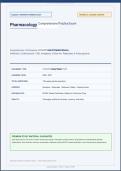
STUDY NOTES & REFERENCE GUIDE
SUBJECT: NURSING PHARMACOLOGY VERIFIED A+ GRADED CONTENT
Pharmacology Comprehensive Practice Exam
··
··
Comprehensive 140-Question Comprehensive PracticeRationale
with Detailed Exam
Antibiotics, Cardiovascular, CNS, Analgesics, Endocrine, Respiratory & Anticoagulants
DOCUMENT TYPE: Comprehensive
/ StudyPractice
Guide Exam
ACADEMIC YEAR:
TOTAL QUESTIONS: 138 unique practice questions
CONTENT: Questions · Rationales · Reference Tables · Practice Exams
SUITABLE FOR: NCLEX, Board Certification, Midterm & Final Exam Prep
QUALITY: Thoroughly verified for accuracy, currency, and clarity
PREMIUM STUDY MATERIAL GUARANTEE
Each document in this series contains exclusively original, thoroughly verified content. All questions include detailed rationale
explanations. Structured for maximum examination readiness across NCLEX, board certification, and university-level assessments.
2026·2027 Academic Excellence Series | High-Yield Study Document
courseroomsity - Stuvia | Page 1 of 200
, STUDY NOTES & REFERENCE GUIDE
PHARMACOLOGY Comprehensive Practice Exam
TABLE OF CONTENTS
·
Section 1: Chapter 1: Antibiotics & Antimicrobials
Section 2: Chapter 2: Cardiovascular Medications
Section 3: Chapter 3: CNS & Psychiatric Medications
Section 4: Chapter 4: Analgesics & Pain Management
Section 5: Chapter 5: Endocrine & Diabetes Medications
Section 6: Chapter 6: Respiratory Medications
Section 7: Chapter 7: Anticoagulants & Blood Modifiers
GRADED A+ VERIFIED | 2026/2027 ACADEMIC SERIES Page 2 of 200
courseroomsity - Stuvia | Page 2 of 200
, STUDY NOTES & REFERENCE GUIDE
PHARMACOLOGY Comprehensive Practice Exam
PART I · PRACTICE QUESTIONS (138 Questions)
Chapter 1: Antibiotics & Antimicrobials
Q1.
A patient reports a severe allergy to penicillin. The provider orders amoxicillin. What is
the priority nursing action?
A) Administer the dose and observe for 30 minutes
B) Hold the medication and notify the prescriber immediately
C) Administer diphenhydramine before the dose
D) Halve the prescribed dose and monitor closely
Q2.
A patient is receiving IV gentamicin. Which laboratory value is the most critical to monitor
for early nephrotoxicity?
A) Serum sodium
B) Serum creatinine and BUN
C) Serum potassium
D) Liver enzymes (AST/ALT)
Q3.
During IV vancomycin infusion over 30 minutes, a patient develops flushing and pruritus of
the face and neck. What is the correct intervention?
A) Stop the infusion and call a code
B) Slow the infusion rate to run over at least 60 minutes; give diphenhydramine as ordered
C) Administer IV epinephrine immediately
D) Increase the infusion rate to finish quickly
Q4.
A patient taking ciprofloxacin asks if they can take their antacid at the same time. What is
the best response?
A) 'Yes, antacids help protect your stomach from ciprofloxacin.'
B) 'Take the antacid at least 2 hours before or 6 hours after ciprofloxacin.'
C) 'Antacids do not interact with antibiotics.'
D) 'Switch to a liquid antacid instead.'
Q5.
Before starting amphotericin B infusion, which premedication order is most appropriate to
reduce infusion-related reactions?
A) Metformin 500 mg PO
B) Diphenhydramine 25 mg IV and acetaminophen 650 mg PO
C) Ondansetron 4 mg IV only
D) Prednisone 40 mg PO daily for 7 days
GRADED A+ VERIFIED | 2026/2027 ACADEMIC SERIES Page 3 of 200
courseroomsity - Stuvia | Page 3 of 200
, STUDY NOTES & REFERENCE GUIDE
PHARMACOLOGY Comprehensive Practice Exam
Q6.
A patient is prescribed acyclovir for a severe herpes zoster outbreak. Which intervention is
most important during therapy?
A) Restrict dietary protein intake
B) Ensure adequate hydration of at least 1·1.5 L of fluid daily
C) Avoid all sunlight exposure
D) Monitor serum glucose every 4 hours
Q7.
A nurse is educating a patient being discharged with a 10-day azithromycin course. Which
statement indicates a need for further teaching?
A) 'I will complete all 10 days even if I feel better sooner.'
B) 'I can stop taking it once my symptoms resolve to save the rest for next time.'
C) 'I should report any irregular heartbeat or dizziness immediately.'
D) 'I will avoid taking antacids at the same time as azithromycin.'
Q8.
Blood cultures are ordered before starting IV antibiotics for a patient with suspected
sepsis. The nurse should:
A) Start antibiotics first and draw cultures when convenient
B) Draw at least 2 blood culture sets from separate sites before the first antibiotic dose
C) Wait 1 hour after starting antibiotics to draw cultures
D) Draw a single culture from the existing IV line
Q9.
A patient is on metronidazole for a C. difficile infection. Which patient statement requires
immediate follow-up?
A) 'I've had loose stools three times today.'
B) 'I had two glasses of wine with dinner last night.'
C) 'I'm taking my dose with food to reduce nausea.'
D) 'I notice a metallic taste in my mouth.'
Q10.
Amoxicillin-clavulanate (Augmentin) is prescribed instead of plain amoxicillin. Why is
clavulanate added?
A) To increase amoxicillin absorption in the gut
B) To inhibit beta-lactamase enzymes produced by resistant bacteria
C) To reduce the incidence of allergic reactions
D) To extend the duration of amoxicillin activity in tissues
Q11.
Which of the following antibiotics requires monitoring of peak AND trough serum levels to
minimize toxicity?
A) Azithromycin
B) Doxycycline
C) Gentamicin
D) Clindamycin
GRADED A+ VERIFIED | 2026/2027 ACADEMIC SERIES Page 4 of 200
courseroomsity - Stuvia | Page 4 of 200
SUBJECT: NURSING PHARMACOLOGY VERIFIED A+ GRADED CONTENT
Pharmacology Comprehensive Practice Exam
··
··
Comprehensive 140-Question Comprehensive PracticeRationale
with Detailed Exam
Antibiotics, Cardiovascular, CNS, Analgesics, Endocrine, Respiratory & Anticoagulants
DOCUMENT TYPE: Comprehensive
/ StudyPractice
Guide Exam
ACADEMIC YEAR:
TOTAL QUESTIONS: 138 unique practice questions
CONTENT: Questions · Rationales · Reference Tables · Practice Exams
SUITABLE FOR: NCLEX, Board Certification, Midterm & Final Exam Prep
QUALITY: Thoroughly verified for accuracy, currency, and clarity
PREMIUM STUDY MATERIAL GUARANTEE
Each document in this series contains exclusively original, thoroughly verified content. All questions include detailed rationale
explanations. Structured for maximum examination readiness across NCLEX, board certification, and university-level assessments.
2026·2027 Academic Excellence Series | High-Yield Study Document
courseroomsity - Stuvia | Page 1 of 200
, STUDY NOTES & REFERENCE GUIDE
PHARMACOLOGY Comprehensive Practice Exam
TABLE OF CONTENTS
·
Section 1: Chapter 1: Antibiotics & Antimicrobials
Section 2: Chapter 2: Cardiovascular Medications
Section 3: Chapter 3: CNS & Psychiatric Medications
Section 4: Chapter 4: Analgesics & Pain Management
Section 5: Chapter 5: Endocrine & Diabetes Medications
Section 6: Chapter 6: Respiratory Medications
Section 7: Chapter 7: Anticoagulants & Blood Modifiers
GRADED A+ VERIFIED | 2026/2027 ACADEMIC SERIES Page 2 of 200
courseroomsity - Stuvia | Page 2 of 200
, STUDY NOTES & REFERENCE GUIDE
PHARMACOLOGY Comprehensive Practice Exam
PART I · PRACTICE QUESTIONS (138 Questions)
Chapter 1: Antibiotics & Antimicrobials
Q1.
A patient reports a severe allergy to penicillin. The provider orders amoxicillin. What is
the priority nursing action?
A) Administer the dose and observe for 30 minutes
B) Hold the medication and notify the prescriber immediately
C) Administer diphenhydramine before the dose
D) Halve the prescribed dose and monitor closely
Q2.
A patient is receiving IV gentamicin. Which laboratory value is the most critical to monitor
for early nephrotoxicity?
A) Serum sodium
B) Serum creatinine and BUN
C) Serum potassium
D) Liver enzymes (AST/ALT)
Q3.
During IV vancomycin infusion over 30 minutes, a patient develops flushing and pruritus of
the face and neck. What is the correct intervention?
A) Stop the infusion and call a code
B) Slow the infusion rate to run over at least 60 minutes; give diphenhydramine as ordered
C) Administer IV epinephrine immediately
D) Increase the infusion rate to finish quickly
Q4.
A patient taking ciprofloxacin asks if they can take their antacid at the same time. What is
the best response?
A) 'Yes, antacids help protect your stomach from ciprofloxacin.'
B) 'Take the antacid at least 2 hours before or 6 hours after ciprofloxacin.'
C) 'Antacids do not interact with antibiotics.'
D) 'Switch to a liquid antacid instead.'
Q5.
Before starting amphotericin B infusion, which premedication order is most appropriate to
reduce infusion-related reactions?
A) Metformin 500 mg PO
B) Diphenhydramine 25 mg IV and acetaminophen 650 mg PO
C) Ondansetron 4 mg IV only
D) Prednisone 40 mg PO daily for 7 days
GRADED A+ VERIFIED | 2026/2027 ACADEMIC SERIES Page 3 of 200
courseroomsity - Stuvia | Page 3 of 200
, STUDY NOTES & REFERENCE GUIDE
PHARMACOLOGY Comprehensive Practice Exam
Q6.
A patient is prescribed acyclovir for a severe herpes zoster outbreak. Which intervention is
most important during therapy?
A) Restrict dietary protein intake
B) Ensure adequate hydration of at least 1·1.5 L of fluid daily
C) Avoid all sunlight exposure
D) Monitor serum glucose every 4 hours
Q7.
A nurse is educating a patient being discharged with a 10-day azithromycin course. Which
statement indicates a need for further teaching?
A) 'I will complete all 10 days even if I feel better sooner.'
B) 'I can stop taking it once my symptoms resolve to save the rest for next time.'
C) 'I should report any irregular heartbeat or dizziness immediately.'
D) 'I will avoid taking antacids at the same time as azithromycin.'
Q8.
Blood cultures are ordered before starting IV antibiotics for a patient with suspected
sepsis. The nurse should:
A) Start antibiotics first and draw cultures when convenient
B) Draw at least 2 blood culture sets from separate sites before the first antibiotic dose
C) Wait 1 hour after starting antibiotics to draw cultures
D) Draw a single culture from the existing IV line
Q9.
A patient is on metronidazole for a C. difficile infection. Which patient statement requires
immediate follow-up?
A) 'I've had loose stools three times today.'
B) 'I had two glasses of wine with dinner last night.'
C) 'I'm taking my dose with food to reduce nausea.'
D) 'I notice a metallic taste in my mouth.'
Q10.
Amoxicillin-clavulanate (Augmentin) is prescribed instead of plain amoxicillin. Why is
clavulanate added?
A) To increase amoxicillin absorption in the gut
B) To inhibit beta-lactamase enzymes produced by resistant bacteria
C) To reduce the incidence of allergic reactions
D) To extend the duration of amoxicillin activity in tissues
Q11.
Which of the following antibiotics requires monitoring of peak AND trough serum levels to
minimize toxicity?
A) Azithromycin
B) Doxycycline
C) Gentamicin
D) Clindamycin
GRADED A+ VERIFIED | 2026/2027 ACADEMIC SERIES Page 4 of 200
courseroomsity - Stuvia | Page 4 of 200


